

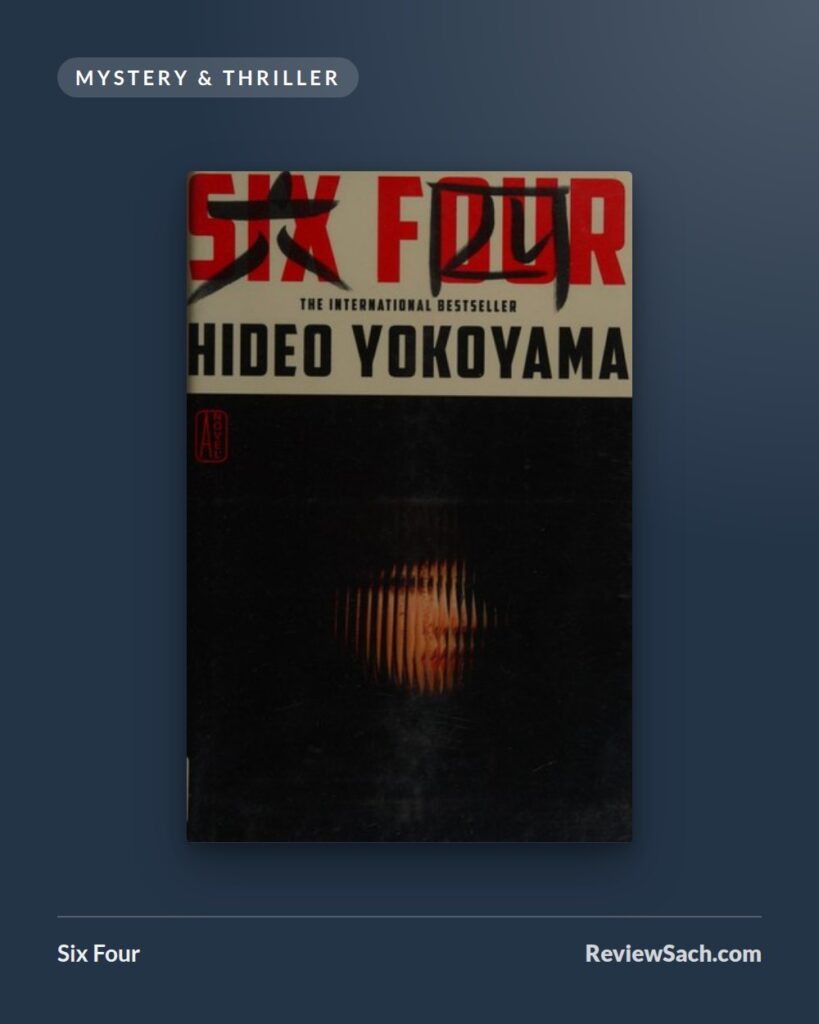
Author: Hideo Yokoyama · Published: 2012 · Genre: Crime Fiction, Police Procedural · Original title: 64 (Rokuyon)
Six Four is a Japanese police novel, and its biggest strength is its portrait of an institution: the rivalries, loyalties and face-saving that decide what a police force actually does. Its biggest weakness is pace. For hundreds of pages the drama is meetings, press briefings and office politics, and readers expecting a conventional thriller may give up before the payoff. Read it if you like slow-burn crime fiction with depth, or are curious about how Japanese institutions work.

What it’s about
In January 1989, during the last few days of the Showa era, a girl named Shoko Amamiya was kidnapped in a provincial Japanese prefecture. A ransom was paid, the girl was killed, and the kidnapper was never caught. Inside the police the case is known as Six Four, after Showa 64, the year it happened, and it remains the force’s great failure.
More than a decade later, Yoshinobu Mikami, a former detective who once worked the case, has been moved to the post of press director. He is caught between the reporters of the press club, who are furious about the police’s refusal to name the driver in a traffic accident, and his superiors in Administrative Affairs, who want the press kept in line. The commissioner of the national police plans to visit the Amamiya family, and Mikami is ordered to arrange it. As he does, he finds hints that something about the original investigation was buried. All this happens while his own teenage daughter, Ayumi, has run away from home, and Mikami and his wife wait on every phone call.
The book was a huge success in Japan, and Jonathan Lloyd-Davies’s English translation was shortlisted for the CWA International Dagger.
What’s great
- The institution as the subject. Yokoyama, a former newspaper reporter, knows both sides of the press room. The power struggle between Criminal Investigations and Administrative Affairs, and between Tokyo and the provinces, is gripping in its own way, and it explains why Mikami can trust almost no one.
- Mikami. He is proud, combative, self-conscious about his looks and ashamed of things he can’t fix. His marriage, strained by fear and silence over their missing daughter, gives the procedural real emotional weight without melodrama.
- The payoff. When the plot finally accelerates, many threads, including details that seemed like dull bureaucracy, turn out to matter. The last part of the book is tense, ingenious and moving.
- A window on Japan. Hierarchy, the power of the press clubs and the pressure to save face are shown from the inside rather than explained like a guidebook.
What’s weak
It is long and slow. The first half is mostly Mikami negotiating, being snubbed and trying to read colleagues’ motives, and the press club conflict, though important, can feel repetitive. Readers who want a mystery driven by clues and suspects will find that the detective work arrives late.
It can also be hard to follow. Many characters are known by rank or surname, the departments and their rivalries take time to learn, and English readers may need to keep notes on who outranks whom. Mikami’s long internal debates sometimes go over the same ground more than once.
Who should read it
Read it if you like police procedurals with literary ambitions, in the vein of Henning Mankell or Tana French, or if you are interested in modern Japan. Be patient through the first half. Readers who want fast action should start elsewhere.
Rating: 4/5
Image credits — Featured image: cover image via Open Library; cover design © the publisher, shown for review purposes. In-article images: Photo by Suzi Kim on Unsplash.
