

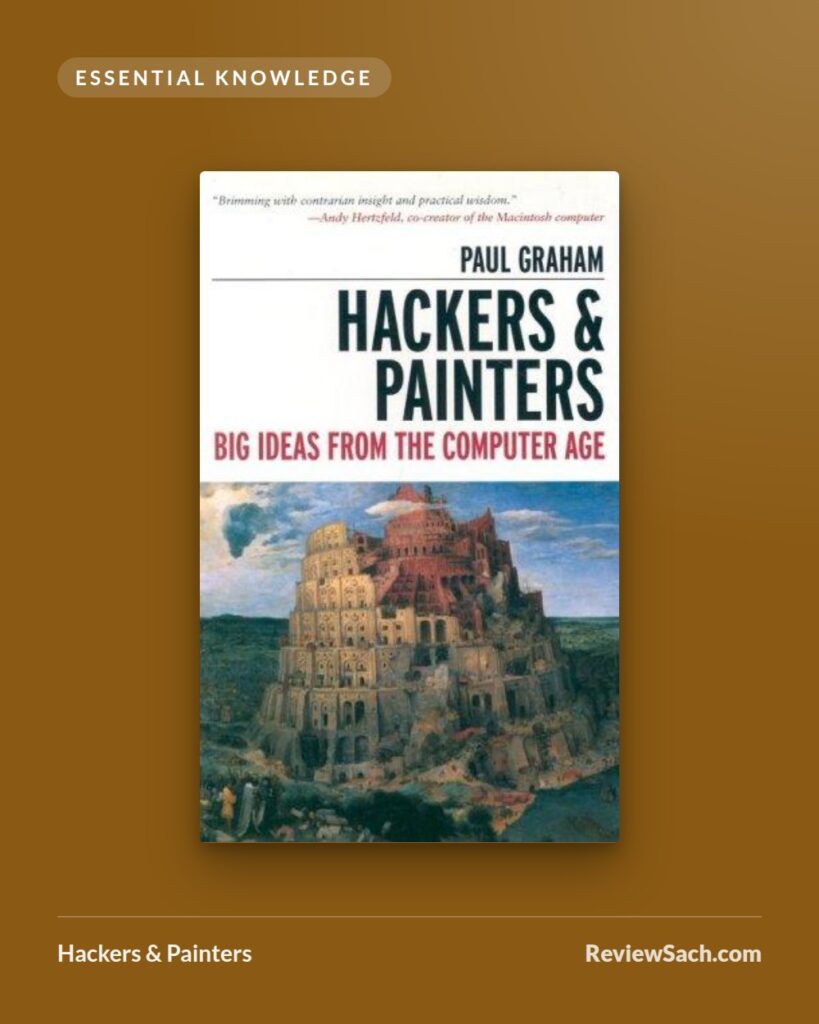
Author: Paul Graham · Published: 2004 · Genre: Essays, Technology
Hackers & Painters collects essays by the programmer and investor Paul Graham, and its biggest strength is clarity of thought: Graham takes big questions about software, work and wealth and answers them in plain, memorable prose. Its biggest weakness is his certainty. He generalizes freely, treats his own experience as universal and spends a long stretch arguing that Lisp beats nearly every other language. Read it if you build software or startups, or simply enjoy essays that make you argue back.

The core ideas
Graham wrote these essays after co-founding Viaweb, an early web-based software company that let merchants build online stores and that Yahoo bought in 1998. The book, subtitled Big Ideas from the Computer Age, ranges widely:
- Programming is a craft, like painting. In the title essay he argues that hackers are makers, closer to painters or architects than to scientists. They learn by doing, sketch in code and revise, and do their best work with tools that let them change their minds.
- Wealth is created, not divided. In “How to Make Wealth” he argues that wealth is what people want, not money, and that a startup is a way to compress a working life into a few intense years.
- Software would move to the web. In “The Other Road Ahead,” written while desktop software still dominated, he argued that applications would run on servers and be used through browsers.
- Language matters. “Beating the Averages” introduces the Blub paradox: a programmer comfortable with an average language can’t see what a more powerful one offers, because they think in that language. Graham credits Lisp with letting Viaweb build features faster than its rivals.
- Think the unthinkable. “What You Can’t Say” argues that every era has true ideas it forbids, and suggests ways to find them.
What’s great
- The prose. Graham writes short sentences with almost no jargon, and his best essays read like conversations with a clever friend. They are a model of explanatory writing.
- Original framing. “Why Nerds Are Unpopular” argues that smart teenagers are unpopular partly because they care more about being smart than being popular, and it is more humane than its title suggests.
- Predictions that held up. The case for web applications looks prescient today, and “A Plan for Spam” helped popularize statistical, Bayesian spam filtering, which became a standard approach.
- Taste and design. His essays on design argue that good taste is not purely subjective and that great work comes from small teams with high standards, advice that still sounds fresh.
What’s weak
Graham’s confidence often outruns his evidence. The high school essay generalizes from personal experience, and “Mind the Gap,” his defence of growing differences in wealth, reads differently now that tech fortunes are a political issue. The tone can be smug, and he rarely gives opposing views their strongest form.
The programming essays are dated and partisan. The Lisp chapters will mean little to non-programmers, and the claim that one language gave Viaweb its edge is impossible to test. Many details about tools and companies belong firmly to 2004. Graham went on to co-found Y Combinator in 2005, and most of these essays, plus many later ones, are free on his website.
Who should read it
Read it if you are a programmer, founder or tech-curious reader who enjoys big arguments. Skip the language chapters if you don’t code. If you already read Graham online, you have met much of this before.
Rating: 4/5
Image credits — Featured image: cover image via Open Library; cover design © the publisher, shown for review purposes. In-article images: Photo by Chris Ried on Unsplash.
