

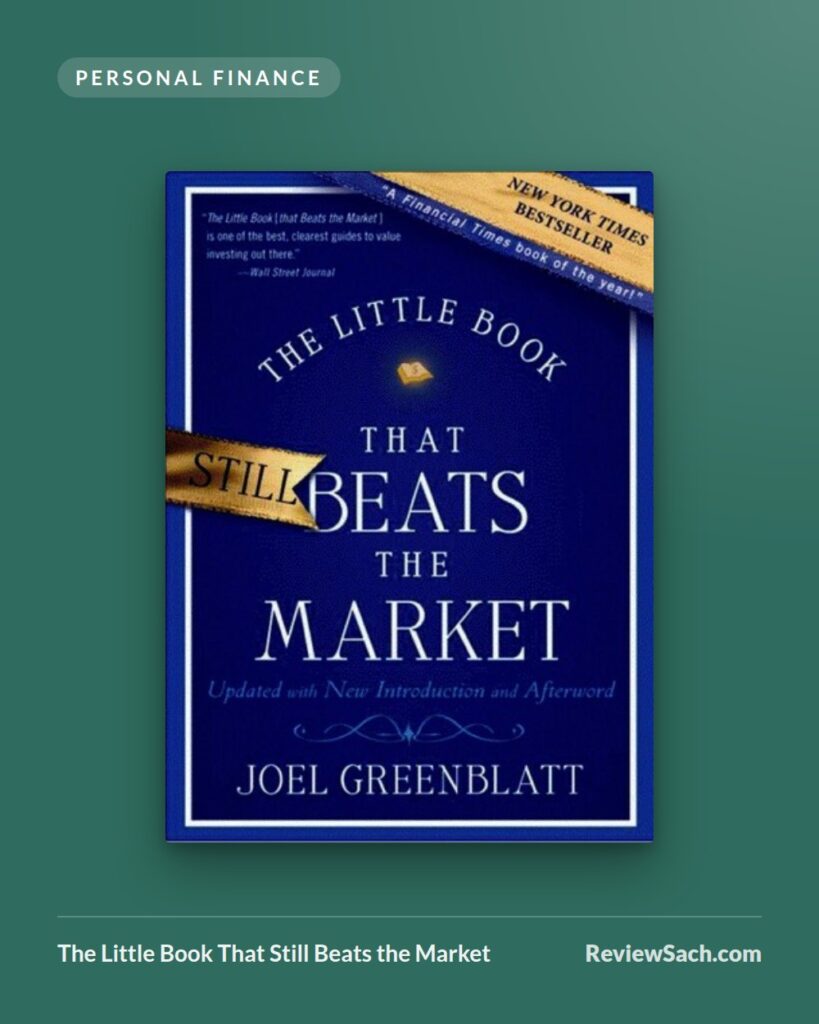
Author: Joel Greenblatt · Published: 2005 · Genre: Personal Finance, Investing
The Little Book That Still Beats the Market explains value investing so plainly that a teenager could follow it, and that clarity is its biggest strength. Its biggest weakness is the “magic formula” itself: the back-tested returns that sell the book have not been matched since it was published, and independent tests found the edge smaller and less stable. It is worth reading for beginners who want to understand how value investors think, not as a promise of market-beating returns.

The big idea
Greenblatt, who founded the hedge fund Gotham Capital and teaches at Columbia Business School, says he wrote the book so his children could understand it. He starts with a kid named Jason who sells gum at school, and uses that tiny business to explain what makes a company worth owning: how much it earns compared with the money invested in it, and how much you pay for those earnings.
That becomes the formula. Rank companies by return on capital, a measure of how good the business is, and by earnings yield, a measure of how cheap it is. Add the two rankings and look at the companies that score best on the combination. In the book’s method, an investor builds a portfolio of 20 to 30 top-ranked stocks over a year, holds each for about a year and repeats the process for many years. Financial companies and utilities are excluded.
The original edition came out in 2005. This updated “Still” edition, published in 2010, extends the back-test through the 2008 crash and reports annual returns of roughly 24 percent from 1988 to 2009, more than double the S&P 500.
What’s great
- Clarity. Return on capital and earnings yield are explained without jargon, and Benjamin Graham’s parable of Mr. Market, the moody business partner who offers wildly different prices every day, is told as well as anywhere.
- Honesty about pain. Greenblatt stresses that the formula can trail the market for years at a time. He argues this is exactly why it keeps working: most people abandon a strategy after a few bad years.
- A way of thinking. Even readers who never use the formula come away knowing to ask two questions of any business: is it good, and is it cheap?
- Length. It is short enough to read in an evening.
What’s weak
The headline numbers come from back-tests, not a fund that investors actually owned. When Wesley Gray of Alpha Architect re-ran the strategy in 2011, he found results highly sensitive to small changes in assumptions and driven heavily by very small companies, which are harder and costlier to trade. A 2009 study of Nordic markets found the extra returns could be explained by standard risk models.
Performance after publication has been more modest. One independent analysis of US stocks from 2003 to 2015 found the formula beat the S&P 500 by about three percentage points a year, well short of the book’s figures, and that it trailed the index for several years around the financial crisis. Simple published strategies also tend to weaken as more investors use them.
The book is also thin on taxes, trading costs and how to judge a company’s numbers when they are distorted by one-off events. Its simplicity, the main selling point, leaves out much of what makes real investing hard.
Who should read it
Read it if you are new to investing and want a clear, honest introduction to the logic of buying good businesses at fair prices. Read it as education, not as a recommendation to buy any particular stock or follow any strategy, and pair it with a broader book before making decisions with real money.
Rating: 4/5
Image credits — Featured image: cover image via Open Library; cover design © the publisher, shown for review purposes. In-article images: Photo by Nicholas Cappello on Unsplash.
