

Author: Karen Hao · Published: 2025 · Genre: Technology, Journalism
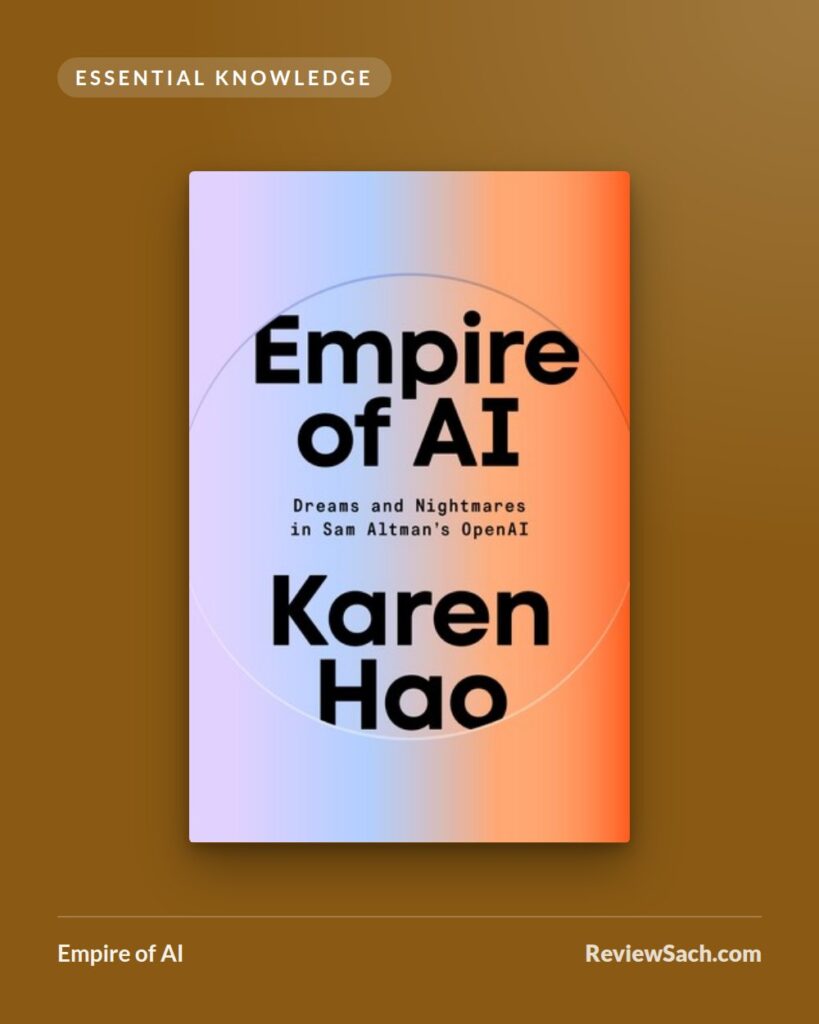
Empire of AI, subtitled Dreams and Nightmares in Sam Altman’s OpenAI in the US, is a reporter’s history of the company behind ChatGPT, and its biggest strength is its reporting range: it connects boardroom battles in San Francisco to data workers in Kenya and fights over water in Chile. Its biggest weakness is that it argues a thesis more than it weighs one, so readers who see real promise in AI will find their view given little room. Read it if you want to understand how the AI boom was built and who pays for it.
The big idea
Hao argues that OpenAI and its rivals behave like the colonial empires of the past. They claim resources that were never theirs, from data scraped off the internet to the land, water and electricity that data centres need. They rely on cheap labour in poorer countries. And they justify it all with a civilizing mission: the promise that artificial general intelligence will benefit all of humanity.
The book follows OpenAI from its 2015 founding as a nonprofit by Sam Altman, Elon Musk and others, through Musk’s departure, the creation of a capped-profit arm and the Microsoft partnership, to the bet on ever-larger models and the launch of ChatGPT. It covers the tension between safety-minded staff and those pushing for speed, and the board’s firing and rapid reinstatement of Altman in November 2023. Hao draws on interviews with about 260 people, along with documents and internal messages.
What’s great
- The global view. The strongest chapters leave Silicon Valley. Hao interviews Kenyan contract workers who labelled violent and abusive text so that OpenAI’s models could learn to filter it, and data annotators in Venezuela, where economic collapse made low-paid gig work a lifeline. She also reports on local resistance to a planned data centre in Chile.
- The board crisis. Her account of the November 2023 ouster is detailed and gripping, and it shows how much of the drama turned on trust and candour.
- Context. Hao, who first profiled OpenAI for MIT Technology Review in 2020, explains how a nonprofit with an idealistic mission became a commercial giant, and argues that the industry’s focus on scale was a choice, not an inevitability.
- Recognition. The book won the National Book Critics Circle Award for nonfiction.
The controversy
OpenAI declined to cooperate with the book, so much of the inside story comes from former employees, other sources and documents. OpenAI’s own case, that huge investment in computing is the price of building safe and broadly beneficial AI, is described but rarely given the benefit of the doubt. The empire metaphor is illuminating but stretched: many of the harms Hao describes are industry-wide, and one framework has to cover everything from Kenyan wages to boardroom politics. The benefits people report from using these tools get little space.
Accuracy has been tested too. After outside fact-checkers, including the writer Andy Masley, raised questions, Hao acknowledged in late 2025 that a unit error had exaggerated a comparison between the planned Chilean data centre’s water use and that of local residents by a factor of 1,000. She published corrections to that passage and to a second water claim. The fix doesn’t undo her broader reporting, but readers should know about it.
Who should read it
Read it if you follow AI, work in tech or policy, or want a critical counterweight to industry optimism. Pair it with Keach Hagey’s The Optimist, a more Altman-centred biography from the same year, for a fuller picture.
Rating: 4/5
Image credits — Featured image: cover image via Open Library; cover design © the publisher, shown for review purposes. In-article images: Photo by Taylor Vick on Unsplash.
