

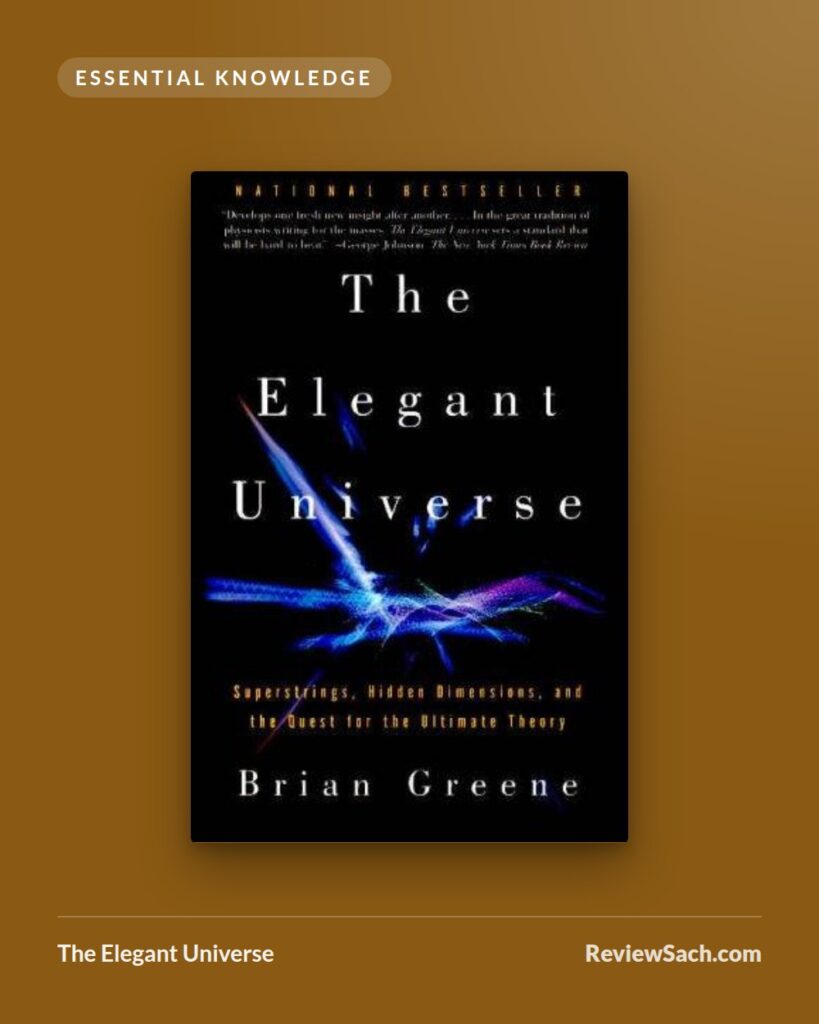
Author: Brian Greene · Published: 1999 · Genre: Popular Science, Physics
The Elegant Universe is a physicist’s guide to string theory, and its biggest strength is explanation: Greene’s analogies make relativity, quantum mechanics and hidden dimensions feel graspable with almost no mathematics. Its biggest weakness is that it is, at heart, an enthusiastic case for a theory that no experiment has yet confirmed, more than twenty-five years later. Read it if you want one of the clearest popular accounts of what string theory claims and why so many physicists found it compelling.
The core ideas
- Two theories that clash. General relativity describes gravity and the large-scale universe; quantum mechanics describes the very small. Each works brilliantly on its own, but in extreme conditions, such as the centre of a black hole or the first instant of the Big Bang, combining them produces nonsense.
- Strings, not points. String theory proposes that the basic constituents of matter are tiny vibrating strings. Different vibration patterns would appear to us as different particles, like different notes from one violin string, and one pattern behaves like the graviton, the particle that would carry gravity.
- Extra dimensions. The mathematics requires more dimensions of space than the three we see, curled up too small to detect, possibly in intricate shapes called Calabi-Yau spaces. Greene’s image of a garden hose, which looks like a line from far away but has a circular dimension up close, is the book’s best-known analogy.
- Unification. In the mid-1990s, physicists including Edward Witten argued that five apparently different string theories are aspects of one deeper framework, called M-theory.
What’s great
- The first third is a classic. Greene’s chapters on special and general relativity and on quantum mechanics are among the best popular explanations written, and they are worth reading even if you never care about strings.
- Analogies that work. Garden hoses, ants and imaginary observers drifting through space make strange ideas concrete, and Greene usually flags where an analogy breaks down.
- An insider’s view. Greene was an active string theorist, and his account of research showing that the fabric of space could, in theory, tear and repair itself, work he took part in, conveys what doing theoretical physics feels like.
- Recognition. The book was a Pulitzer Prize finalist and later became a PBS NOVA series hosted by Greene.
What’s weak
The central problem is evidence. String theory’s distinctive predictions mostly involve energies far beyond any experiment we can build, and so far there is no experimental confirmation of strings or extra dimensions. Supersymmetry, an idea built into superstring theory, has been searched for at the Large Hadron Collider without success, though string theory does not require it to appear at those energies.
Critics such as Lee Smolin in The Trouble with Physics and Peter Woit in Not Even Wrong argued in 2006 that the field had become too dominant given its lack of testable predictions. Defenders reply that string theory has produced valuable mathematics and real insight into quantum gravity and black holes, and that it remains a leading candidate for a unified theory. Greene acknowledges the testing problem, but the tone throughout is that of an advocate.
The book is also dated. Later developments, notably the “landscape” of an enormous number of possible solutions, which made unique predictions look even harder, came after it. The final chapters on M-theory and black holes are dense, and many readers lose the thread there.
Who should read it
Read it if you want to understand modern theoretical physics and enjoy careful explanation. Read the relativity and quantum chapters closely, treat the string chapters as a tour of an elegant hypothesis, and pair it with Smolin or Woit for the sceptical side.
Rating: 4/5
Image credits — Featured image: cover image via Open Library; cover design © the publisher, shown for review purposes. In-article images: Image by ESA/Hubble & NASA via NASA, CC BY 4.0.
