

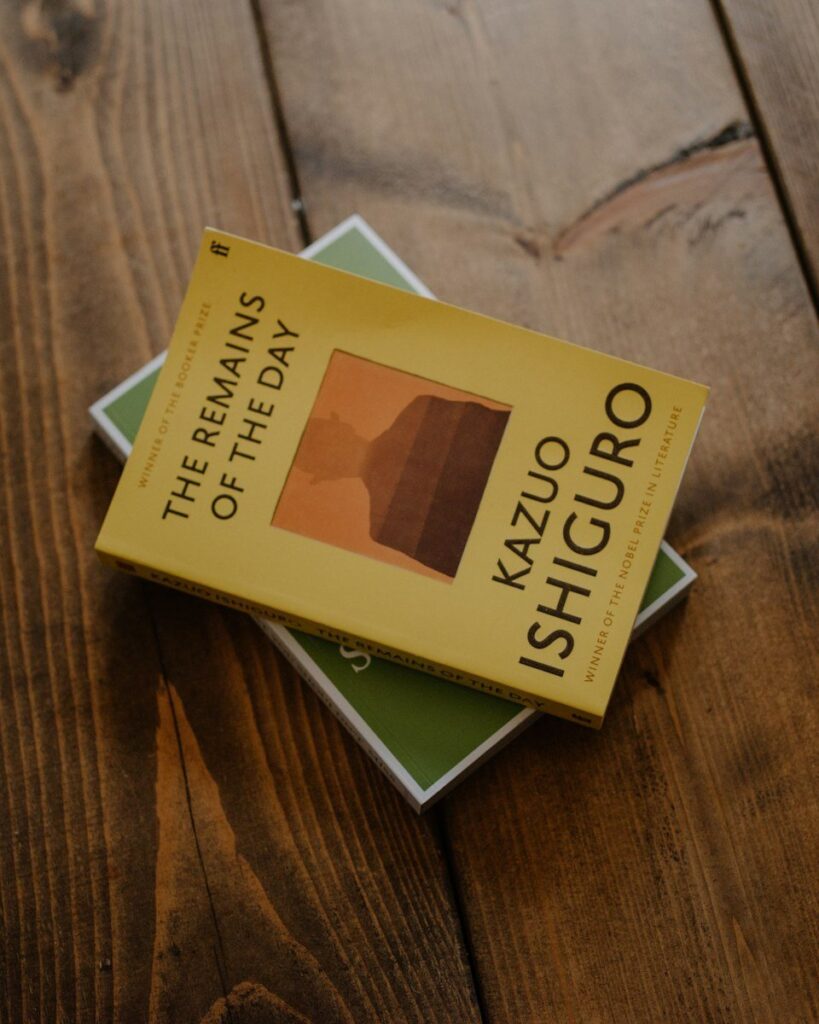
Author: Kazuo Ishiguro · Published: 1989 · Genre: Literary Fiction, Historical Fiction
The Remains of the Day is a short novel narrated by an English butler, and its biggest strength is how much Ishiguro lets you see through a narrator who refuses to see it himself. Its biggest limitation is the same restraint: almost nothing happens on the surface, and if you want plot or open emotion, the polite, measured voice can feel like a wall. It won the Booker Prize in 1989 and is worth reading for anyone who likes fiction that rewards close attention.

What it’s about
In the summer of 1956, Stevens, the long-serving butler of Darlington Hall, takes a rare holiday. His new employer, a genial American named Mr Farraday, lends him his car, and Stevens drives toward the West Country to visit Miss Kenton, the hall’s former housekeeper. A recent letter from her has hinted that her marriage is unhappy, and Stevens tells himself the visit is purely professional: the house is short of staff, and she might come back.
As he drives, he remembers. Most of the book is Stevens looking back at the 1920s and 1930s, when he served Lord Darlington, a well-meaning aristocrat who hosted unofficial diplomatic gatherings and drifted into sympathy with Nazi Germany and the cause of appeasement. Stevens recalls his own father, an aging under-butler, his long working partnership with Miss Kenton, and the question that obsesses him: what makes a great butler? His answer is “dignity”, which in practice means never letting a private feeling show.
What’s great
- The voice. Stevens’s formal, slightly pompous English is both a comic creation and a tragic one. He describes painful moments in the language of household management, and the gap between what he says and what he plainly feels is where the novel lives.
- The unreliable narrator done right. Stevens doesn’t lie so much as edit. He corrects himself, admits he may be misremembering, and changes the subject at the worst moments. Ishiguro trusts you to notice, and the slow realization of how much Stevens has avoided is more powerful than any dramatic revelation.
- Big history through a small window. Through one servant’s memories, the book looks at loyalty given to the wrong cause. In one episode Lord Darlington orders the dismissal of two Jewish maids, and Stevens’s quiet compliance shows how ordinary obedience lets a decent-seeming house serve something ugly.
- Small comic scenes. Stevens’s anxious attempts to master the art of “bantering” for his American employer are genuinely funny and quietly sad.
What’s weak
The restraint that makes the book great also limits it. The central irony, that Stevens has given his life to a man and an ideal that didn’t deserve it, becomes clear fairly early, and the middle stretches can feel like the same note played again. Miss Kenton, seen only through Stevens’s guarded memories, is vivid but never fully her own person. That is the point, but it can still frustrate.
The politics are also kept at a distance. Lord Darlington’s appeasement is shown rather than examined, so readers hoping for a novel about the 1930s will find a novel about one man’s blindness instead. And the English country-house world, though lovingly observed, can feel closed and a little museum-like.
Who should read it
Read it if you like character-driven literary fiction, unreliable narrators, or novels about work, duty and regret. It is short enough for a weekend, and it is even better the second time. The 1993 film with Anthony Hopkins and Emma Thompson is a fine companion, but read the book first.
Rating: 4.5/5
Image credits — Featured image: Photo by Annie Spratt on Unsplash. In-article images: Photo by Steve Payne on Unsplash.
