

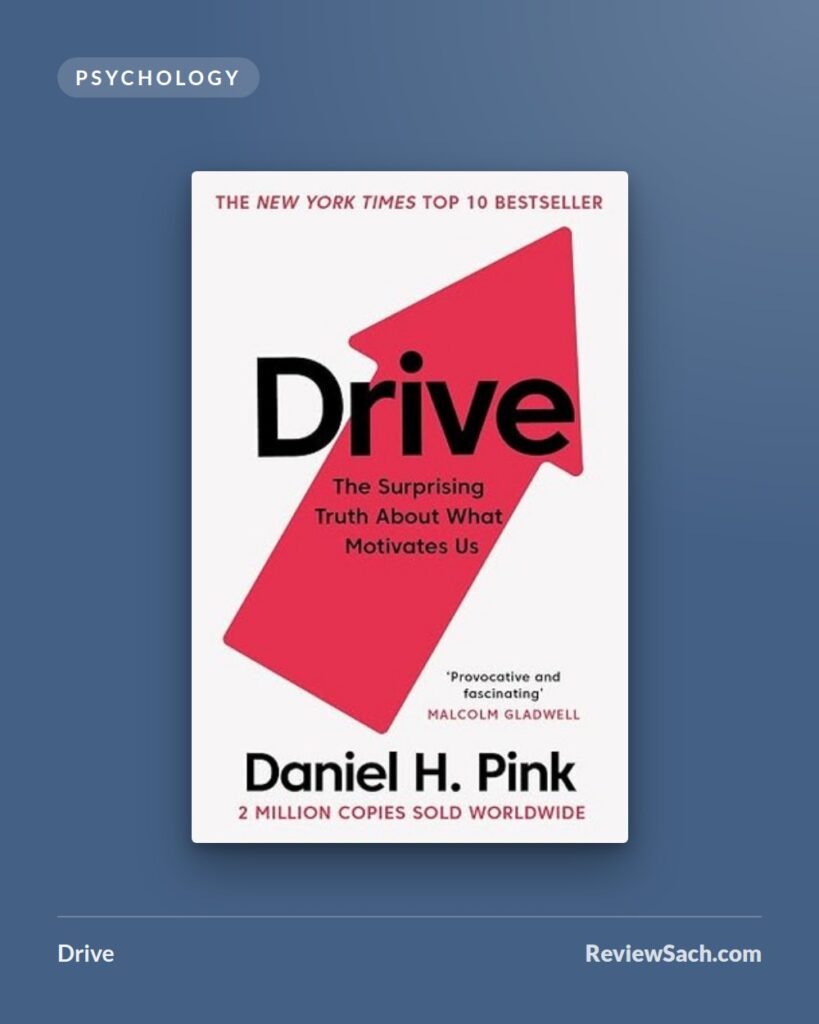
Author: Daniel H. Pink · Published: 2009 · Genre: Psychology, Business
Drive argues that carrots and sticks work worse than managers think, and that people do their best creative work when they have autonomy, mastery and purpose. Its biggest strength is how clearly it turns decades of lab research into a framework you can use at work. Its biggest weakness is that it presents a long-running scientific argument as if it had been won, and skims over evidence that rewards often work fine. It’s worth reading for managers, teachers and anyone designing incentives, as long as you treat it as a starting point.

The big idea
Pink sorts the history of motivation into operating systems. Motivation 1.0 was about survival. Motivation 2.0 is the carrot-and-stick model of the industrial workplace: reward the behavior you want, punish the behavior you don’t. Pink says that model still suits routine, rule-based work, but it misfires on tasks that need judgment and creativity, and it can crowd out the interest people bring to the work.
His replacement, Motivation 3.0, rests on three elements. Autonomy means control over what you do, when, how and with whom. Mastery means the urge to get better at something that matters. Purpose means connecting the work to something larger than yourself. He contrasts “Type X” behavior, driven by external rewards, with “Type I” behavior, driven by the work itself, and argues the second can be learned.
One practical point is often missed: Pink says baseline pay must be fair and adequate first. His case is against contingent “if you do this, then you get that” rewards for complex work, not against paying people well.
What’s great
- Well-chosen studies, well told. Harry Harlow’s monkeys solving puzzles with no reward, Edward Deci’s experiments in which students paid to solve puzzles lost interest once the pay stopped, and Sam Glucksberg’s version of the candle problem, where a cash incentive slowed people down, make the argument concrete.
- Memorable real-world contrasts. Pink sets Microsoft’s paid, professionally managed Encarta encyclopedia against volunteer-built Wikipedia, and describes Atlassian’s FedEx Days, when engineers could work on anything they liked as long as they delivered something within a day.
- A usable toolkit. The closing section offers exercises, reading lists and ideas for managers, parents and teachers, which makes the book more practical than most popular psychology.
The controversy
The research Pink relies on is real, but the debate around it is older and more contested than Drive admits. Whether rewards undermine intrinsic motivation, the so-called overjustification effect, has been argued over since the 1970s. In the 1990s, meta-analyses by Judy Cameron, W. David Pierce and Robert Eisenberger concluded that the harmful effects of rewards were small and limited to narrow conditions. A 1999 meta-analysis by Deci, Richard Koestner and Richard Ryan replied that expected, tangible rewards for doing an interesting task do reliably reduce people’s interest in it. Pink largely tells the second side of the story.
Later work points to a more mixed picture. A 2014 meta-analysis by Christopher Cerasoli, Jessica Nicklin and Michael Ford, covering about 40 years of studies, found that intrinsic motivation was the better predictor of the quality of work, while incentives were the better predictor of quantity. Both mattered. That is closer to “use both, carefully” than to “carrots and sticks don’t work.”
Two other limits stand out. Many key findings come from short lab tasks, often with students, and Pink generalizes them to whole careers and companies. And some of his corporate examples aged badly: Best Buy, which he praises for its Results-Only Work Environment, dropped the program in 2013.
Who should read it
Read it if you manage people, teach, or design pay and bonus schemes and want a clear introduction to the psychology of intrinsic motivation. Pair it with a more skeptical source on incentives so you don’t mistake its conclusions for settled science.
Rating: 3.5/5
Image credits — Featured image: cover image via Open Library; cover design © the publisher, shown for review purposes. In-article images: Photo by Vitaly Gariev on Unsplash.
