

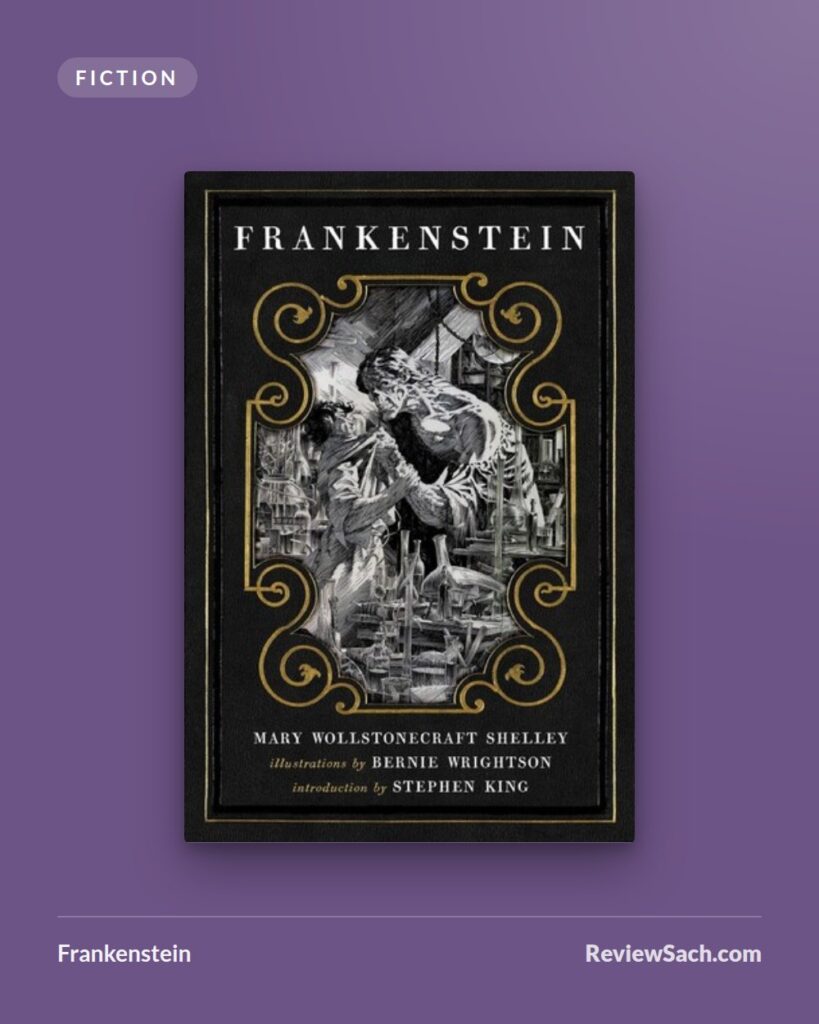
Author: Mary Shelley · Published: 1818 · Genre: Fiction, Gothic, Science Fiction
Frankenstein is the story of a young scientist who builds a living being and then abandons it, and it is far stranger and sadder than the bolt-necked monster of the movies. Its biggest strength is the creature’s own account of his life, which turns a horror story into a searching novel about responsibility and rejection. Its biggest weakness is Victor Frankenstein himself, whose melodramatic lamenting and the plot’s convenient coincidences can test a modern reader’s patience. It is worth reading for anyone interested in the roots of science fiction or in the ethics of creation.

What it’s about
The novel opens with letters from Robert Walton, an explorer heading for the Arctic, who takes aboard a stranger in a terrible state. The stranger is Victor Frankenstein, and his story forms most of the book. Raised in Geneva, Victor becomes obsessed with discovering the secret of life while studying at the University of Ingolstadt. He succeeds, but the moment his creation opens its eyes he is horrified by it and flees.
The abandoned creature has to make sense of the world alone. At the heart of the novel he tells his own story: how he learned language and reading by secretly watching a family in a cottage, how he discovered books such as Paradise Lost, and how every attempt to approach people ended in fear and violence. He then makes a demand of Victor that drives the rest of the book. I will leave the turns that follow, and the ending, for you to discover.
Mary Shelley began the story in 1816, during a ghost-story contest with Lord Byron, Percy Shelley and John Polidori at a villa near Lake Geneva. She was still a teenager when she started it, and it was first published anonymously.
What’s great
- The creature’s voice. He is eloquent, wounded and intelligent, and his arguments are hard to dismiss. The book makes you wonder whether he was born a monster or made into one.
- Big questions, lightly carried. Shelley asks what creators owe what they make, how isolation breeds cruelty and where ambition becomes recklessness. Those questions feel newly urgent in an age of genetic engineering and artificial intelligence.
- Structure. The nested narrators, from Walton to Victor to the creature and back, make you weigh each account against the others.
- Atmosphere. The Alpine glaciers, storms and frozen seas give the book a grand, eerie beauty that suits its themes.
What’s weak
Victor is hard company. He spends long stretches fainting, falling ill and blaming fate, and he repeatedly fails to take obvious steps that might prevent disaster. That is partly the point, since his evasion of responsibility is the novel’s subject, but it slows the middle of the book.
The plotting relies on coincidence, and the creature’s rapid mastery of language and literature from eavesdropping takes some forgiving. The women, especially Victor’s beloved Elizabeth, are idealized and given little to do, and the prose can be overwrought.
Editions matter too. Shelley revised the novel for an 1831 edition, adding her famous introduction about its origin and changing some details. Many scholars prefer the 1818 text as closer to her first vision, but the 1831 version is still widely printed, so check which one you are buying.
Who should read it
Read it if you love gothic fiction, science fiction or novels of ideas, or if you only know the story from film. Choose an annotated edition that states which text it uses, and be patient with the first chapters.
Rating: 4.5/5
Image credits — Featured image: cover image via Open Library; cover design © the publisher, shown for review purposes. In-article images: Photo by Martin Masson on Unsplash.
