

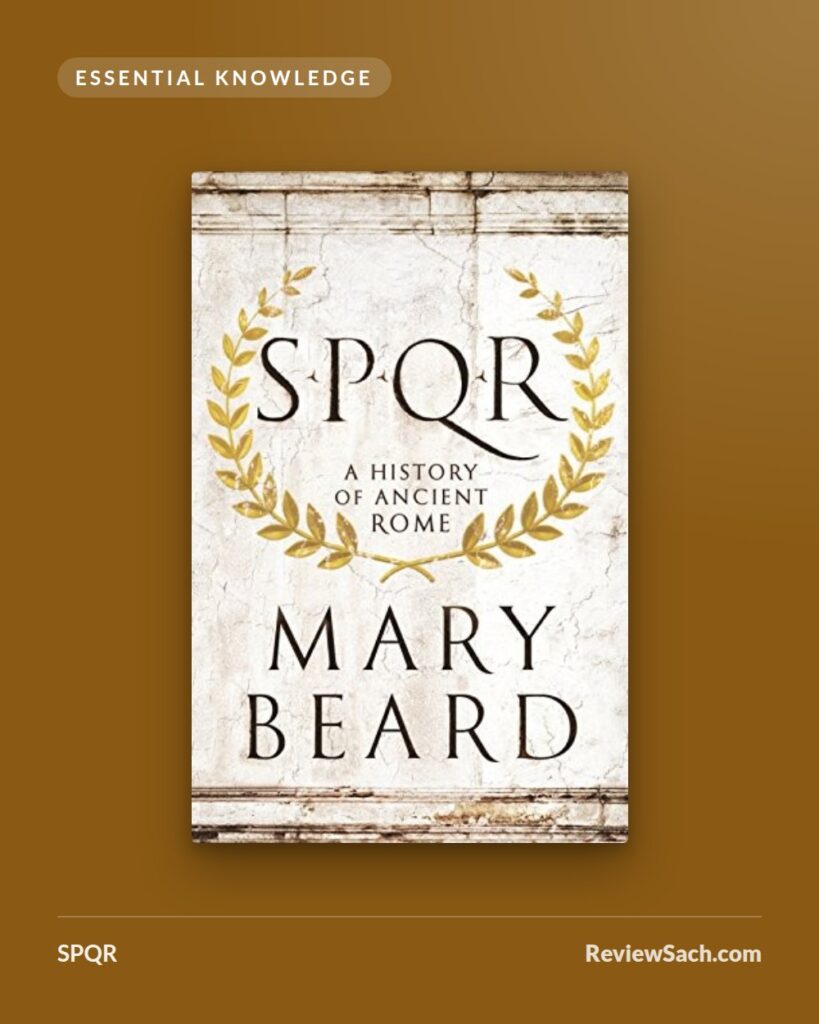
Author: Mary Beard · Published: 2015 · Genre: History, Ancient Rome
SPQR, subtitled A History of Ancient Rome, is a Cambridge classicist’s account of Rome’s first thousand years, and its biggest strength is its skepticism: Beard keeps asking how we know what we think we know, and shows what the evidence can and can’t support. Its biggest weakness is structure. She circles, digresses and sorts much of the material by theme, and she stops in AD 212, so readers wanting a clear story of battles, emperors and the fall will be frustrated. Read it if you know a little about Rome and want to think about it more sharply.
The big idea
Beard’s Rome is less a parade of great men than a long experiment in what it meant to be Roman. The book runs from the city’s legendary beginnings to AD 212, when the emperor Caracalla granted citizenship to almost all free inhabitants of the empire. That end point is the argument in miniature: one of Rome’s most distinctive features was the steady, if grudging, extension of citizenship to outsiders, conquered peoples and freed slaves.
She opens not at the founding but in 63 BC, with Cicero’s clash with the conspirator Catiline, and uses it to show how a single dramatic episode was shaped and reshaped by the people who wrote about it. The stories of Romulus and Remus and the early kings are treated as myths Romans told about themselves, revealing more about later Rome than about its origins. The late Republic gets detailed attention, and the imperial period is handled largely by theme: how emperors ruled, how the provinces were run, and how ordinary people lived.
What’s great
- The method. Beard shows her working. She explains what an inscription, a coin or a ruined house can tell us, and where historians have filled gaps with guesswork. You come away a better reader of history.
- Ordinary Romans. Some of the best pages are about people outside the elite, such as soldiers, freed slaves, traders and the crowds in Rome’s apartment blocks, recovered from tombstones, graffiti and everyday objects.
- Voice. Her style is conversational, witty and opinionated. She punctures myths, admits uncertainty and makes old debates feel urgent.
- Fresh angles on famous figures. Cicero, Julius Caesar and Augustus appear as politicians working within a system rather than as marble legends.
What’s weak
The thematic approach can confuse beginners. Beard argues that, for most people in the empire, it mattered surprisingly little which emperor was on the throne, so she does not march through the emperors one by one. That is a defensible view, but readers who want a narrative spine may lose track of who ruled when.
Military history and the details of campaigns are thin, and stopping in 212 means no crisis of the third century, no Constantine and no fall. Some readers also find that the asides and frequent hedging slow the pace, and the early chapters, built on scant evidence, can feel like a long series of caveats before the story properly begins.
Who should read it
Read it if you have some basic knowledge of Rome, perhaps from school, novels or documentaries, and want a sharper, more modern view. Complete beginners may want a simple timeline beside them, and anyone interested in the later empire and its fall will need a second book.
Rating: 4/5
Image credits — Featured image: cover image via Open Library; cover design © the publisher, shown for review purposes. In-article images: Photo by Holger Woizick on Unsplash.
