

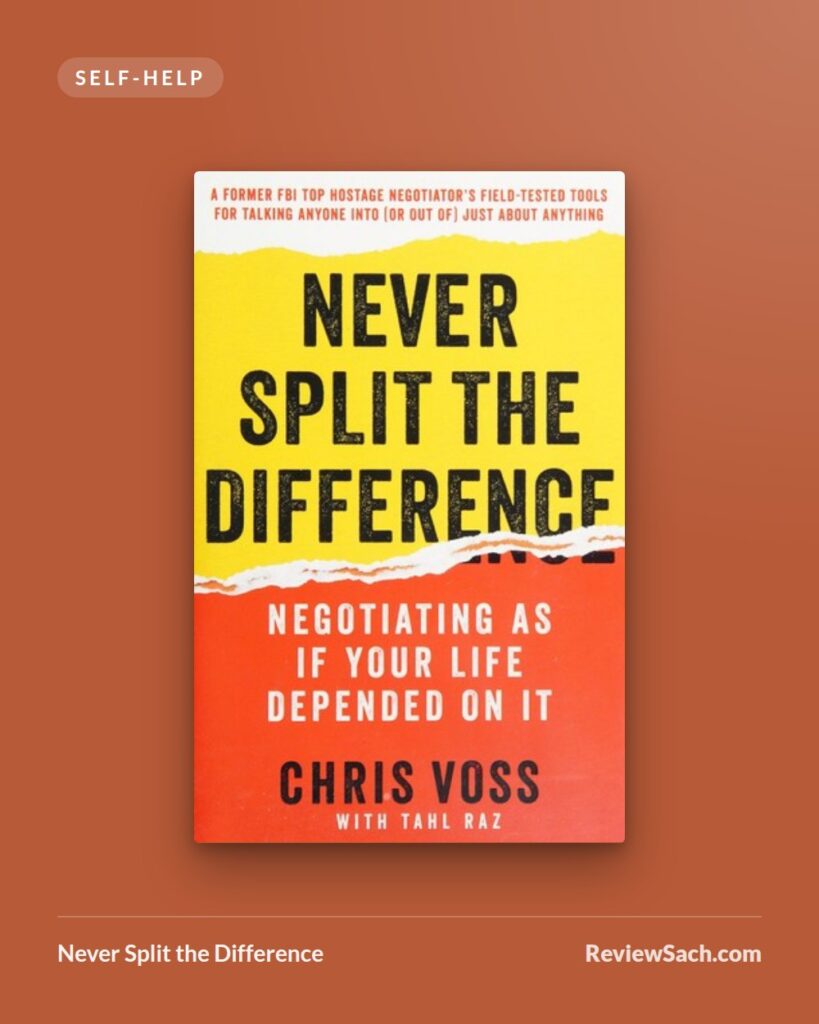
Author: Chris Voss with Tahl Raz · Published: 2016 · Genre: Self-Help, Negotiation, Business
Never Split the Difference argues that negotiation is driven by emotion, not logic, and teaches techniques from hostage negotiation for salary talks, car purchases and family arguments. Its biggest strength is how usable those techniques are: you can try mirroring or labeling in your next conversation. Its biggest weakness is the evidence, which is mostly Voss’s own stories, and a few tactics that can feel manipulative if used carelessly. It is worth reading for anyone who avoids negotiating or tends to cave.

The big idea
Voss spent more than two decades at the FBI and became its lead international kidnapping negotiator. He argues that the rational, problem-solving model taught in business schools, associated with Getting to Yes, underestimates how much fear, pride and the need for control drive people. His alternative is tactical empathy: understanding and naming the other side’s feelings so they feel heard, then using that trust to steer the outcome.
The ten chapters each teach a technique. Mirroring means repeating the last few words someone said, as a question, to keep them talking. Labeling names an emotion out loud, in a tentative way, to defuse it. An accusation audit lists every negative thing the other side might think about you before they can say it. Calibrated questions, which begin with “how” or “what,” push the other side to solve your problem. The final chapters cover bargaining and hunting for what he calls black swans, hidden facts that change the whole deal.
What’s great
- Concrete tools. Few books give you so many techniques you can test the same day. The advice to summarize the other side’s view until they say “that’s right,” a sign they feel understood, rather than offering polite agreement to end the conversation, is especially sharp.
- Seeking a no. Voss argues that people relax when they are allowed to say no, so questions framed to invite a no often move talks forward faster than pressing for yes.
- The Ackerman model. His haggling system sets a target, opens at 65 percent of it, then rises to 85, 95 and 100 percent in shrinking steps, ending on a precise, non-round number and a small non-monetary extra. It is clear and easy to follow.
- Stories. Hostage cases, including a 1993 Brooklyn bank robbery, make the lessons memorable, and the late-night radio DJ voice is a technique readers remember.
What’s weak
The evidence is anecdotal. Voss rarely engages with negotiation research, and his stories show that a technique worked once, not that it works reliably. He also cites the 7-38-55 rule, the claim that words carry only a small share of a message, which comes from narrow studies of how people judge feelings and is widely misapplied.
His contrast with Getting to Yes is overdrawn. Roger Fisher and William Ury’s book also stresses emotions and relationships, so the gap between the two schools is smaller than Voss suggests.
Hostage talks also differ from most business. In a hostage case, the relationship usually ends when the deal is done. In a job or a supplier relationship, it continues. Tactics such as framing offers around fear of loss or opening with an extreme anchor can win the round and damage trust. Voss says he wants deals both sides honor, but the book’s combative framing can push readers the other way.
Who should read it
Read it if you dread asking for a raise, buying a car or handling a tense family conversation. Use the listening tools freely, and use the hardball tactics with care.
Rating: 4/5
Image credits — Featured image: cover image via Open Library; cover design © the publisher, shown for review purposes. In-article images: Photo by Amina Atar on Unsplash.
