

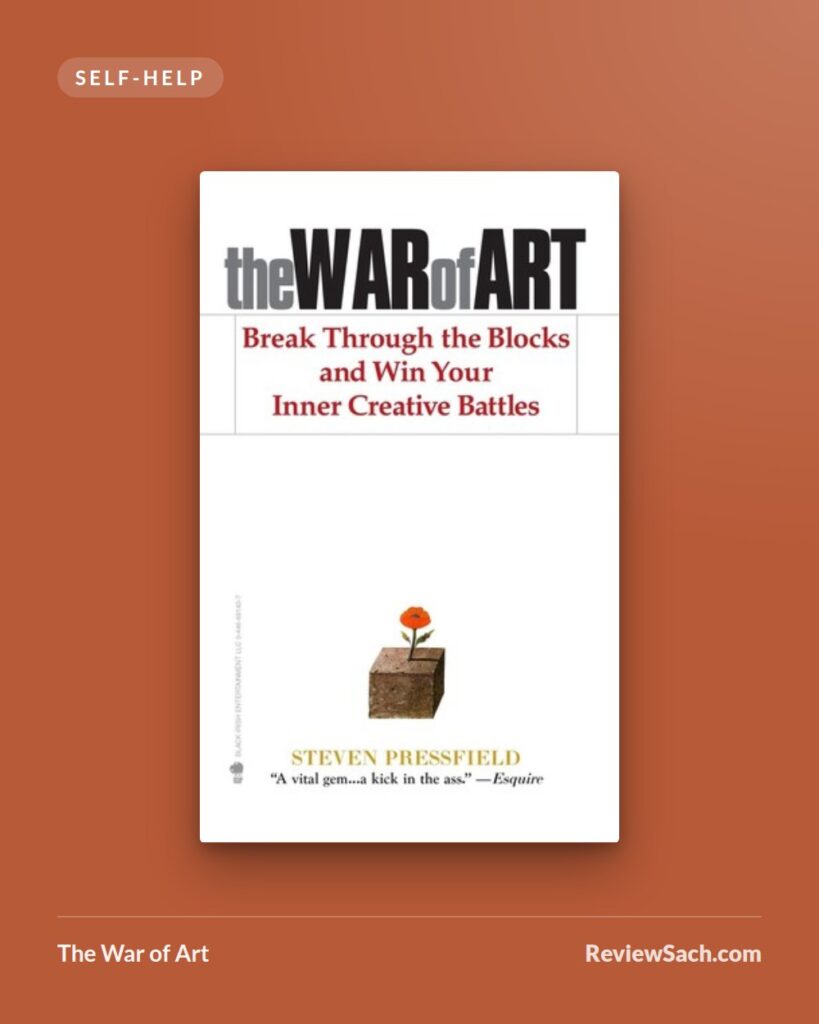
Author: Steven Pressfield · Published: 2002 · Genre: Self-Help, Creativity
The War of Art argues that the force stopping you from writing, painting or starting a business is not lack of talent but Resistance, an inner enemy that must be beaten every day. Its biggest strength is that diagnosis: naming Resistance turns vague guilt into something you can recognize and fight. Its biggest weakness is that the label covers too much, including illness, depression and therapy, and the last third trades advice for mysticism. It is worth reading for creative people who know what they want to make but keep not making it.

The big idea
Pressfield, the novelist behind The Legend of Bagger Vance and Gates of Fire, spent years failing to finish his work before he broke through. The book distills what he learned into three parts, written as very short chapters, many only a page long.
The first part defines Resistance. It is universal, it is strongest when the work matters most, and it disguises itself as procrastination, rationalization, drama, self-doubt and the urge to fix your life before you can begin. Pressfield’s most famous example is Hitler, who wanted to be a painter; Pressfield argues it was easier for him to start a world war than to face a blank canvas.
The second part is about turning pro. Amateurs work when they feel inspired. Professionals show up every day, work through fear, don’t take rejection personally and treat the craft as a job. The third part turns to the Muse: Pressfield believes that once you commit, forces beyond you, which he calls angels or the unconscious, begin to help. He also contrasts a hierarchical orientation, where you measure yourself by rank and others’ opinions, with a territorial one, where the work itself is the reward.
What’s great
- A useful name. Calling the problem Resistance separates it from your identity. You are not lazy; you are under attack, and you can fight back.
- Turning pro. The professional’s habits, such as fixed hours, patience and indifference to praise and blame, are concrete and genuinely helpful.
- Brevity and punch. The tiny chapters read like a coach shouting from the sideline. Many readers keep it on their desks to reread when stuck.
- Honesty about the grind. Pressfield’s story of finishing his first novel after years of trying, only for a mentor to congratulate him and tell him to start the next one, captures the point better than any theory.
What’s weak
Resistance explains too much. Because everything that slows you down counts as Resistance, the idea cannot be wrong, and it gives no way to tell avoidance from a real problem. That matters most in the passages on health. Pressfield treats seeking support or waiting to heal as Resistance in disguise and suggests that some illness and depression can be its symptoms. For someone with clinical depression, reading an inability to work as a failure of will could delay real help. The book is a motivational tool, not a mental health resource.
The third part will divide readers. Talk of angels and the Muse is offered as belief rather than argument, and some readers feel it belongs to a different book. The war framing can also be harsh for people who are already hard on themselves.
Finally, there is no evidence here beyond Pressfield’s own experience, and the same point recurs many times in different words.
Who should read it
Read it if you are a writer, artist or would-be founder who keeps postponing the work. If you are struggling with depression or anxiety, talk to a professional before you treat the problem as a battle of will.
Rating: 3.5/5
Image credits — Featured image: cover image via Open Library; cover design © the publisher, shown for review purposes. In-article images: Photo by Florian Klauer on Unsplash.
