

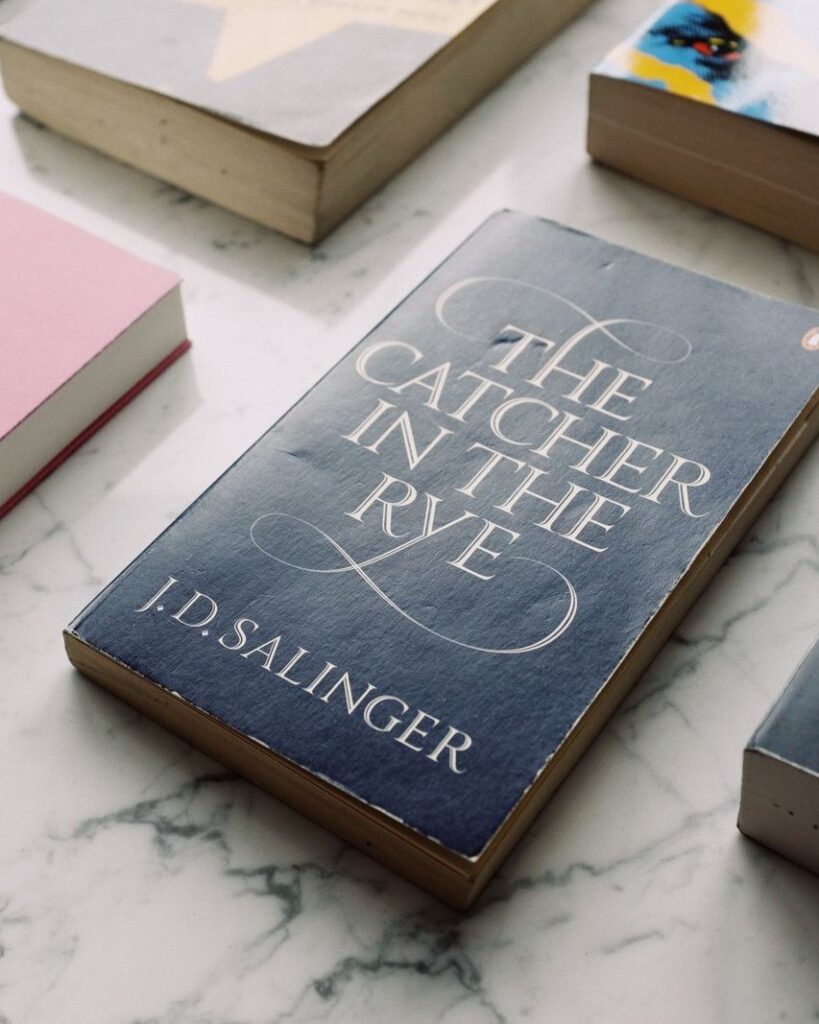
Author: J.D. Salinger · Published: 1951 · Genre: Literary fiction, Coming-of-age
The Catcher in the Rye spends a few days inside the head of Holden Caulfield, a sixteen-year-old who has just been kicked out of prep school and is quietly falling apart. The voice is brilliant, and the book is sadder than its rebellious reputation suggests. But Holden’s constant complaining wears thin for many adult readers. It’s worth reading once, ideally before you turn twenty-five.
What it’s about
Just before Christmas break, Holden is expelled from Pencey Prep, a boarding school in Pennsylvania, for failing most of his classes. Rather than go home early and face his parents, he leaves school at night and spends a few days drifting around New York City. He checks into a cheap hotel, tries to pick up women in bars, calls old acquaintances, goes on an awkward date with his sometime girlfriend Sally Hayes, and keeps circling back to the idea of seeing his ten-year-old sister, Phoebe. Along the way he chats with two nuns over breakfast, gets cheated by a hotel elevator operator named Maurice, and ends up on the couch of a former teacher, Mr. Antolini.
Holden tells the story some months later from a place in California where he has been sent to rest and recover. Underneath the wisecracks is grief. His younger brother Allie died of leukemia a few years earlier, and Holden has never come to terms with it. Once you notice how often Allie comes up, the whole book reads differently.
What works
- The voice. Holden’s slangy, repetitive narration sounds like a real teenager thinking out loud, complete with his favorite insult for almost everyone: phony. Salinger makes it look easy. A generation of imitators proved it isn’t.
- The loneliness. Holden keeps reaching for connection and then sabotaging it. His habit of asking cab drivers where the ducks in the Central Park lagoon go in winter is funny and heartbreaking at the same time.
- Phoebe. His little sister is the best character in the book: sharp, bossy and the one person who sees straight through him. Their scenes together give the novel its warmth and its most honest moments.
- The title. Holden misremembers a line from a Robert Burns poem and imagines himself standing at the edge of a cliff, catching children before they fall. It’s a clear, quiet image of a boy who wants to protect innocence because he couldn’t protect his brother.
The controversy
For decades, Catcher was one of the most frequently challenged and banned books in American schools and libraries. Objections focused on its profanity, its sexual references and a hero who drinks, smokes and lies. Supporters of the book have always countered that it shows those things honestly and without glamour.
It also picked up a darker association. Mark David Chapman was carrying a copy when he shot John Lennon in 1980. That says far more about Chapman than about the novel, but it has shadowed the book’s reputation ever since. Salinger, for his part, withdrew from public life and never allowed a film adaptation.
The literary criticism is more lasting. Many readers find Holden whiny, privileged and self-pitying, and argue the book mistakes adolescent moaning for insight. Others see a traumatized kid who needs help, which a careful reading makes plain. Both reactions are reasonable, and which one you have often depends on your age. The plot is also thin: almost nothing happens beyond a series of encounters, so if the voice doesn’t grab you, nothing else will.
Who should read it
Older teenagers and young adults will likely recognize themselves in Holden. Adult readers should approach it as a portrait of grief rather than a rebellion anthem. Anyone who can’t stand repetitive, unreliable narrators should skip it.
Rating: 3.5/5
Photo credits — Featured image: Photo by ready made on Pexels.
