

Author: Arthur Conan Doyle · Published: 1902 · Genre: Mystery, Classic Crime, Gothic
The Hound of the Baskervilles is the best of the four Sherlock Holmes novels and the easiest place to start. It pits a family curse and a spectral hound against Holmes’s cold logic, and its Dartmoor atmosphere is superb. It is more Gothic thriller than fair-play puzzle, and Holmes is missing for much of it, but it holds up remarkably well more than a century on.
What it’s about Dr James Mortimer, a country doctor from Devon, arrives at Baker Street with an old family manuscript. It tells of Hugo Baskerville, a wicked ancestor supposedly hunted down on the moor by a monstrous hound, and of a curse on his descendants. Mortimer’s friend Sir Charles Baskerville has just been found dead in the grounds of Baskerville Hall, his face twisted in terror. Near the body, Mortimer tells Holmes, he saw “the footprints of a gigantic hound”.
The heir, Sir Henry Baskerville, arrives from Canada. Within days in London he receives an anonymous warning pieced together from newspaper print, a boot goes missing from his hotel, and a bearded man in a cab seems to be following him. Holmes says he is too busy to leave London, so he sends Watson to Baskerville Hall with Sir Henry. There they find secretive servants, the Barrymores; curious neighbours; an escaped convict loose on the moor; and a deadly bog, the Grimpen Mire.
What works – Atmosphere. Doyle’s Dartmoor, with its fog, ancient stone huts and sucking mire, is one of the great settings in crime fiction. The book is genuinely eerie, and the howl across the moor at night still works. – Watson. With Holmes away, Watson carries the story through reports and diary entries. He is braver and sharper than the bumbling versions in older films, and his reports make the reader a fellow investigator. – Reason versus superstition. The core of the novel is the clash between a supernatural legend and Holmes’s insistence on a material explanation. Doyle keeps both possibilities alive for a long time. – Stacked mysteries. Doyle keeps adding oddities: a light signalling across the moor at night, a woman sobbing in the corridors of the Hall, a lone figure watching from a hilltop. Each one opens a new question, so the book rarely sags even when Holmes is away. – The London chapters. Holmes identifying the newspaper behind the warning from its typeface, and chasing a cab through the streets, are Holmes at his crispest and funniest.
What doesn’t Holmes is offstage for a large part of the middle. There is a reason for it, but the book loses energy without him. It is also not really a whodunit: attentive readers will identify the villain well before the end, and the climax depends more on action than on deduction. Some secondary characters are flat, a few of the villain’s arrangements look shaky under close inspection, and the treatment of the convict and of one local woman is very much of its time.
Some context helps. Doyle had killed Holmes off at the Reichenbach Falls in 1893. The Hound was serialised in The Strand Magazine from 1901 and set before that death, so it was not yet the full resurrection, which came in 1903 with “The Adventure of the Empty House”. Doyle credited his friend Bertram Fletcher Robinson with telling him the West Country legend that gave him the idea.
Who should read it New readers of Holmes, fans of Gothic atmosphere, and anyone who wants a mystery best read on a dark evening. If you want pure deduction, the short stories are sharper. If you want mood and menace, this is the one.
Rating: 4/5
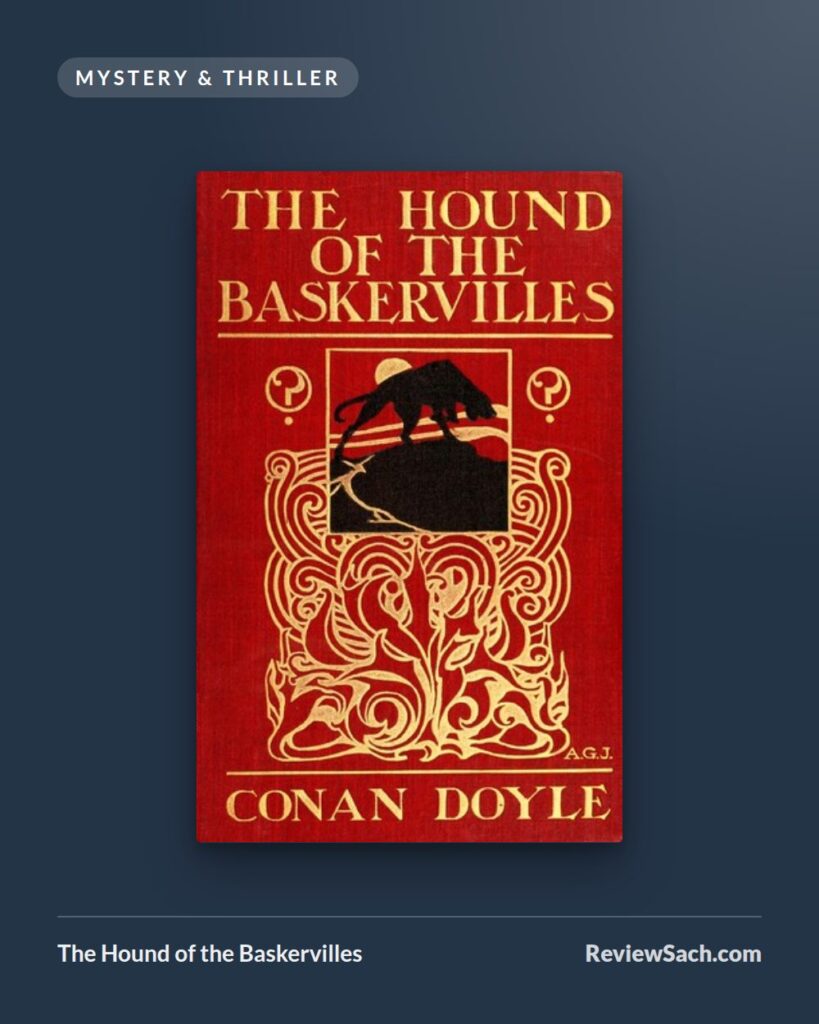
Image credits — Cover image via Open Library. Cover design © the publisher, shown for review purposes.
