

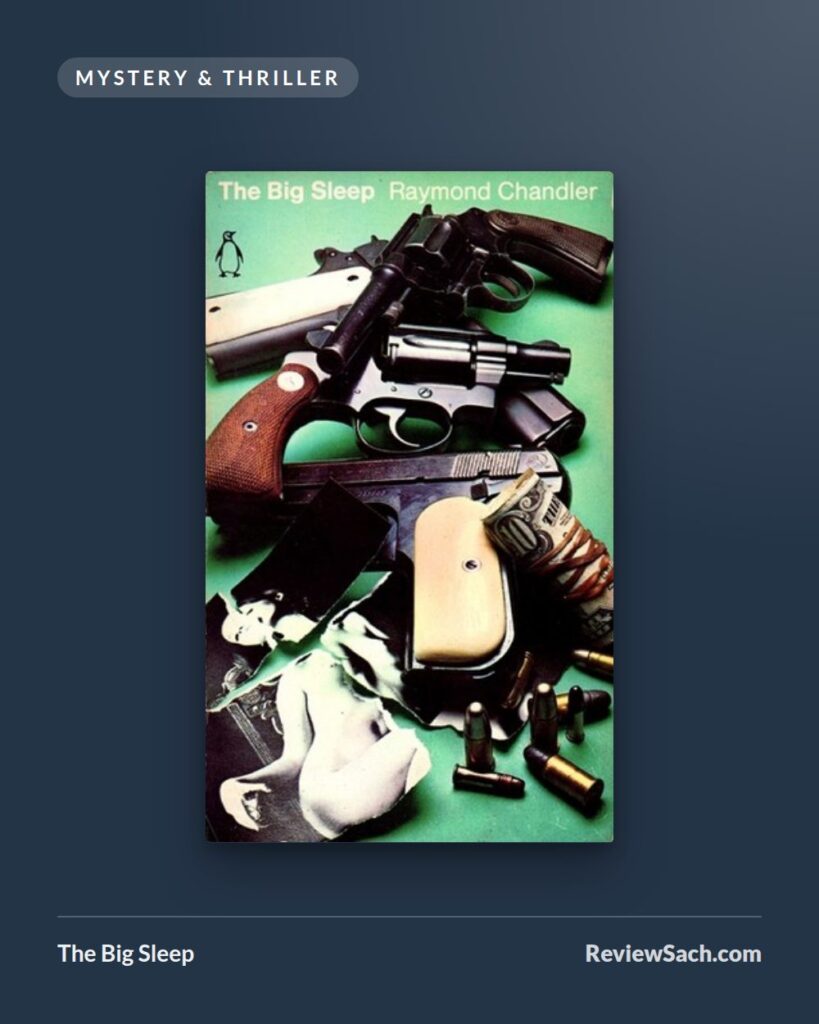
Author: Raymond Chandler · Published: 1939 · Genre: Hardboiled Crime, Noir
The Big Sleep is the first Philip Marlowe novel and the book that set the template for the wisecracking, world-weary private eye. Read it for the voice, the Los Angeles atmosphere and the similes, not for a tidy plot, because the plot is famously tangled. Its attitudes to women and gay men are dated and ugly, but anyone serious about crime fiction should read it.
What it’s about
Marlowe, a Los Angeles private detective, is summoned by General Sternwood, a dying millionaire who receives him in a steaming orchid greenhouse. The general is being squeezed over debts that his wild younger daughter, Carmen, has supposedly run up. The man holding the paper is Arthur Geiger, who runs a rare-book shop. The general would like the problem to go away quietly.
It doesn’t. The job pulls Marlowe into pornography rackets, gambling clubs and a string of killings. Hovering over everything is the general’s elder daughter, Vivian, and her missing husband, Rusty Regan, a former bootlegger the old man was fond of. Everyone assumes Marlowe has really been hired to find Regan. Marlowe isn’t sure himself.
What works
- The voice. Marlowe’s first-person narration is the reason the book lasts. The similes are funny and precise, the dialogue crackles, and the opening, with Marlowe dressed in his powder-blue suit to call on four million dollars, is one of the most famous in the genre.
- Los Angeles. Chandler’s city is rain-soaked, rich and rotten. Mansions sit on oil money, bookshops front for smut, and cops are tired and compromised. It reads like a report from a place that seduces and disappoints in equal measure.
- Marlowe’s code. He isn’t just tough. He is a knight in a dirty world who turns down money, sex and easy exits so he can finish a job decently. That loneliness gives the book its melancholy, and its closing pages, where the title’s meaning settles in, are genuinely moving.
- The supporting cast. Carmen and Vivian are unforgettable in very different ways, and even small parts, such as the gambler Eddie Mars or a sad small-time grifter named Harry Jones, are sketched vividly in a few lines.
- Economy. It’s short, and the scenes move fast. Chandler built it partly from his earlier pulp stories, and it keeps their energy while adding real literary polish.
What doesn’t
The plot doesn’t fully add up. When Howard Hawks was filming the 1946 adaptation with Humphrey Bogart and Lauren Bacall, the screenwriters reportedly asked Chandler who had killed the Sternwoods’ chauffeur, and Chandler later wrote that he didn’t know either. That loose end is real, and it isn’t the only one. If you need every thread tied off, you’ll be frustrated.
The book is also very much a product of 1939. Women are mostly temptresses or unstable, described with casual contempt. Gay characters are treated with open disgust and slurs. Some critics read Marlowe’s scorn as part of his defensive loneliness and the novel’s portrait of a sick city. To many modern readers, it’s simply prejudice, and it’s worth knowing before you start.
The pacing can also feel uneven today. Marlowe spends long stretches reacting to events rather than detecting, and the violence arrives in sudden bursts rather than building toward a clear solution.
Who should read it
Anyone who enjoys crime fiction, especially noir and private-eye stories, should read it once, if only to see where the tropes began. Writers will learn a lot from its style. Readers who want a fair-play puzzle, or who have no patience for period bigotry, should approach with caution. If you only know the Bogart film, expect a darker, seedier book: censorship forced the movie to soften much of what Chandler put on the page.
Rating: 4.5/5
Image credits — Cover image via Open Library. Cover design © the publisher, shown for review purposes.
