

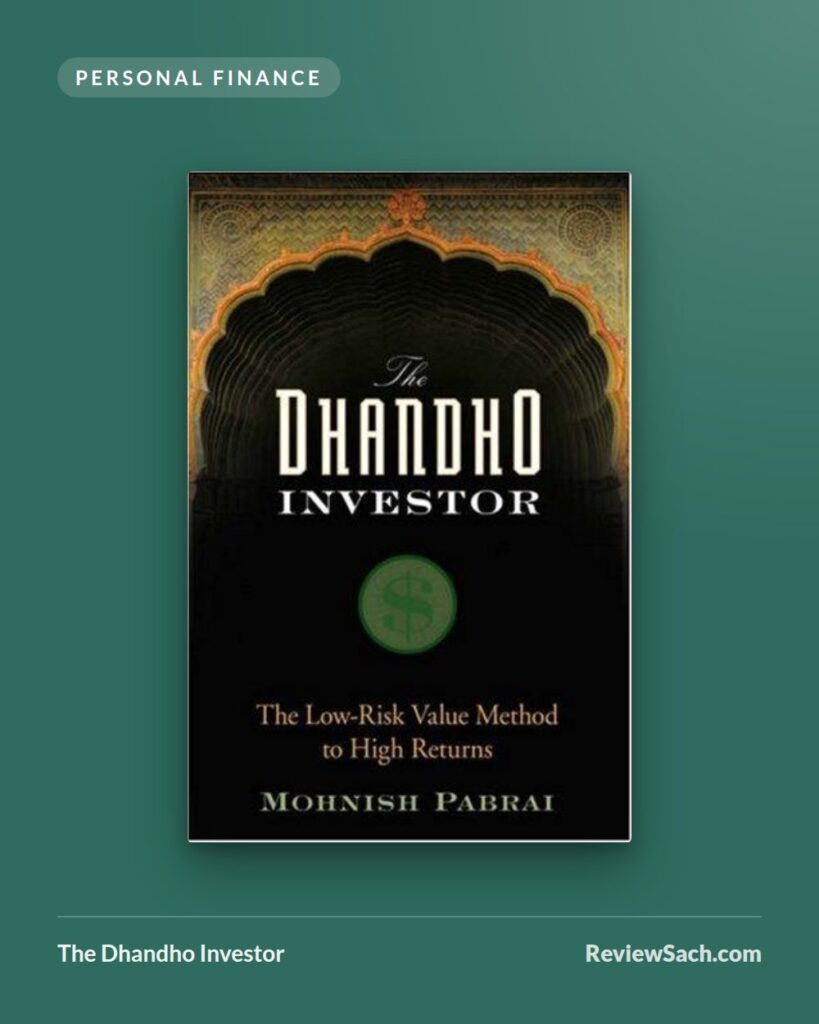
Author: Mohnish Pabrai · Published: 2007 · Genre: Investing, Business
The Dhandho Investor distils value investing into one memorable rule: look for bets where heads you win and tails you don’t lose much. Mohnish Pabrai’s short, lively book makes low-risk, high-return investing feel intuitive through vivid business stories. It is an excellent introduction to the value mindset, but its neat examples make investing look easier than it is.
The big idea
“Dhandho” is a Gujarati word for business; Pabrai translates it as endeavours that create wealth, and uses it to mean making money while taking minimal risk. He opens with the Patels, Gujarati families expelled from Uganda by Idi Amin in 1972. Some who reached the United States bought struggling motels cheaply, with small down payments, lived on the premises and did all the work as a family. Their low costs let them undercut rivals and still earn high returns, and Indian-American families went on to own a very large share of America’s motels.
From these stories he builds a nine-point framework: buy existing businesses; buy simple businesses in slow-changing industries; buy distressed businesses in distressed industries; look for durable moats; make few, big, infrequent bets; look for arbitrage; always insist on a margin of safety; seek low-risk, high-uncertainty situations; and copy proven ideas rather than innovate.
Pabrai, who built and sold his own IT company before running investment funds modelled on Warren Buffett’s early partnerships, writes as a practitioner rather than a theorist.
What works
- Risk versus uncertainty. Pabrai’s key insight is that markets often price uncertain situations as if they were risky. A business with a murky near-term outlook but little chance of permanent loss can be a bargain precisely because others fear it.
- Great stories. Richard Branson starting Virgin Atlantic with limited downside, and Lakshmi Mittal buying distressed steel mills, turn abstract principles into something you can picture.
- Copycat wisdom. His argument that cloning proven ideas beats original invention, with examples such as Sam Walton borrowing retail ideas from rivals, applies to business and investing alike.
- Patience. Pabrai stresses that great bets are rare, so the investor’s main job is to wait, keep cash ready and act decisively only when the odds are clearly favourable.
- Brevity. It is short and clear enough to finish in a sitting, which is rare for an investing book.
What doesn’t
The stories are chosen with hindsight. For every Patel motel or Mittal deal, many similar bets failed, and the book rarely examines them. That makes the framework look more reliable than it is.
The framework is also easier to apply to owning a small business than to buying shares. A motel owner controls costs and effort; a minority shareholder in a listed company controls neither, so the lopsided odds of the Patel story are much harder to find on the stock market than the book suggests.
Its use of the Kelly formula to size bets is also aggressive. Kelly assumes you know your odds, which stock investors rarely do, and betting heavily on a few ideas can produce brutal losses when your estimates are wrong. The danger proved real soon after publication: Pabrai’s own concentrated funds fell sharply in the 2008 crash. He argued at the time that his approach was sound, and long-term investors must be able to endure such drops, but the episode shows how different “tails, I don’t lose much” can feel in practice.
Who should read it
New value investors who want a lively, memorable framework, and entrepreneurs interested in low-risk ways to start or buy a business. Pair it with a proper book on valuation, and treat the bet-sizing advice with real caution. Experienced value investors will know most of the ideas already.
Rating: 3.5/5
Image credits — Cover image via Open Library. Cover design © the publisher, shown for review purposes.
