

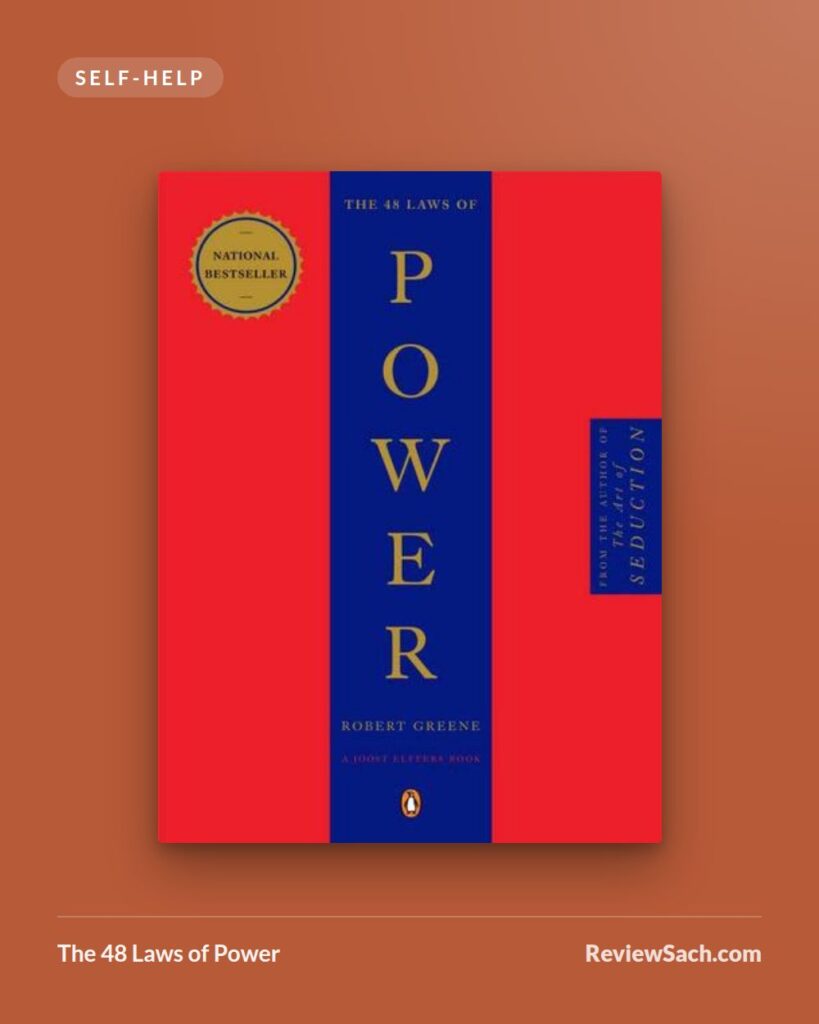
Author: Robert Greene · Published: 1998 · Genre: Self-Help, Strategy
The 48 Laws of Power argues that power runs on rules as old as royal courts, and that you will be played unless you learn them. It’s a gripping, beautifully packaged book full of historical stories. It’s also openly amoral, and treating it as a life manual can make you worse at relationships, not better. Read it to recognize manipulation, not to become a manipulator.
What it’s about
Greene, working with the book producer Joost Elffers, distills power into 48 laws, each illustrated with historical anecdotes. The first is “Never outshine the master.” Others advise concealing your intentions, saying less than necessary, and crushing your enemies completely.
Each law follows a similar pattern. Greene tells a story of someone who broke the law and paid for it, then one of someone who observed it and thrived, followed by an interpretation, practical keys and a “reversal” section on when the law doesn’t apply. The margins are packed with quotations and fables from sources such as Machiavelli, Sun Tzu, Baltasar Gracián and Aesop.
The best-known example comes early. Nicolas Fouquet, finance minister to Louis XIV, throws a spectacular party at his new château, Vaux-le-Vicomte, to impress the young king. Louis, feeling upstaged, has him arrested soon afterward, and Fouquet spends the rest of his life in prison. The lesson: never make your superiors feel inferior. It’s a vivid story, and it sets the tone for the whole book: power is dangerous, even when you mean well.
What works
- The stories. Greene is a gifted storyteller, and the anecdotes, ranging from Renaissance Italy to imperial China, are consistently entertaining.
- Pattern recognition. Many laws describe behavior everyone has seen: flatterers, credit-takers, bosses threatened by talented staff. Naming these patterns can help readers spot them at work and protect themselves.
- The reversals. Each law includes cases where it fails, which adds more nuance than its critics sometimes admit.
- Design. The format, with sidebars, fables and quotations, makes it easy to dip in and out rather than read front to back.
The controversy
This is one of the most divisive self-help books ever published. It has been banned in some American prisons, reportedly over concerns that it could help inmates manipulate staff or each other. It’s also hugely popular in hip-hop and business circles; Greene later co-wrote The 50th Law with the rapper 50 Cent.
Critics argue that it celebrates deception, treats every relationship as a contest and teaches readers to see friends and colleagues as pawns. Some laws, such as crushing enemies totally, would be destructive if applied to ordinary jobs, friendships or families. Historians also note that the anecdotes are selective and sometimes simplified to fit the rule they illustrate.
Defenders argue the book is descriptive: power games happen whether you approve of them or not, and it’s better to understand them than to be their victim. That’s a reasonable case, and the reversals support it. But the tone often reads as prescriptive, and the book rarely weighs the long-term cost of lost trust, which in most modern workplaces is the most valuable form of power there is.
Beyond the ethics, it’s long. After a dozen laws the formula feels mechanical, several laws overlap, and few readers will need all 48 to get the point.
Who should read it
Read it if you work in a highly political organization, or want to understand manipulative behavior you’ve run into. Read it with skepticism and a strong sense of your own values. If you want guidance on how to live well or build lasting trust, this is the wrong book.
Rating: 3.5/5
Image credits — Cover image via Open Library. Cover design © the publisher, shown for review purposes.
