

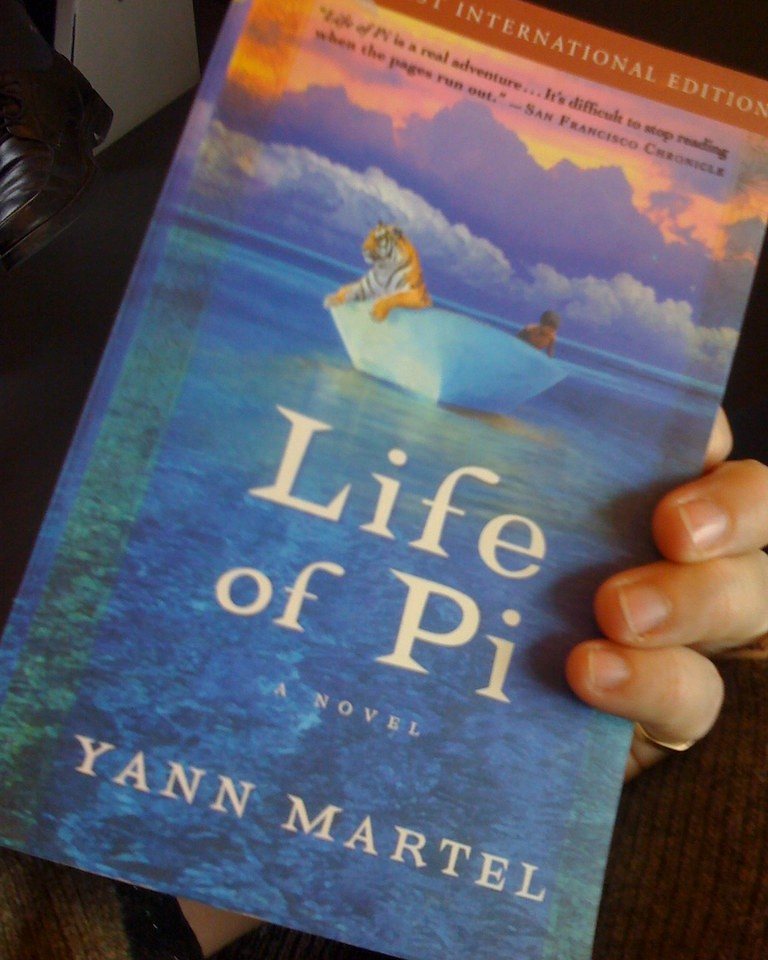
Author: Yann Martel · Published: 2001 · Genre: Literary fiction, Adventure
Life of Pi is a survival story about an Indian teenager adrift in the Pacific with a Bengal tiger, and a sly argument about why we choose the stories we believe. The middle section is gripping, and the ending makes you rethink everything before it. The opening third is slow, and some readers find the conclusion too clever by half. It’s worth reading, especially if you like novels that ask something of you.
What it’s about
Piscine Molitor Patel, named after a Paris swimming pool and known to everyone as Pi, grows up in Pondicherry, India, where his father runs a zoo. Curious and devout, Pi practices Hinduism, Christianity and Islam all at once, to the confusion of his family and of the religious leaders who each think he belongs to them.
When Pi is sixteen, his family sells the zoo and sets sail for Canada on a Japanese cargo ship, the Tsimtsum, carrying some of the animals with them. The ship sinks. Pi ends up in a lifeboat with a zebra with a broken leg, a hyena, an orangutan and a full-grown Bengal tiger named Richard Parker. For 227 days, he has to survive both the ocean and the tiger.
The book is framed as a story told to a writer who travels to India, where an old man promises him a story that will make him believe in God. The novel won the Booker Prize in 2002.
What works
- Richard Parker. The tiger is never cute. Martel’s knowledge of zoos makes the animal’s behavior specific and frightening, and the way Pi learns to control him, using a whistle, food, seasickness and the rules of territory, is ingenious.
- The survival detail. Solar stills, turtle blood, improvised fishing gear, careful rationing of biscuits and water: the practical problems of staying alive feel real and absorbing. Pi, a lifelong vegetarian, also has to learn to kill fish to survive, and Martel makes that small moral crisis land.
- The religion chapters. The scene in which a priest, an imam and a pandit all confront Pi and his parents at once, each outraged to learn he follows the others, is very funny and makes a serious point about faith and ownership.
- The ending. Without giving anything away, the final section changes how you read the whole book, and it’s designed to be argued about afterward.
What doesn’t
The first hundred pages are slow. The long passages on zoology and religion before the ship sinks are charming in places but test your patience, and some readers give up before Pi ever reaches the ocean.
The ending, admired by many, strikes others as a gimmick that turns a survival story into a philosophical puzzle with too tidy an answer. The book’s big promise, that it will make you believe in God, is also bolder than what it delivers. It makes a case for faith as a choice of the better story, which won’t persuade everyone.
There was also a dispute over its origins. In his author’s note, Martel thanks the Brazilian writer Moacyr Scliar for the spark of the idea. Scliar’s 1981 novella Max and the Cats also puts a boy in a boat with a big cat, and after the Booker win some critics accused Martel of borrowing the premise. Martel said he knew Scliar’s book only from a review and had never read it, and the two novels are very different in execution.
Who should read it
Readers who like adventure stories with ideas behind them, and book clubs looking for an ending to argue over. Ang Lee’s 2012 film is excellent, but read the book first.
Rating: 4/5
Photo credits — Featured image: Photo by SoniaT 360. via Flickr, CC BY 2.0, cropped.
