

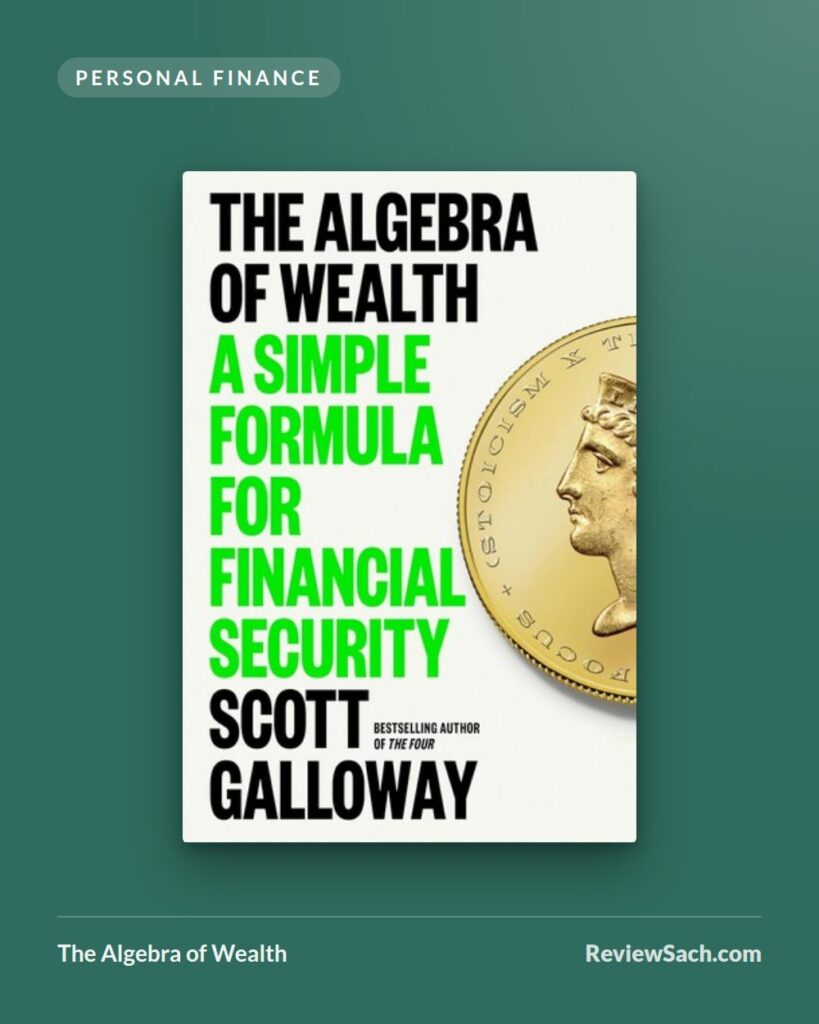
Author: Scott Galloway · Published: 2024 · Genre: Personal Finance, Careers
The Algebra of Wealth boils financial security down to one formula: focus plus stoicism, time and diversification. It is a punchy, opinionated guide aimed mainly at ambitious people in their twenties and thirties, and it is much stronger on career and mindset than on investing mechanics. Read it if you want a blunt push to earn more and spend less. Skip it if you already understand index funds and compounding.
The big idea
Galloway, an NYU business professor and serial entrepreneur, defines wealth as the absence of economic anxiety. His practical test is simple: you are rich when your passive income is greater than your spending, or “burn”. His father, living contentedly on an income that exceeds his modest costs, is the example. The goal is not a yacht. It is not having to worry.
The formula has four parts. Stoicism means building character and resisting the endless pressure to consume. Focus is about income: follow your talent rather than your passion, pick an industry that is growing, and accept that building a career takes years of intense work. Time is compounding, and the case for starting to invest early, however small the amounts. Diversification is his body armour against the one bad bet that wipes you out.
What works
- Talent over passion. The most useful idea in the book is that passion often follows mastery, not the other way round. Galloway argues that the rewards of being good at something, such as money, respect and camaraderie, are what make people love their work.
- Honesty about luck. He is frank that timing and privilege helped him, joking that his smartest move was being born a white man in California in the 1960s. That candour makes the tough-love advice easier to take.
- Clear warnings. He is blunt about day trading, which he treats as gambling with worse odds, and about piling into hyped assets after the crowd has already arrived. The advice to go against the herd is simple and sound.
- Location as a money decision. He urges readers to treat where they live as a financial choice, since the city you pick shapes your pay, your costs, your tax bill and your career network. Few personal finance books give this much weight to such a big lever.
- Pace. Short sections, sharp lines and a conversational tone make it quick to read. It feels like a good lecture from a professor who enjoys provoking his students.
What doesn’t
The investing sections are thin. Readers who want real detail on asset allocation, tax-advantaged accounts or how to draw down savings will need another book, and some technical terms appear with little explanation. Reviewers who noticed this were right: it is better as a mindset book than a financial plan.
The career advice also leans heavily towards high-earning, big-city professional paths. Critics have pointed out that careers such as teaching or public service barely feature, and some of his advice about choosing relationships that serve your ambitions struck reviewers as coldly transactional. If your goals are modest or your work is a vocation, parts of the book will feel like they were written for someone else.
Finally, the formula is more slogan than algebra. Many of its lessons, such as spending less than you earn and starting early, are familiar from Morgan Housel or JL Collins, just delivered with more swagger. The swagger is entertaining, but it can make ordinary advice sound more original than it is. Readers who dislike Galloway’s persona from his podcasts and newsletter will not be won over here.
Who should read it
Graduates and early-career professionals who want a motivating, no-nonsense overview of how careers, habits and money connect. It also makes a good graduation gift. Experienced investors, and anyone looking for a detailed financial plan, can safely pass.
Rating: 3.5/5
Image credits — Cover image via Open Library. Cover design © the publisher, shown for review purposes.
