

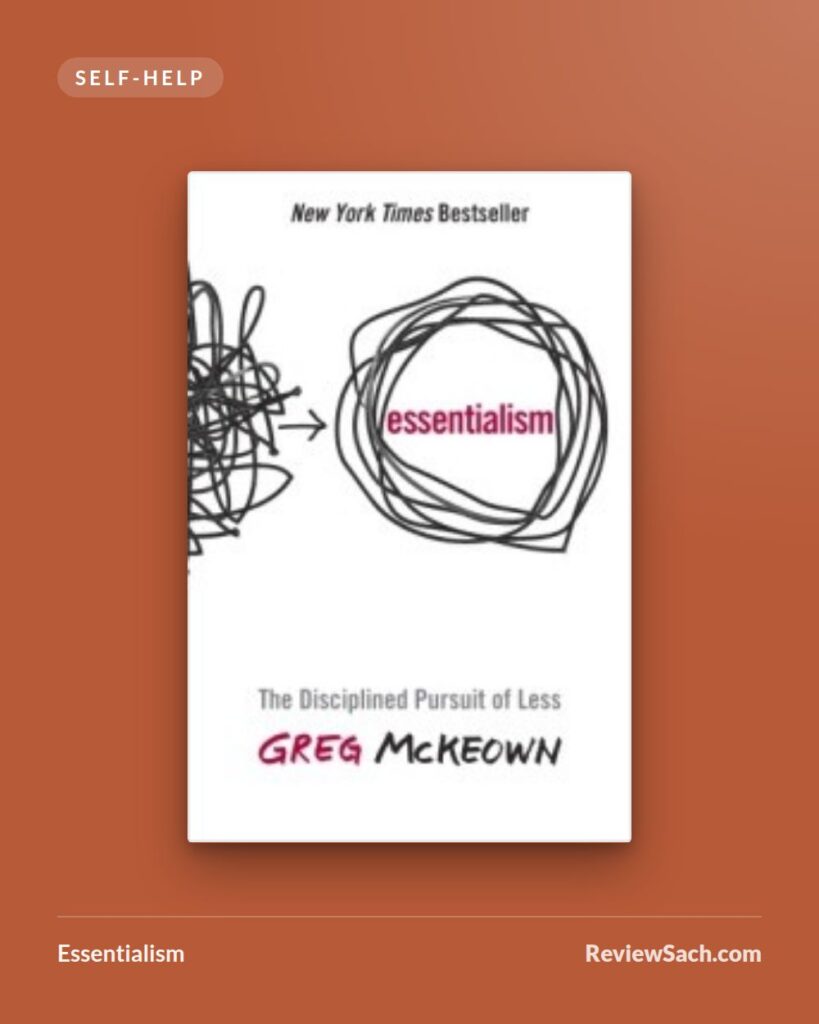
Author: Greg McKeown · Published: 2014 · Genre: Self-Help, Productivity
Essentialism: The Disciplined Pursuit of Less argues that you can’t do everything, so you should find the few things that really matter and cut the rest. It’s a clear, persuasive book that gives overcommitted people both permission and tools to say no. It suits professionals drowning in requests. Its weakness is repetition, and an assumption that readers have more control over their time than many do.
The big idea
McKeown opens with a personal failure. The day after his daughter was born, he left the hospital to attend a client meeting because a colleague asked him to, thinking the client would respect the sacrifice. The client didn’t, and the meeting turned out to be unimportant. His lesson: if you don’t prioritize your life, someone else will.
He contrasts two mindsets. The nonessentialist believes everything is important and ends up spread thin, making tiny progress in many directions at once. The essentialist accepts trade-offs and asks which problem they want, not how to do it all. His motto, borrowed from designer Dieter Rams, is less but better.
He also describes the paradox of success. Clarity of purpose leads to success, success brings more options and requests, those options scatter your effort, and eventually they undermine the clarity that got you there.
The book is organized in three stages: explore what’s essential, eliminate what isn’t, and execute so that doing the essential becomes easy. The explore section argues for deliberately making space to think, including time away from devices, time to play and enough sleep, all treated as the groundwork for good choices rather than luxuries. The execute section leans on routines and small wins, so the essential becomes the default and takes less willpower.
What works
- The 90 percent rule. When deciding on an opportunity, score it against your most important criterion. Anything below 90 counts as a zero. It’s a simple filter against lukewarm commitments.
- Graceful no. McKeown gives practical ways to decline without damaging relationships, such as saying you’ll check your calendar, suggesting someone else, or offering a smaller version of what’s asked. He stresses that a clear no earns more respect over time than a vague yes.
- Uncommit. He tackles sunk-cost thinking head on: ask whether you’d take on a project today if you weren’t already in it, and if not, get out. Like an editor, cut the good to make room for the great.
- Protect the asset. He treats sleep and rest as tools for your best work, not rewards for finishing it, which is a welcome correction to hustle culture.
- Buffers. Planning for things to take longer than expected, and adding extra time on purpose, is plain advice that most people ignore.
What doesn’t
The book is repetitive. Its core idea is simple, and many chapters restate it with a new example rather than adding something new. A long essay could carry most of the argument, which is an awkward flaw in a book about cutting everything nonessential.
It also assumes a lot of freedom. Saying no to your boss, choosing your projects and protecting large blocks of time are easier for consultants and executives than for shift workers or junior staff. McKeown suggests asking managers to help you prioritize, but not everyone has a manager who will listen.
Much of the evidence is anecdotal, drawn from successful people and companies, and the ideas overlap heavily with The 7 Habits and other books about priorities. Readers familiar with the genre will recognize a lot.
Who should read it
Read it if you say yes to everything and feel busy but unproductive. Pair it with Getting Things Done: McKeown helps you decide what matters, and Allen helps you manage the rest.
Rating: 4/5
Image credits — Cover image via Open Library. Cover design © the publisher, shown for review purposes.
