

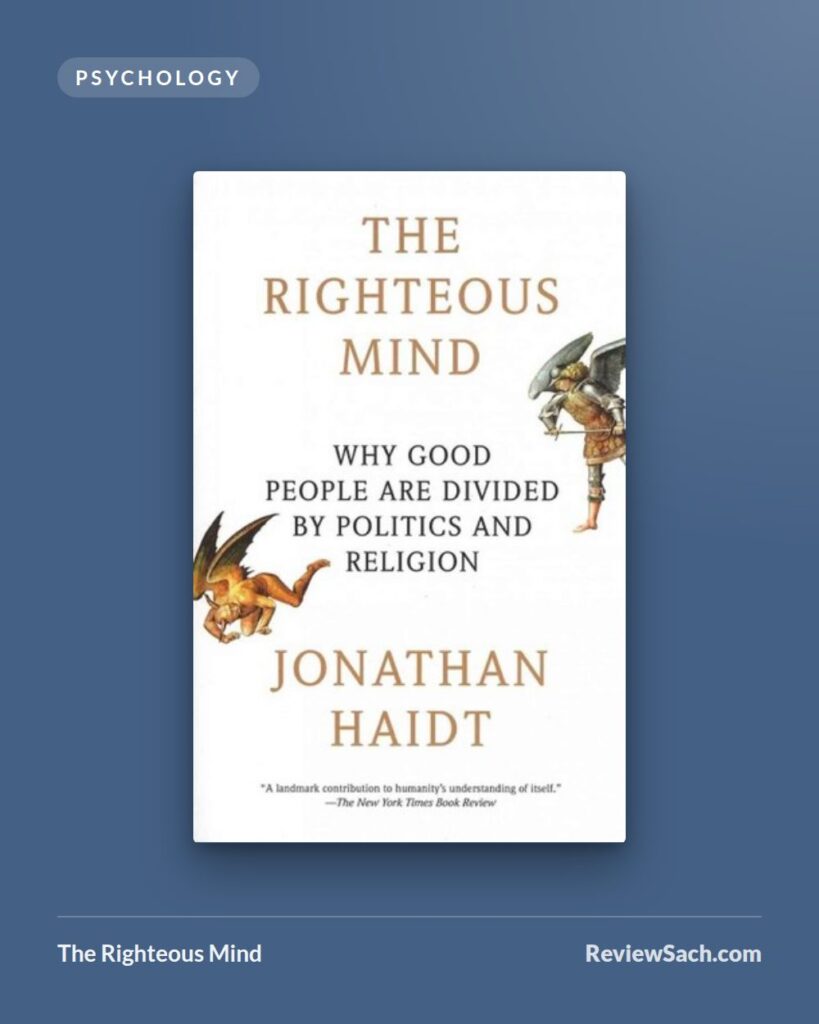
Author: Jonathan Haidt · Published: 2012 · Genre: Psychology, Moral Psychology, Politics
The Righteous Mind argues that moral judgments come mostly from gut intuition, with reasoning arriving afterward to justify them, and that liberals and conservatives rely on different sets of moral intuitions. It is a genuinely illuminating book for anyone baffled by people on the other side of politics. Some of its science is debated, but the framework is well worth having.
The big idea
Haidt, a social psychologist, builds the book around three principles, one for each of its three parts.
First, intuitions come first and strategic reasoning second. His image is an elephant and its rider: the rider, reasoning, thinks it is in charge but mostly serves the elephant, intuition, acting more like a press secretary than a judge. He shows this with scenarios designed to feel wrong without causing harm to anyone, such as a family that eats its pet dog after it is killed by a car. People condemn it instantly, then struggle to explain why.
Second, there is more to morality than harm and fairness. Haidt’s moral foundations theory proposes several intuitive foundations: care, fairness, loyalty, authority, sanctity and, added in this book, liberty. His surveys suggest American liberals rely mainly on care and fairness, while conservatives draw on all of them more evenly.
Third, morality binds and blinds. Humans evolved to form cohesive groups, which makes us cooperative inside the team and hostile or blind toward outsiders. He sums up human nature as 90 percent chimp and 10 percent bee: mostly selfish, but capable of losing ourselves in a group.
What works
- It explains the other side. The book’s best argument is that conservatives aren’t simply less moral or less intelligent; they value things like loyalty and sanctity that liberal frameworks tend to ignore. Haidt says he began the research as a committed liberal, which gives the argument credibility with readers on the left.
- Memorable research. The harmless-taboo scenarios, and his finding that people hold firm moral views they can’t justify, which he calls moral dumbfounding, are vivid and easy to discuss over dinner.
- Cross-cultural perspective. His time doing research in India and his discussion of WEIRD societies (Western, educated, industrialized, rich and democratic) show how unusual the individualistic morality of Western college students is.
- Readable structure. Each chapter ends with a clear summary, which makes a complex argument easy to follow.
What doesn’t
The theory has serious critics. Some researchers argue the list of foundations is somewhat arbitrary, and that the questionnaire used to measure them does not consistently produce the same distinct factors across cultures. Others propose that most moral judgments come down to perceived harm, which would undercut the idea of separate foundations altogether.
The evolutionary argument in the final part relies on group selection, the idea that natural selection acted on competing groups as well as on individuals. That idea remains contested among evolutionary biologists, and Haidt presents it with more confidence than the field supports.
Some readers also find the politics uneven. Haidt is sharper on liberal blind spots than conservative ones, and his claim that conservatives have a broader moral palette can read as a compliment rather than a neutral finding. The heavy focus on American politics of the early 2010s also dates some sections.
The religion chapters are less developed than the politics ones, and the argument that religion is mainly a group-binding adaptation will satisfy neither many believers nor many scholars of religion. And readers hoping for concrete advice on bridging political divides will find only a few pages of it at the very end.
Who should read it
Anyone who wants to understand political polarization, argue more productively or simply make sense of relatives with different views. It pairs well with Kahneman’s work on intuition.
Rating: 4/5
Image credits — Cover image via Open Library. Cover design © the publisher, shown for review purposes.
