

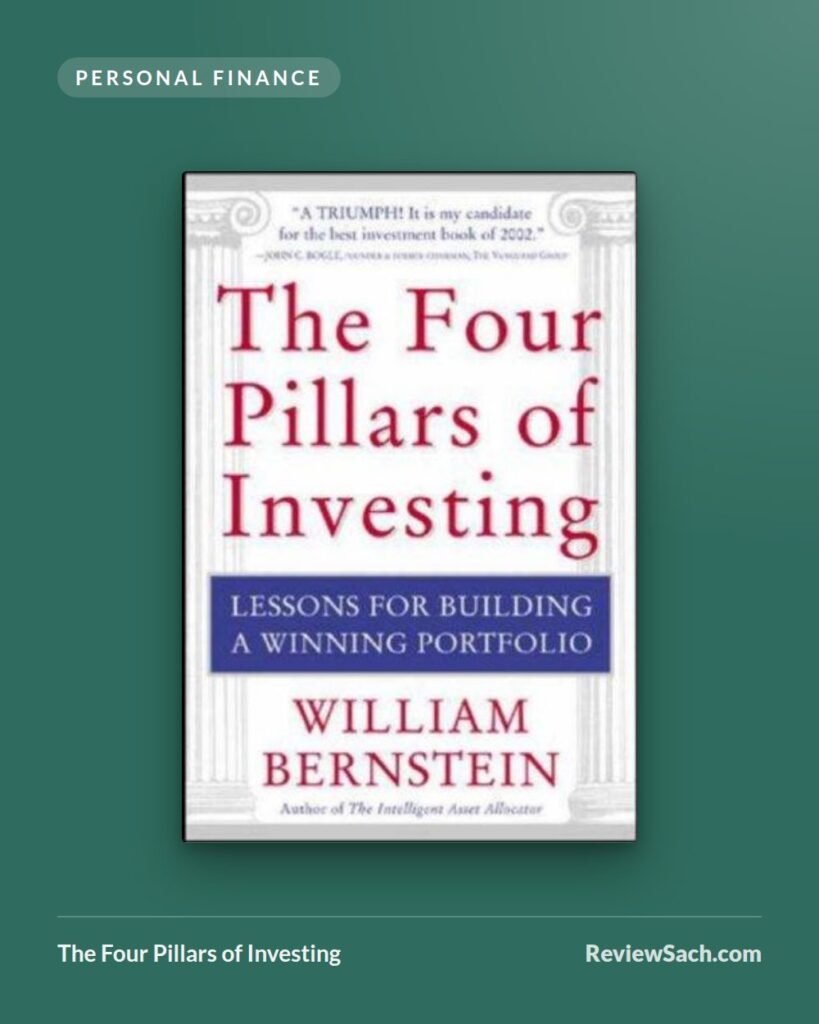
Author: William J. Bernstein · Published: 2002 · Genre: Personal Finance, Investing
The Four Pillars of Investing argues that successful investors need four kinds of knowledge: the theory of risk and return, the history of markets, the psychology of their own mistakes, and how the financial industry really works. Master those, and a sensible portfolio of low-cost index funds follows naturally. It is one of the most intelligent investing books written for individuals, though it asks more of the reader than most.
The big idea
Bernstein, a neurologist who became a financial theorist and adviser, builds his case one pillar at a time.
Theory teaches that risk and return are inseparable: high expected returns exist only because investors must bear the risk of painful losses. He shows how to estimate long-run returns from dividends and their growth, and why spreading money across different asset classes matters.
History shows that markets swing between manias and panics, from Britain’s railway boom in the 1840s to the late-1990s technology bubble. The lesson is that low prices point to higher future returns, and that euphoria is the time to worry.
Psychology covers overconfidence, herd behaviour and the urge to chase recent winners, and argues that investors are usually their own worst enemies. Drawing on behavioural finance, he shows how people misjudge probabilities, extrapolate recent trends and feel losses far more sharply than equal gains.
Business describes brokers, fund companies and the financial media as largely working against the investor’s interests, through fees, conflicts and hype.
He finishes with model portfolios for different situations, built mostly from index funds covering US and foreign stocks and high-quality bonds.
What works
- The history pillar is superb. Bernstein is a gifted storyteller of financial disasters. His accounts of past bubbles make the case for humility better than any chart or formula, and they show how sensible people get swept up when everyone around them seems to be getting rich.
- Honesty about risk. He refuses to pretend that stocks are safe if you just hold them long enough. Their higher returns, he explains, are compensation for real losses that will eventually come.
- Clear-eyed about the industry. The business pillar is a sharp guide to conflicts of interest, from commission-driven brokers to fund marketing. It helps readers see why cheap, simple products usually win.
- Integrated thinking. Most investing books cover one of these areas. Bernstein ties them together, showing how theory, history and psychology each point to the same practical plan.
What doesn’t
It is demanding. The theory chapters use concepts such as standard deviation, correlation and expected-return calculations that will lose readers without some comfort with numbers. Beginners may find it too technical, and some reviewers say it gives active management too little credit.
The original portfolios also tilted towards small-company and value stocks and included narrower asset classes. Whether such tilts reliably pay off is still debated, and they add complexity a beginner may not need. Readers of the 2002 edition should treat the specific allocations as illustrations rather than instructions.
The book assumes a US reader, with American tax accounts and fund examples, though the principles travel well. Its structure also means some repetition, since the four pillars keep arriving at the same destination: diversify, keep costs low and stay the course.
A second edition, published in 2023, updates the history and data for two decades of new crises and bubbles. Anyone starting now should choose it over the original.
Who should read it
Serious do-it-yourself investors who want to understand why index investing works, not just be told that it does. If you want a quick plan, read Bogle or Collins; if you want the full education, read this.
Rating: 4.5/5
Image credits — Cover image via Open Library. Cover design © the publisher, shown for review purposes.
