

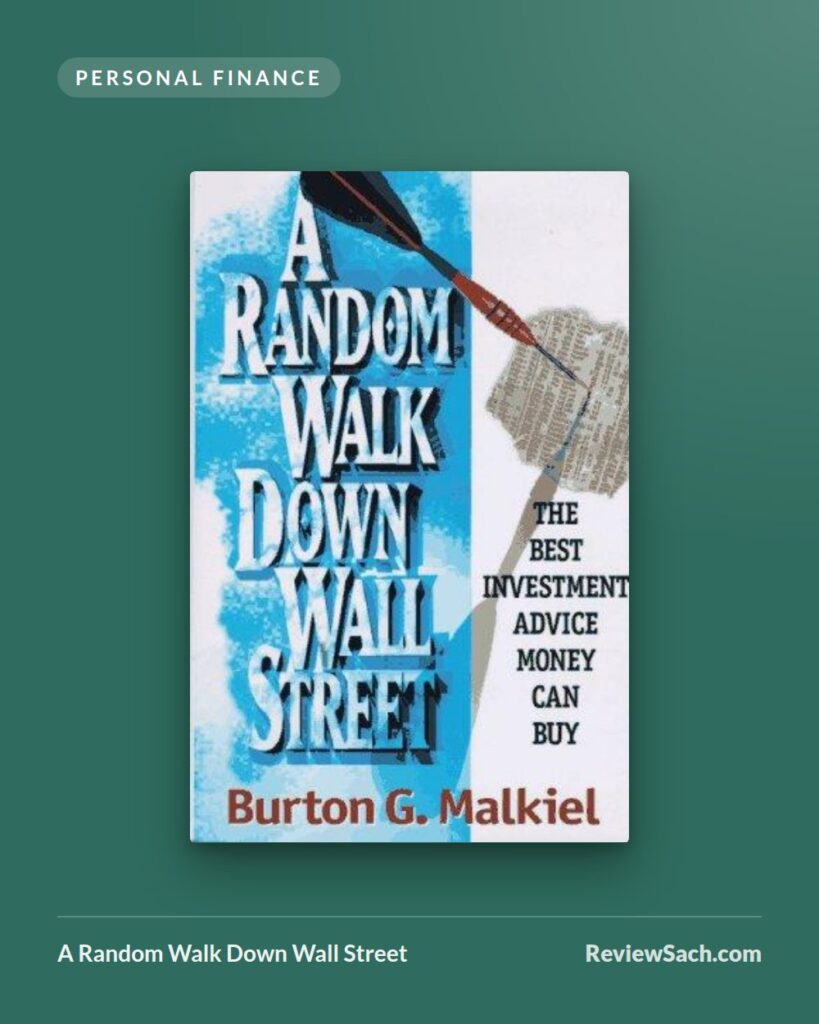
Author: Burton G. Malkiel · Published: 1973 · Genre: Personal Finance, Investing
A Random Walk Down Wall Street argues that stock prices move so unpredictably that neither chart readers nor most professional stock pickers can reliably beat the market. The practical conclusion is to buy a low-cost index fund and hold it. The book is witty, well sourced and still one of the most persuasive investing books in print. Its length is the main hurdle.
The big idea
Malkiel, a Princeton economist, starts with two old theories of what a stock is worth. The firm-foundation theory says an asset has an intrinsic value based on its future earnings and dividends. The castle-in-the-air theory says price depends on what someone else will pay, so the trick is to anticipate crowd psychology. Both have been used to justify great fortunes and great disasters.
He then tests the tools investors use. Technical analysis, reading patterns in price charts, fares worst: past price movements don’t predict future ones in any way you can profit from after costs. Fundamental analysis is better in principle, but analysts’ forecasts are often wrong, and the information they rely on is quickly reflected in prices. Actively managed funds that shine in one period often lag in the next. His best-known claim is that a blindfolded monkey throwing darts at the stock listings could pick a portfolio that does about as well as the experts’.
The answer, which he was pushing in 1973 before a retail index fund existed, is to own the whole market cheaply.
What works
- The history of bubbles. Malkiel’s tour through tulip mania, the South Sea Bubble, the go-go growth stocks of the 1960s, the dot-com crash and more is lively and genuinely useful. Seeing the same story repeat in new costumes is the best inoculation against the next one.
- Fair treatment of critics. Later editions give real space to behavioural finance and to research suggesting that some patterns, such as momentum and value effects, persist. Malkiel’s reply, that these edges are small, unreliable and tend to shrink once published, is argued rather than asserted.
- Plain-English theory. Malkiel explains ideas such as the efficient-market hypothesis, beta and modern portfolio theory without equations getting in the way, and with enough dry humour to keep a non-specialist reading.
- Practical guidance. The final section covers saving, asset allocation by life stage, rebalancing and fees, turning the theory into a plan most people could follow. His emphasis on keeping costs low is simple, and for most readers it will matter more than any clever strategy.
What doesn’t
The book is long, and decades of revision show. A thirteenth edition marked the book’s fiftieth anniversary in 2023, and each round has bolted on new material, from the 2008 crisis to cryptocurrencies. Some chapters feel crowded, and the thread can get lost.
The efficient-market case is also more contested than a casual reader might realise. Behavioural economists argue that markets can stay badly mispriced for years, as the bubbles in Malkiel’s own history show. He handles this by saying mispricing is hard to exploit, not that it never happens. That is a sound position, but a subtler one than the dartboard monkey suggests.
Some of the life-cycle advice and fund suggestions are US-specific and date quickly between editions. Readers elsewhere will need to translate account types and tax rules into local equivalents.
Who should read it
Anyone deciding between picking stocks, paying a fund manager or buying an index fund, and anyone who suspects the financial media is mostly noise. If you want the same argument in far fewer pages, Bogle’s The Little Book of Common Sense Investing is the shorter route; if you want to understand why the argument holds, read this.
Rating: 4.5/5
Image credits — Cover image via Open Library. Cover design © the publisher, shown for review purposes.
