

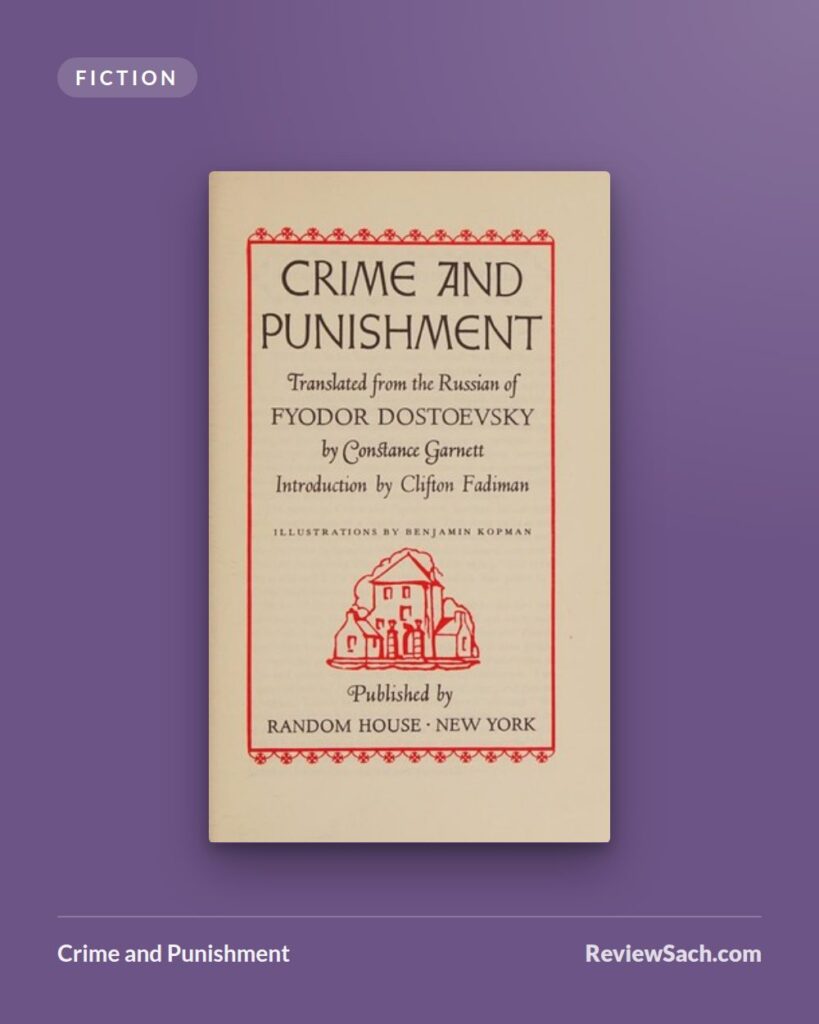
Author: Fyodor Dostoevsky · Published: 1866 · Genre: Psychological fiction, Classic · Original title: Prestupleniye i nakazaniye
Crime and Punishment tells you who the murderer is before the murder even happens, and it is still one of the most gripping novels ever written. It’s a psychological thriller, a philosophical argument and a portrait of big-city poverty all at once. It is long, feverish and sometimes melodramatic. If you read one Russian novel, make it this one.
What it’s about
Rodion Raskolnikov is a former student living in a tiny, stifling rented room in St. Petersburg. He is broke, proud and half sick. He has written an article arguing that a few extraordinary people, like Napoleon, have the right to step over moral law for the sake of a higher purpose. To test himself against that theory, he murders an old pawnbroker, Alyona Ivanovna, whom he considers a parasite. Her gentle half-sister Lizaveta walks in during the crime, and he kills her too.
The rest of the novel isn’t really about whether he’ll be caught. It’s about whether he can live with what he has done. Raskolnikov spirals into fever and paranoia while circling the people around him: his loyal friend Razumikhin; his mother and his sister Dunya, who has agreed to marry a smug lawyer named Luzhin to help the family; the drunken ex-clerk Marmeladov and his daughter Sonya, who has been driven into prostitution to feed her family; and Porfiry Petrovich, the investigator who seems to know more than he lets on.
What works
- The psychology. Dostoevsky gets inside a mind under pressure better than almost any writer before or since. Raskolnikov’s swings between arrogance, terror, pity and self-disgust feel uncomfortably real.
- Porfiry. The cat-and-mouse conversations between Raskolnikov and the investigator are superb. Porfiry never raises his voice, yet every friendly chat tightens the net. The creators of the TV detective Columbo have cited him as an inspiration, and you can see why.
- Sonya. Her quiet faith and suffering give the book its moral center. The scene where she reads Raskolnikov the Gospel story of the raising of Lazarus is one of the most powerful in the novel.
- The city. The novel opens in the stifling heat of a St. Petersburg July, among taverns, dusty stairwells and crowded tenements. Poverty here isn’t a backdrop but a pressure that pushes every character toward desperate choices.
- Svidrigailov. Dunya’s former employer, a sinister and oddly charming man, works as Raskolnikov’s dark mirror: a picture of what he might become if he stopped feeling guilty.
What doesn’t
The epilogue is the most common complaint. It resolves Raskolnikov’s story quickly and in a spiritual register that many readers find rushed after hundreds of pages of close psychological realism.
Sonya is also idealized. She is more saint than person, the familiar figure of the pure, suffering woman, and her inner life gets far less attention than the men’s.
The pacing is uneven. Long, feverish monologues, crowded family scenes and convenient coincidences pile up, especially in the middle, and characters keep overhearing crucial conversations through thin walls. The novel first ran as a serial in the magazine The Russian Messenger across 1866, and it shows in its cliffhangers and loose threads.
Finally, translation matters. Older versions can smooth out Dostoevsky’s rough, nervous energy. Richard Pevear and Larissa Volokhonsky’s 1992 translation is a popular choice for keeping that edge.
Who should read it
Anyone who likes crime fiction and wants to see where the psychological thriller came from, and anyone curious about Russian literature. Set aside real time: it runs to more than 500 pages and rewards slow, attentive reading. If you enjoy it, The Brothers Karamazov is the natural next step.
Rating: 5/5
Image credits — Cover image via Open Library. Cover design © the publisher, shown for review purposes.
