

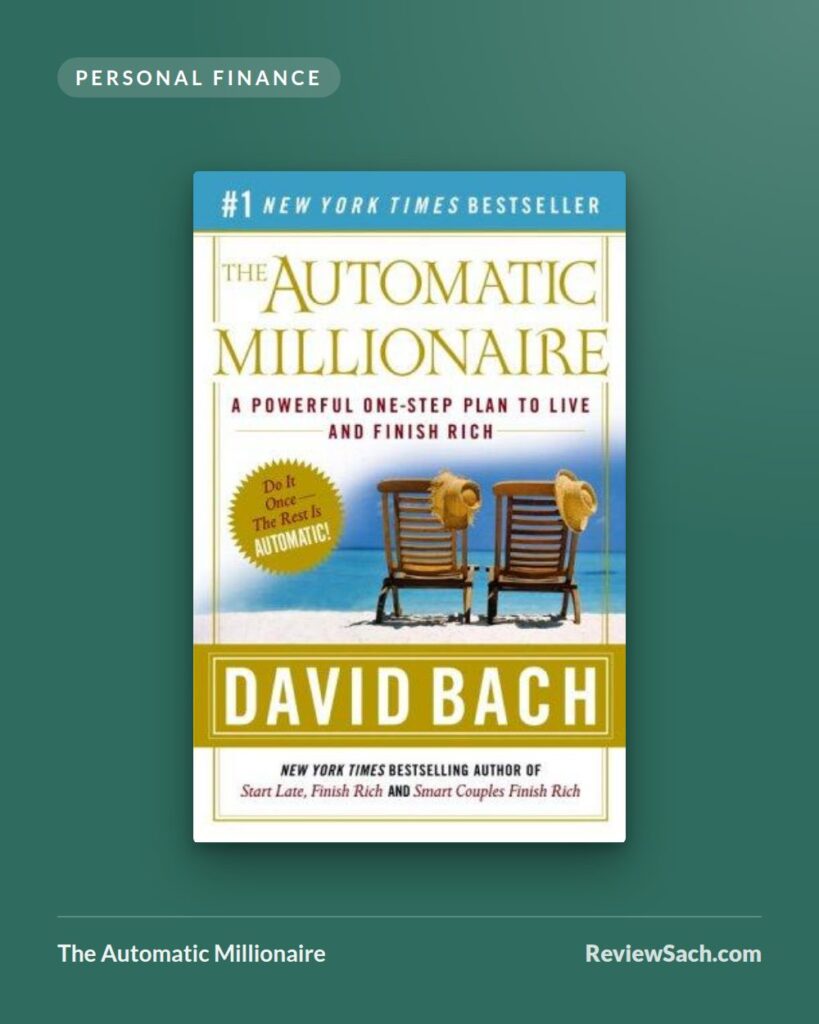
Author: David Bach · Published: 2004 · Genre: Personal Finance, Saving
The Automatic Millionaire argues that you don’t need a budget or iron willpower to build wealth, only a system that moves money into savings and investments before you can spend it. That core idea is excellent, and the book explains it quickly. The trouble is what surrounds it: rosy return assumptions, the much-criticised latte factor and housing advice that aged badly. Take the system and leave the rest.
The big idea
Bach, a former financial adviser, pitches the book at people who hate thinking about money. He frames it around a couple he calls Jim and Sue McIntyre, who he says became millionaires on ordinary middle-class incomes. Their secret, in his telling, was not a high salary but a plan they never had to think about.
The plan has a handful of steps. Pay yourself first, aiming for the equivalent of an hour’s pay each working day, or roughly 10% to 15% of gross income. Make it automatic, through payroll deductions into retirement accounts and scheduled transfers. Build an emergency fund, also automatically. Buy a home rather than renting, and pay the mortgage down faster with biweekly payments. Automate debt repayment and charitable giving too.
The latte factor is his tool for finding the money. Small daily purchases, such as coffees and snacks, add up; invested instead over decades, he argues, they could grow into a large sum.
What works
- Automation is the right answer. Bach helped popularise the idea that setting up transfers once beats relying on discipline every month. Many later books, including Ramit Sethi’s, build on the same insight.
- Pay yourself first. Treating savings as the first bill rather than whatever is left at the end of the month is simple and effective.
- Short and readable. The book can be finished in an evening, and each chapter ends with clear action steps. For someone who has never saved, that low barrier matters.
The controversy
The latte factor is one of the most disputed ideas in popular personal finance. Critics, notably the journalist Helaine Olen in Pound Foolish, argue that Bach’s calculations rely on double-digit assumed returns, ignore inflation and taxes, and so exaggerate what small savings can become. Olen also argues that household financial strain is driven far more by housing, health care, education, job loss and medical bills than by coffee. Ramit Sethi and others have made a similar point: focus on the big wins, not small pleasures.
Bach’s defenders say the latte is a metaphor for mindless spending, not a literal villain, and that noticing small leaks is a useful habit. That is fair, but the book presents its maths as if it were a realistic forecast.
The housing chapter is the other weak spot. Published in 2004, near the height of the US housing boom, it presents home ownership as close to a sure path to wealth. The crash a few years later showed that buying at the wrong time, or with too much debt, can be very costly. Renting and investing the difference can work just as well, depending on prices and circumstances.
The McIntyres’ story is also inspirational rather than evidential. One couple’s success shows what is possible, not what is typical, and readers have no way to check the details. The investing guidance is also thin: the book cares far more about getting money moving than about explaining what it should be invested in, or at what cost.
Who should read it
Someone who has never saved and wants a simple, low-effort first step. Readers who already know the basics should skip it and go straight to Sethi or Bogle.
Rating: 3/5
Image credits — Cover image via Open Library. Cover design © the publisher, shown for review purposes.
