

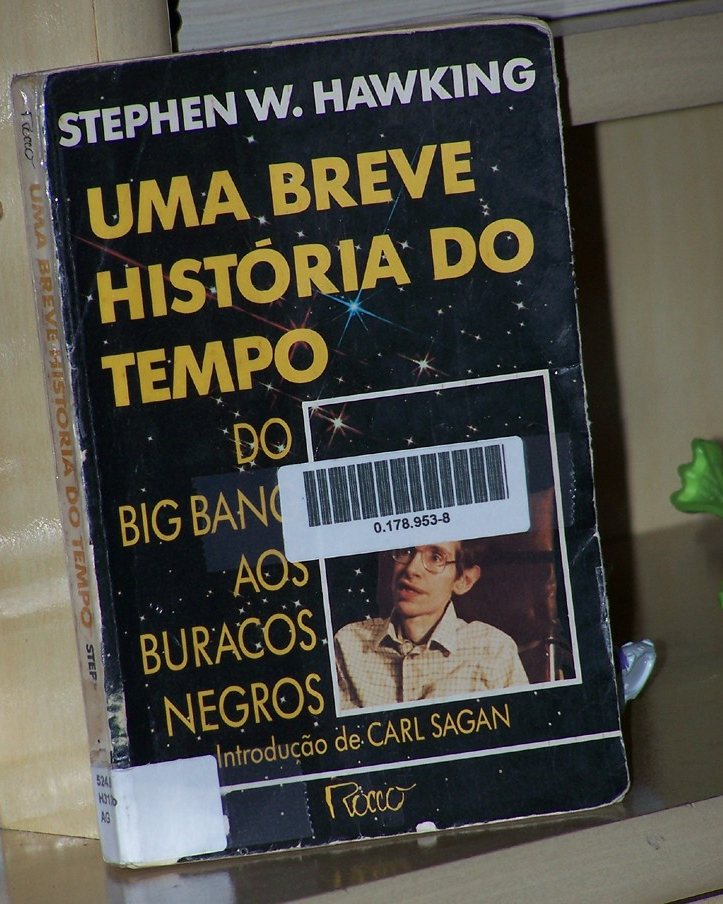
Author: Stephen Hawking · Published: 1988 · Genre: Science, Cosmology
A Brief History of Time‘s biggest strength is its ambition: with almost no math, Hawking takes you from Aristotle to black holes to the question of whether the universe needs a beginning at all. Its biggest weakness is that the middle chapters, on particles, forces and imaginary time, are far harder than the friendly opening suggests, and many readers stall there. Read it if you want the big picture of modern cosmology from someone who helped shape it, and you don’t mind rereading a few pages.
The core ideas
- Space and time are not a fixed stage. Hawking explains how Einstein’s relativity replaced absolute time and recast gravity as the curvature of spacetime, and how Hubble’s discovery that galaxies are moving apart points back to a hot, dense beginning, the Big Bang.
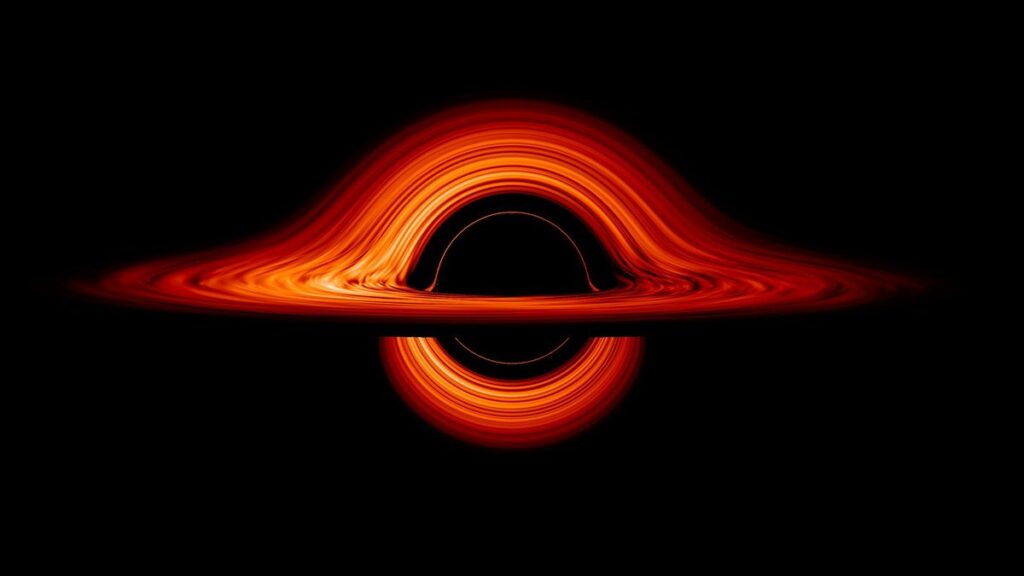
- Black holes aren’t completely black. Hawking describes his own 1974 result: quantum effects near the event horizon make black holes emit radiation, now called Hawking radiation, so they can slowly evaporate.
- The universe may have no boundary. With James Hartle, Hawking proposed that in imaginary time the universe could be finite but without an edge or starting point, much as the Earth’s surface has no edge. If so, he asks, what role would be left for a creator?
- Why time has a direction. He links three arrows of time: the growth of disorder, our psychological sense of past and future, and the expansion of the universe. He also admits he once got this wrong, having assumed disorder would decrease if the universe recollapsed, until work by Don Page and Raymond Laflamme changed his mind.
- The search for a unified theory. The book ends on the hope of combining relativity and quantum mechanics into one theory, which would let us, in his famous phrase, “know the mind of God.”
What’s great
- Clarity at the start. The early chapters on Aristotle, Ptolemy, Galileo, Newton and Einstein are a model of how to explain big ideas simply. The opening story, about a lecturer told by an audience member that the world rests on a tower of tortoises, is a light way into a serious question: how do we know what we know?
- An insider’s view. Hawking isn’t just summarizing others. He explains debates he took part in, and his open admission of error is a good lesson in how science really works.
- Almost no equations. He famously kept only one, E = mc², after being warned that each equation would halve his sales.
- Brevity. It’s a short book, and the chapters are self-contained enough to read in sittings.
What’s weak
- The hard parts are really hard. Without diagrams or math, the chapters on elementary particles and imaginary time rely on analogies that are easier to nod along to than to understand. The book is so famous for going unfinished that mathematician Jordan Ellenberg named his tongue-in-cheek 2014 “Hawking Index” of unread bestsellers after it.
- Parts are dated. It predates the 1998 discovery that the universe’s expansion is speeding up, which reshaped the question of how it will end. Its optimism that a complete unified theory might be close hasn’t paid off. And Hawking himself later reversed his long-held view that black holes destroy information, conceding a famous bet in 2004.
- The God framing. The references to God made headlines, but they’re rhetorical flourishes rather than arguments, and some readers find them a distraction.
Who should read it
Read it if you’re curious about the universe and want the classic account, ideally in the 1996 illustrated edition, whose pictures help with the hardest chapters. If you get stuck, A Briefer History of Time (2005), written with Leonard Mlodinow, covers the same ground more gently.
Rating: 4/5
Image credits — Featured image: Image by Andréia via Flickr, CC BY 2.0, cropped. In-article images: Image by NASA's Scientific Visualization Studio via Wikimedia Commons, Public Domain.
