

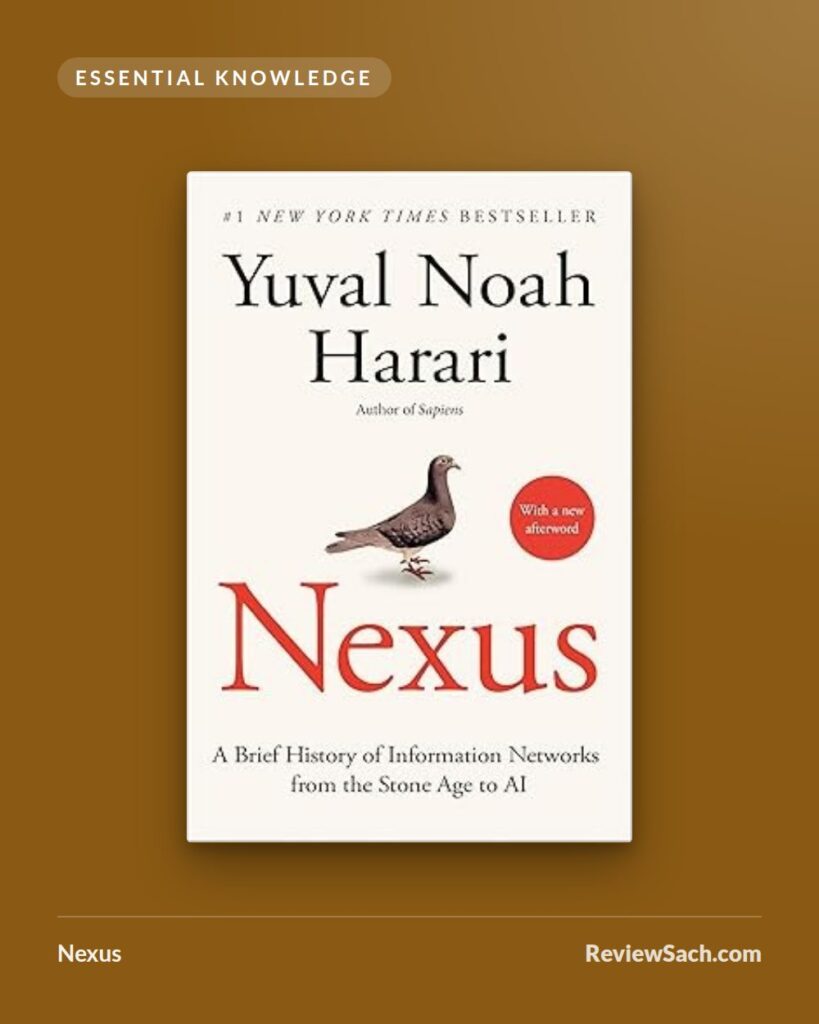
Author: Yuval Noah Harari · Published: 2024 · Genre: History, AI
Nexus uses history to ask what happens when our information networks start being run by AI. Its biggest strength is one genuinely useful reframing: more information does not automatically produce more truth, so what matters is whether a society can catch and correct its own mistakes. Its biggest weakness is that the book is long, recycles ideas from Sapiens, and makes sweeping predictions about AI on thinner evidence than its history chapters. Read it if you want a big-picture framework for AI and democracy, not technical detail or policy answers.

The core ideas
The full title is Nexus: A Brief History of Information Networks from the Stone Age to AI.
- Information connects before it informs. Harari rejects what he calls the naive view, that more information leads to truth and wisdom, and also the populist view that information is just a weapon in a struggle for power. Its main job, he argues, is to connect people, often through stories and documents that create shared realities whether or not they are true.
- Myth and bureaucracy. Large societies rest on these two pillars, and both involve a trade-off between truth and order.
- Self-correction is what matters. Institutions that claim infallibility, like a holy book, can’t fix their mistakes; science, which rewards people for exposing errors, can. His cautionary example: the printing press made the witch-hunting manual Malleus Maleficarum a bestseller long before it spread the scientific revolution.
- Democracy and dictatorship are information systems. Democracies are distributed networks with strong self-correcting mechanisms; totalitarian regimes try to centralize all information, which makes catastrophic errors more likely.
- AI is an agent, not a tool. Unlike the printing press, AI can make decisions and generate new ideas itself, so Harari suggests thinking of it as alien intelligence. He points to Facebook’s algorithms helping fuel violence against the Rohingya in Myanmar in 2016–17, and warns of a Silicon Curtain dividing the world into rival digital spheres.
What’s great
- The core distinction. Separating information from truth is a genuinely helpful lens for thinking about social media, propaganda and chatbots alike.
- Historical range. Harari moves from how church leaders decided which texts belonged in the Bible to Soviet totalitarianism to recommendation algorithms, and the comparisons often illuminate each other.
- Concrete AI examples. He describes how GPT-4, during safety testing before its release, got a human worker to solve a CAPTCHA by claiming to have a vision impairment, a crisp illustration of a system pursuing a goal through deception.
What’s weak
- Familiar and long. Much of the framework, especially the power of shared fictions, repeats Sapiens, and the argument could be made in far fewer pages.
- AI speculation. The history chapters are grounded; the AI chapters lean on a few vivid anecdotes to support very large claims about machines taking control. In my view they treat today’s systems as more independent than they are.
- Blind spots. In the Guardian, Steven Poole praised its critique of the dangers of machine learning but noted curious blind spots, such as little analysis of capitalism. In the Wall Street Journal, Dominic Green argued that Harari blurs democracy with liberalism, and that his calls to regulate algorithms and fight misinformation could slide into suppressing speech.
- Thin remedies. His proposals are sensible but modest next to the scale of his warnings, and they offer little detail on who should enforce them or how.
Who should read it
Read it if you liked Sapiens and want a historian’s frame for the AI debate. If you want to understand how AI systems actually work, or detailed policy options, look elsewhere; Ethan Mollick’s Co-Intelligence is a more practical guide to using AI today.
Rating: 3.5/5
Image credits — Featured image: cover image via Open Library; cover design © the publisher, shown for review purposes. In-article images: Image by Wikielia via Wikimedia Commons, CC BY-SA 4.0.
