

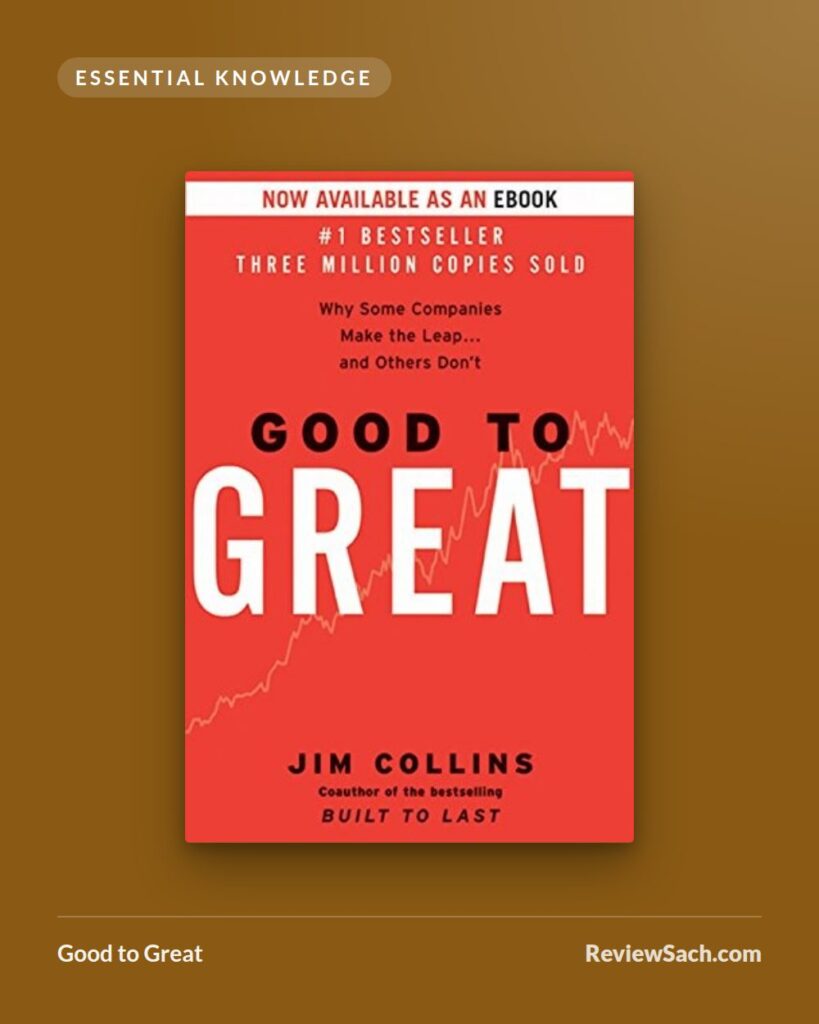
Author: Jim Collins · Published: 2001 · Genre: Business, Management
Good to Great‘s biggest strength is its vocabulary: Level 5 leaders, the Hedgehog Concept and the flywheel are clear, memorable tools for thinking about how organizations improve. Its biggest weakness is the evidence behind them. Collins picked winners after the fact and worked backward to what they had in common, and several of his standout companies fell apart within a decade. It’s worth reading for managers who want a framework for focus and discipline, as long as they treat it as a set of ideas rather than proven laws.

The core ideas
Collins and his research team screened 1,435 companies that had appeared on the Fortune 500 for a specific pattern: about 15 years of stock returns at or below the market, a transition point, then 15 years of cumulative returns at least three times the market. Eleven companies qualified, including Abbott, Circuit City, Fannie Mae, Gillette, Kimberly-Clark, Kroger, Nucor, Philip Morris, Pitney Bowes, Walgreens and Wells Fargo. Each was compared with a similar company that never made the leap. The findings:
- Level 5 Leadership. The CEOs who led the shift combined personal humility with ferocious professional will. Darwin Smith, who sold Kimberly-Clark’s paper mills to bet the company on consumer brands, is the signature example.
- First who, then what. Get the right people on the bus, and the wrong ones off, before deciding where to drive it.
- Confront the brutal facts. The Stockdale Paradox: keep faith that you will prevail while facing the harshest facts of your current situation.
- The Hedgehog Concept. Focus on the overlap of three circles: what you can be best in the world at, what drives your economic engine, and what you are deeply passionate about.
- The flywheel. Transformation comes from steady, cumulative pushes in one direction, not one dramatic program or merger.
What’s great
The book is plain and easy to remember, which is why its terms still circulate in boardrooms. The paired comparisons make the lessons concrete. Kroger and A&P faced the same shift in how Americans shopped for groceries; Kroger confronted the evidence and rebuilt its stores, while A&P did not. Walgreens’ decision to organize around profit per customer visit is a crisp example of a Hedgehog Concept in action.
The warning against charismatic saviors has also aged well. Collins found that quiet, stubborn leaders outperformed celebrity CEOs, a useful corrective to the hero worship common in business books.
The controversy
The main methodological critique is the halo effect. In The Halo Effect (2007), Phil Rosenzweig argued that much of Collins’s source material, including press coverage and interviews, was colored by the companies’ known success. A thriving company gets described as disciplined and focused; the same traits look like rigidity once it struggles. Selecting eleven winners and then searching for common traits also risks finding patterns that are partly coincidence.
Then reality intervened. Circuit City filed for bankruptcy in 2008 and was liquidated. Fannie Mae was placed into federal conservatorship in September 2008 during the financial crisis. In a 2008 blog post, economist Steven Levitt noted that only Nucor had dramatically beaten the market since the book came out, and that a portfolio of the eleven companies looked like it would have underperformed the S&P 500. Wells Fargo was later hit by its fake-accounts scandal.
In fairness, Collins studied specific periods and never claimed greatness was permanent. His 2009 book How the Mighty Fall examines exactly how strong companies decline.
Who should read it
Managers and leaders will get useful language from it, especially the chapters on leadership and brutal facts. Read Rosenzweig’s The Halo Effect next as a corrective, and treat the eleven companies as illustrations, not proof.
Rating: 3.5/5
Image credits — Featured image: cover image via Open Library; cover design © the publisher, shown for review purposes. In-article images: Photo by Georg Eiermann on Unsplash.
