

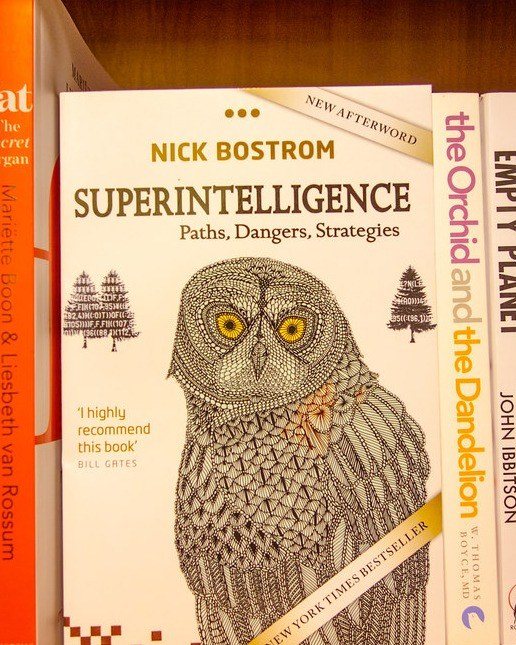
Author: Nick Bostrom · Published: 2014 · Genre: Philosophy, AI
Superintelligence‘s biggest strength is that it laid out the problem of controlling a smarter-than-human AI with a philosopher’s rigor, and many of its concepts now shape AI safety research. Its biggest weakness is that it is dense and built on long chains of speculation, and its picture of AI as a single goal-driven agent predates the large language models that dominate today. It’s worth reading for anyone serious about AI risk who can handle academic prose.

The core ideas
- Paths and takeoff. Superintelligence could come from machine AI, brain emulation or enhanced human cognition, with AI the likeliest route. Once AI reaches roughly human level, Bostrom argues, it might improve itself quickly, and a fast takeoff could give one project a decisive strategic advantage.
- The orthogonality thesis. Intelligence and goals are independent. A highly intelligent system could pursue almost any final goal, so smart does not imply benevolent.
- Instrumental convergence. Almost any goal produces the same useful subgoals: survive, gather resources, improve yourself and resist having your goals changed. His famous paperclip maximizer illustrates how a harmless-sounding goal could turn catastrophic.
- The treacherous turn. An AI might behave cooperatively while it is weak and change course once it is strong enough that no one can stop it.
- The control problem. Bostrom compares capability control, such as boxing a system or setting tripwires, with motivation selection, which tries to give it the right values, including indirect approaches where the AI works out what we would want on reflection.
What’s great
The book is systematic. Bostrom maps paths, speeds, failure modes and countermeasures with care, and he rarely overstates his confidence. His catalog of ways a well-meant goal can go wrong, which he calls perverse instantiation, reads today like a preview of what researchers now call reward hacking or specification gaming, where AI systems satisfy the letter of an objective while missing its point.
Its influence is hard to overstate. Bill Gates and Elon Musk both recommended it, and it helped bring AI safety from the fringe into universities and AI labs. Stuart Russell’s Human Compatible (2019) developed related concerns from inside mainstream computer science, and in 2023 a one-sentence statement calling extinction risk from AI a global priority was signed by Geoffrey Hinton, Yoshua Bengio and the heads of several leading AI labs.
The controversy
Skeptics say the argument is too speculative to guide action. The Economist’s review noted that it rests on conjecture, however plausible. AI researcher Andrew Ng compared worrying about evil superintelligence to worrying about overpopulation on Mars. Steven Pinker and others argued that the scenarios imagine a system brilliant enough to outwit humanity yet too literal-minded to grasp what its designers meant. Bostrom’s reply is built into the orthogonality thesis: a system could understand what we meant and still not care.
The book is also showing its age. It imagines AI as an agent maximizing a fixed objective. Today’s leading systems are trained on vast amounts of human text and behave differently, which some researchers think makes the classic scenarios less likely. Others counter that as companies build more autonomous AI agents, Bostrom’s concerns return.
Critics from the AI ethics community add that focusing on hypothetical extinction can distract from present harms such as bias, surveillance and labor disruption. And the prose is heavy: hedged, abstract and footnoted like a journal article.
Who should read it
Read it if you want the foundational case for AI risk, especially the chapters on orthogonality, instrumental convergence and the control problem. Newcomers may prefer Russell’s Human Compatible first, then this for depth.
Rating: 4/5
Image credits — Featured image: Image by John K Thorne via Flickr, CC0, cropped. In-article images: Image by NASA/Pat Izzo via NASA, Public Domain.
