

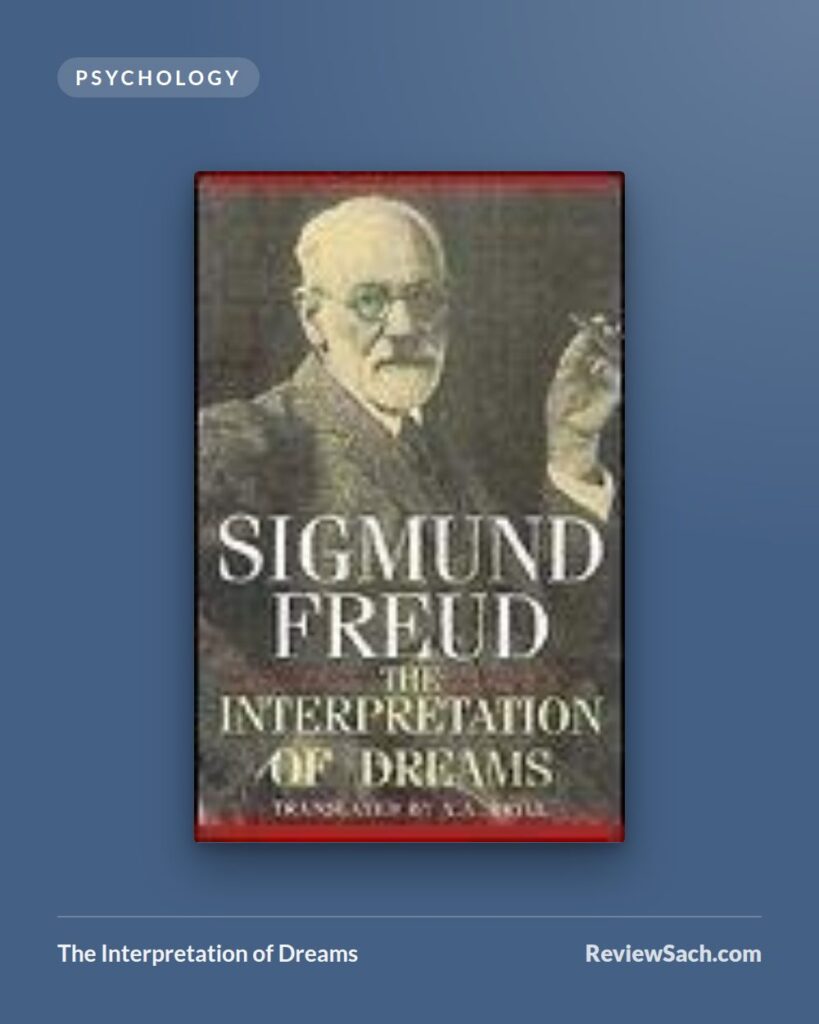
Author: Sigmund Freud · Published: 1899 · Genre: Psychology, Psychoanalysis · Original title: Die Traumdeutung
The Interpretation of Dreams is the book in which Freud built his method, and its biggest strength is the sheer ingenuity of its dream analyses, many of them of his own dreams. Its biggest weakness is that its core claim, that every dream is a disguised wish, rests on Freud’s interpretations rather than evidence, and modern sleep science does not support it. Read it as intellectual history and as a key to the twentieth century’s imagination, not as a guide to what your dreams mean.

The big idea
Freud argues that dreams have meaning and can be decoded. Behind the dream you remember, the manifest content, lies the latent content: thoughts and wishes, often from childhood and often sexual or aggressive, that an inner censor will not let into awareness. The dream is the disguised fulfillment of such a wish.
The disguise is produced by what he calls the dream-work. Condensation packs several ideas into one image. Displacement shifts emotional weight from an important thought onto a trivial detail. Thoughts are turned into pictures, and a final revision smooths the result into something like a story. The analyst reverses the process through free association, asking the dreamer to report whatever comes to mind about each element.
Freud calls dream interpretation the “royal road” to the unconscious, and the dense final chapter builds a whole model of the mind on it. The book also contains his first published account of what he later called the Oedipus complex, drawn from readings of Oedipus Rex and Hamlet.
What’s great
- The specimen dream. Freud’s analysis of his own dream about a patient he calls Irma walks through the method step by step. It is genuinely gripping, partly because it exposes his guilt and professional anxiety about a treatment that had not gone well.
- Candor. In a later preface Freud described the book as part of his self-analysis and his reaction to his father’s death. Few founding works of a field reveal their author’s ambitions, rivalries and embarrassments so openly.
- Influence. Wish fulfillment, repression and symbolic displacement shaped literary criticism, surrealism, film and everyday language. Much of twentieth-century culture is hard to read without this book.
- Close attention. Freud’s insistence that the small, absurd details of a dream matter is a useful habit even if you reject his conclusions.
The controversy
The theory’s scientific standing is weak, and fairness requires saying so plainly. Freud’s evidence is his own interpretations, mostly of his own and his patients’ dreams, and a clever interpreter can find a hidden wish in almost anything. When a patient’s dream seemed to refute the theory, Freud argued it fulfilled her wish to prove him wrong. The philosopher Karl Popper later held up psychoanalysis as a leading example of a theory that cannot be falsified.
Research has largely moved elsewhere. In 1977 the psychiatrists J. Allan Hobson and Robert McCarley proposed that dreams arise as the brain tries to make sense of activity generated during REM sleep, with no hidden message required. Content studies by researchers such as G. William Domhoff find that dreams mostly continue our waking concerns rather than disguise them. The neuropsychologist Mark Solms has argued that dreaming depends on the brain’s motivational systems, a partial and much-debated echo of Freud, but not support for the censor or the disguised wish.
The book is also long and uneven. The opening survey of earlier writing on dreams is a slog, and Freud kept expanding the text across later editions.
Who should read it
Read it if you are interested in the history of psychology, psychoanalysis, or modern literature and art. Choose a good modern translation, and if the length daunts you, start with the Irma chapter and the chapter on the dream-work.
Rating: 3.5/5
Image credits — Featured image: cover image via Open Library; cover design © the publisher, shown for review purposes. In-article images: Image by Zde via Wikimedia Commons, CC BY-SA 4.0.
