

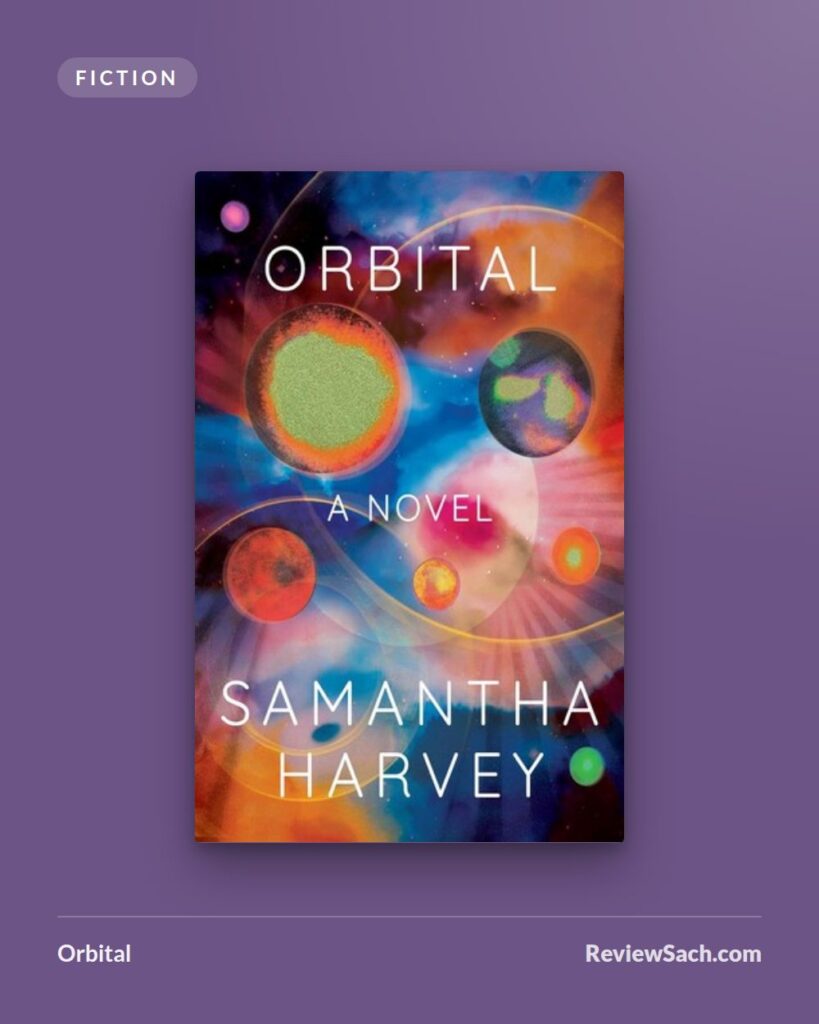
Author: Samantha Harvey · Published: 2023 · Genre: Literary Fiction
Orbital follows six people aboard the International Space Station through a single day, and it’s less a story than a long, beautiful meditation on Earth. The prose is extraordinary and the book is short, around 140 pages. If you want plot or character arcs, it will bore you; if you want to see the planet fresh, read it.
What it’s about
Four men and two women from five countries circle the Earth sixteen times in twenty-four hours. Roman and Anton are Russian cosmonauts, Pietro is Italian, Shaun is American, Nell is British and Chie is Japanese. They are on one of the last missions of its kind before the station program winds down, moving at more than seventeen thousand miles an hour. They run experiments, exercise, eat, clean and look out of the window.
Very little happens. There are no disasters, no aliens and no rescue missions; the drama is in what the crew see, remember and feel. Chie learns that her mother has died back home. The crew watches a huge typhoon gather over the Pacific, heading toward islands and people they care about. Each section follows an orbit, and each describes what the crew can see: continents, oceans, deserts, storms, auroras and cities at night.
Harvey wrote much of the book during the COVID lockdowns, working from hours of footage filmed from the station, and she has said she initially doubted she had the authority to write about a place she would never visit.
What works
- The writing. Harvey describes Earth from orbit with astonishing precision and freshness. Passages about weather systems, mountain ranges and the glow of cities at night read like prose poems, and they justify the book on their own.
- Perspective. Seen from above, borders vanish and human conflict looks absurd. The book returns to climate change, the fragility of the planet, and the odd position of these six people, both privileged and lonely.
- Small human details. How you sleep, wash or keep your muscles working in microgravity; the crew’s jokes and routines; their quiet grief when bad news arrives. The contrast between the cosmic and the ordinary is the book’s engine.
- Structure. The station passes through a sunrise and a sunset on every orbit, so the book holds sixteen days inside one, and the repetition becomes hypnotic rather than dull.
- Length. It knows exactly how long it should be.
What doesn’t
There’s little narrative drive. The characters are sketched in a few details each, and several are hard to tell apart without flipping back. Readers who need conflict, change or tension will find it static. It’s also light on the technical side of spaceflight, so anyone expecting something in the vein of The Martian will be puzzled.
The reflective passages can also drift toward the obvious: we are small, the Earth is beautiful, we should look after it. Harvey often earns these thoughts, but not always, and a few pages read like well-written captions.
Its politics drew criticism as well. Some Ukrainian and Polish commentators argued that the warm portrait of Russian cosmonauts, and the book’s picture of harmony between nations aboard the station, ignored the realities of Russia’s war on Ukraine. Others see that idealism as the whole point: the station as a small model of how people might cooperate.
Who should read it
Readers who love lyrical, contemplative fiction, anyone fascinated by space, and people who want a short prize-winner they can finish in one or two sittings. It won the 2024 Booker Prize, the first winner set in space and one of the shortest in the prize’s history, as well as the Hawthornden Prize. Read it slowly, ideally in a quiet hour or two; skimming defeats the point.
Rating: 4/5
Image credits — Cover image via Open Library. Cover design © the publisher, shown for review purposes.
