

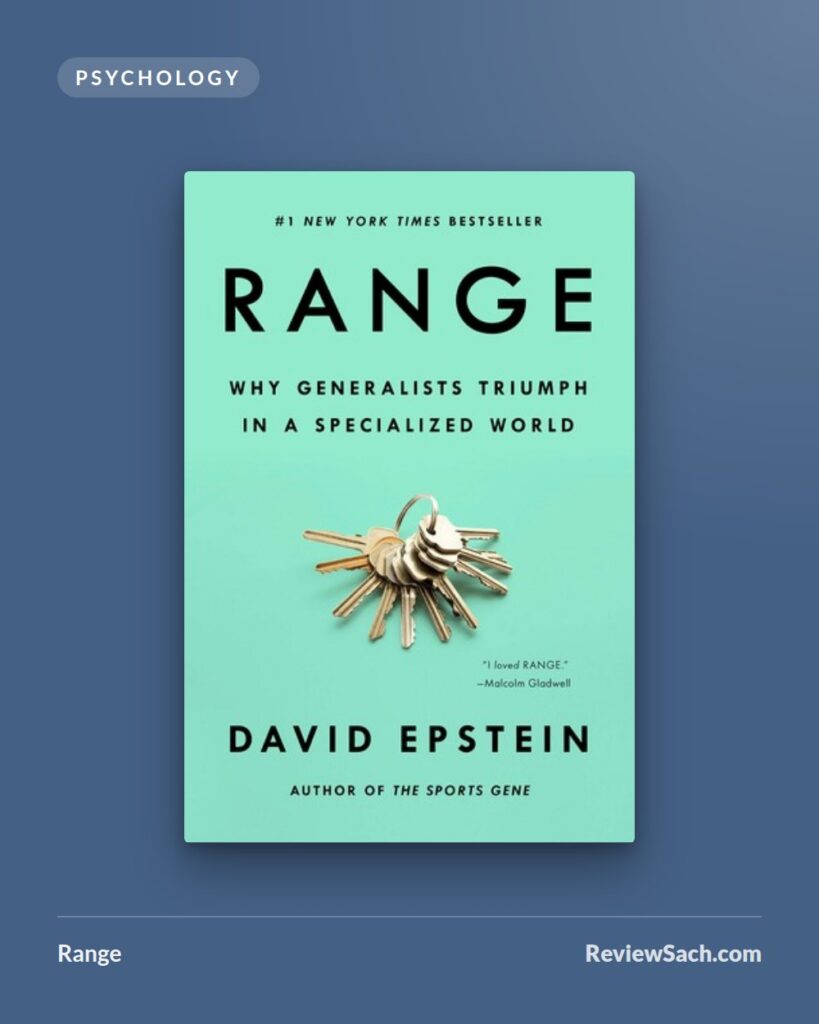
Author: David Epstein · Published: 2019 · Genre: Psychology, Learning, Careers
Range argues that in most fields, people who sample widely and specialize late do better than the early specialists celebrated in books like Outliers. Its biggest strength is the framework of “kind” and “wicked” learning environments, which explains when early, narrow practice works and when it fails. Its biggest weakness is that much of the case rests on hand-picked success stories, which cannot show that range caused the success. It is worth reading for students, parents and anyone worried that they started too late.

The big idea
Epstein opens with a contrast between Tiger Woods, who was swinging a golf club as a toddler, and Roger Federer, who played many sports before settling on tennis. Golf and chess, he argues, are kind environments: the rules are stable, patterns repeat and feedback is fast and accurate. There, early, focused practice builds the intuition that makes experts. Most of life is wicked: rules change, feedback is delayed or misleading, and yesterday’s patterns may not repeat. In wicked environments, breadth, analogy and the ability to transfer knowledge matter more than early drilling.
He builds out from there. Learning that feels harder in the moment, such as spacing practice and mixing problem types, often sticks better. Changing careers is often a sign of finding better “match quality” rather than failure. Outsiders frequently solve problems that stumped specialists, and forecasters who draw on many ideas tend to beat those committed to one big theory.
What’s great
- The kind/wicked distinction. It draws on the psychologist Robin Hogarth’s work and is the most useful idea in the book. It also makes Epstein fairer than his subtitle suggests, because he concedes that early specialization works in some domains.
- Memorable research. He describes a study at the US Air Force Academy in which calculus professors whose students did best in their own course left those students worse prepared for later courses. He cites the economist Ofer Malamud’s comparison of Scottish and English universities: Scottish students, who specialize later, were less likely to switch fields after graduating.
- Great stories. Nintendo’s Gunpei Yokoi built hits like the Game Boy by using old, cheap technology in new ways. The orphan musicians of Vivaldi’s Venice learned many instruments and became famous for it.
- Clear prose. Epstein is a former Sports Illustrated writer, and the chapters move quickly.
What’s weak
The main criticism concerns how Range uses evidence. The generalists in the book are people who succeeded, and Epstein rarely asks how many people switched fields and failed. Without that base rate, a parade of late bloomers is an argument from survivors. Critics have also pointed out that talent muddies the picture: gifted people may find it easy to excel in several domains, so their range could be a result of ability rather than its cause.
Some studies are stretched. The Air Force and Malamud findings are real but narrow, and the book moves quickly from them to broad claims about careers and creativity. Counterexamples, such as founders and scientists who specialized early and stayed in one lane, get little attention. The kind/wicked line is also blurrier in practice than the book implies, since medicine, law and software contain both kinds of problem.
The structure is loose, and the argument repeats across chapters. Several chapters could be shuffled without losing much.
Who should read it
Read it if you are choosing a degree, changing careers, or raising a child who is being pushed to specialize early. Treat it as a strong corrective to the cult of the 10,000 hours, not as proof that generalists always win.
Rating: 4/5
Image credits — Featured image: cover image via Open Library; cover design © the publisher, shown for review purposes. In-article images: Photo by Patrick on Unsplash.
