

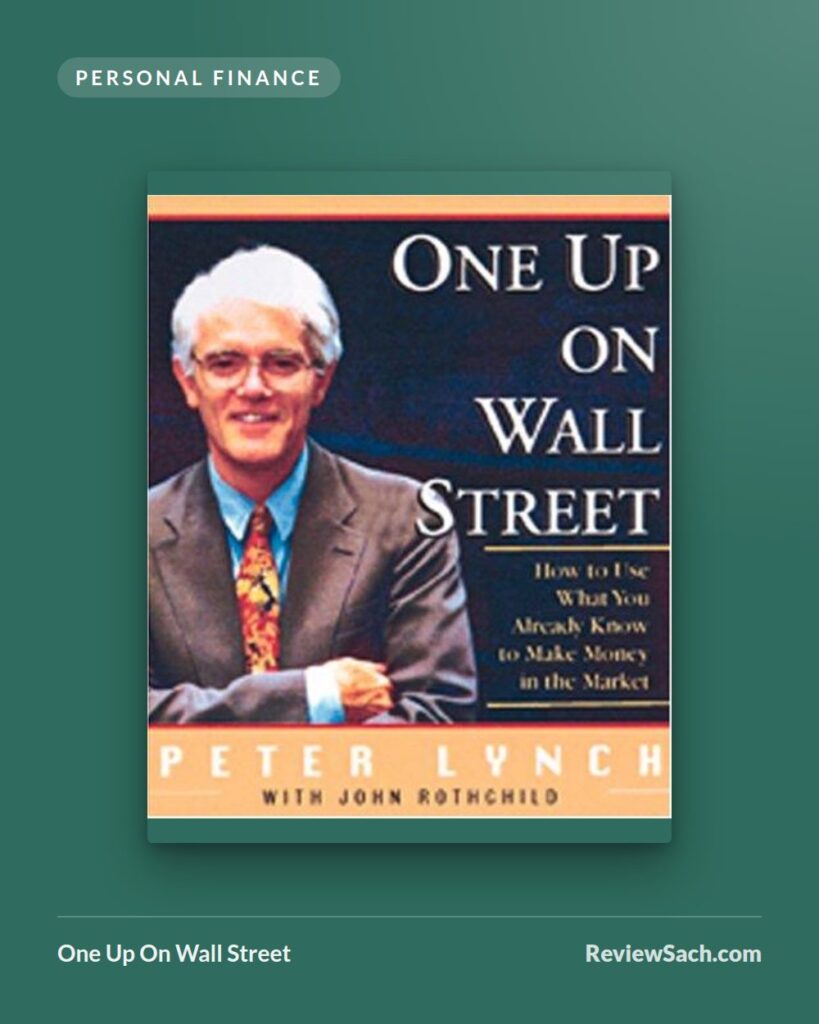
Author: Peter Lynch · Published: 1989 · Genre: Investing, Personal Finance
One Up On Wall Street is the most enjoyable book ever written about picking stocks. Peter Lynch argues that ordinary investors can beat the professionals by spotting good companies in everyday life and then doing proper homework. It is essential for anyone who wants to own individual shares, though most readers will get more from it as a lesson in thinking than as a reason to abandon index funds.
The big idea
Lynch ran Fidelity’s Magellan Fund from 1977 to 1990 and built one of the best records in mutual fund history. Written with John Rothchild, the book makes a surprising claim for a Wall Street star: amateurs have an edge. People notice products, shops and trends at work and at the mall long before analysts pay attention. His favourite example is L’eggs pantyhose, which his wife liked long before he bought shares in its maker, Hanes.
But the famous “invest in what you know” is only the start. Lynch insists that a good product is a lead, not a buy signal. The investor must then study the balance sheet, earnings growth, debt and valuation, and be able to explain the company’s story in a couple of minutes. If you can’t, you don’t understand it well enough to own it.
He also asks readers to check themselves before buying anything: own a home first, don’t invest money you’ll need soon, and be sure you have the temperament to sit through falling prices.
What works
- The six categories. Lynch sorts companies into slow growers, stalwarts, fast growers, cyclicals, turnarounds and asset plays, then explains what to expect from each and when to sell. This framework alone is worth the price of the book.
- The perfect boring stock. His checklist of attractive traits, such as a dull name, an unglamorous or even depressing business, a protected niche and little attention from big institutions, is funny and still sharp. Funeral homes, motels and doughnut chains feature among his examples.
- Warnings. He coins “diworseification” for profitable companies that waste money on unrelated acquisitions, and he warns against buying the hottest stock in the hottest industry.
- Market timing mocked. His “cocktail party” theory says the market is near a top when people at parties stop ignoring the fund manager and start giving him stock tips. It is a funny way of making a serious point: forecasting the market is a waste of effort, so study companies instead.
- Honest tone. Lynch admits his mistakes freely, and his enthusiasm is infectious. The book also popularised the term “tenbagger” for a stock that rises tenfold.
What doesn’t
The book’s biggest weakness is how it is remembered. “Buy what you know” is easily misread as “buy shares in the shops you like”, which Lynch explicitly warns against. Readers who skip the homework chapters come away with the confidence but not the discipline.
The examples are also dated. Most of the companies are from the 1970s and 1980s. Later editions add new introductions that revisit some of the stories, but the core text is unchanged, and information that was once an edge, such as reading company filings, is now available to everyone instantly. Lynch was a full-time professional with a research operation behind him. Few individual investors can match that effort, and evidence consistently shows that most active stock pickers, professional or amateur, trail the index over the long run. The book is inspiring, but inspiration can easily turn into overconfidence.
Who should read it
Anyone who wants to buy individual stocks should read it first, and anyone curious about how a great investor thinks will enjoy it. If you plan to stick with index funds, it is still a pleasure, but treat it as education rather than a plan.
Rating: 4.5/5
Image credits — Cover image via Open Library. Cover design © the publisher, shown for review purposes.
