

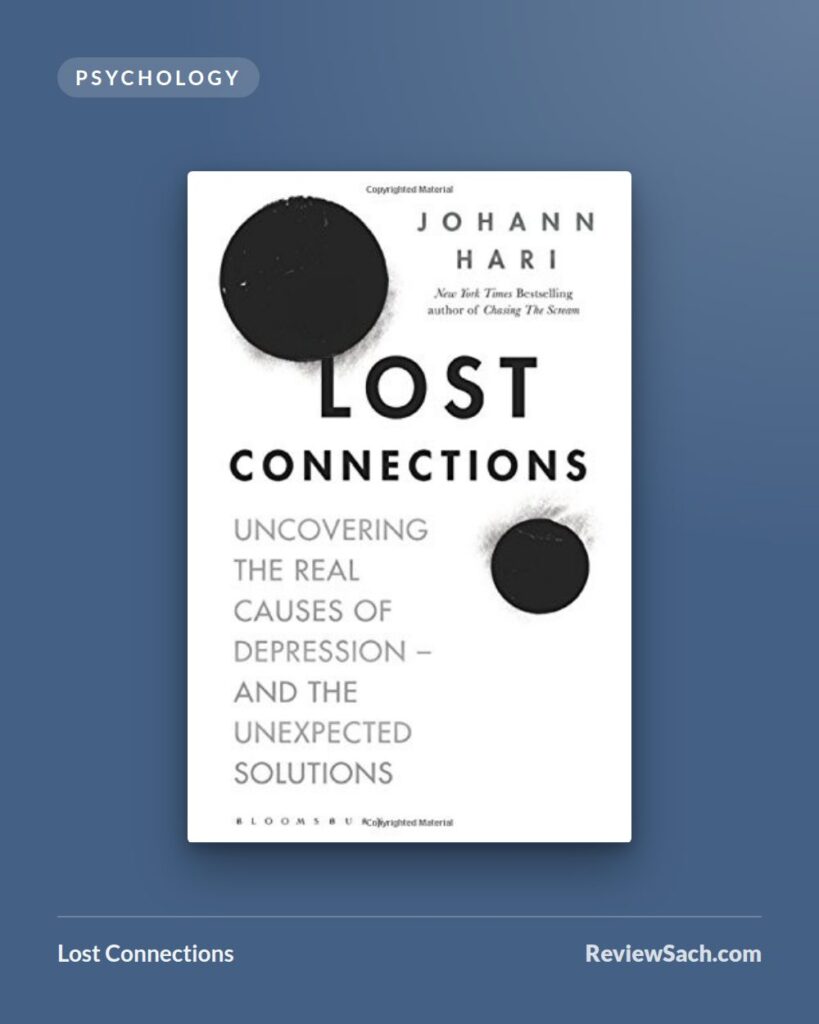
Author: Johann Hari · Published: 2018 · Genre: Psychology, Mental Health, Journalism
Lost Connections argues that depression and anxiety are driven less by brain chemistry than by the way we live: lonely, insecure and cut off from meaning. Hari’s core point, that social and psychological causes deserve far more attention, is sound and well supported. But he overstates the case against antidepressants, oversimplifies the science, and writes with more certainty than the evidence justifies. Worth reading critically, never as a substitute for medical advice.
The big idea
Hari starts with his own story. He began taking antidepressants as a teenager and was told his depression came from a chemical imbalance in his brain. After years on medication, he still felt depressed, and went looking for other explanations.
He argues that the serotonin-imbalance story was oversold, and draws on psychologist Irving Kirsch’s analyses suggesting that the advantage of antidepressants over placebo is small for many patients. He then sets out nine causes of depression and anxiety. Seven are forms of disconnection: from meaningful work, from other people, from meaningful values, from childhood trauma, from status and respect, from the natural world, and from a hopeful or secure future. Two are biological: genes and changes in the brain.
The final part proposes reconnection. Hari visits a medical practice in East London that prescribes community activities to depressed patients, a protest movement in Berlin that turned neighbors into a community, and a cooperative bike business in Baltimore where workers share control. He also discusses basic-income experiments and psychedelic-assisted therapy.
What works
- The social causes are real. Loneliness, insecure or meaningless work, and childhood adversity are strongly linked to depression, and Hari makes that case accessibly. Many psychiatrists would agree these factors get too little attention in public conversation.
- The reporting is lively. The reconnection chapters, especially the Berlin housing protest and the East London practice, are vivid introductions to what is now called social prescribing.
- It challenges an oversimplified story. The idea that depression is simply low serotonin was always a simplification, and Hari is right that it was promoted to the public far beyond what the evidence showed.
What doesn’t
The treatment of antidepressants is the biggest problem. Many psychiatrists and researchers criticized the book for underplaying evidence that the drugs help a substantial number of people, particularly with more severe depression, and warned that it could discourage readers from treatment that works for them. Hari says he isn’t telling anyone to stop their medication, but the book’s overall tone pushes the other way.
His framing also sets up a false contest. The mainstream view in psychiatry has long been biopsychosocial, meaning biology, psychology and circumstances all interact. Hari presents social causes as a revelation the establishment ignored, which overstates his originality.
Trust is a further issue. In 2011, Hari admitted inserting quotes from other sources into his interviews as though they had been said to him, and editing critics’ Wikipedia pages under a pseudonym. He later returned the Orwell Prize he had won. That history doesn’t invalidate this book, but it’s a reason to check claims rather than take them on faith.
Finally, the writing leans toward revelation. Complex research is often boiled down to a single conversation with an expert, and Hari’s tone is more certain than the studies behind it.
Who should read it
Readers interested in the social side of mental health, and professionals thinking about community-based support, will find useful material here. Anyone currently taking antidepressants should talk to a doctor rather than make decisions based on this book. It works best read alongside a mainstream account of depression treatment, so each perspective can check the other.
Rating: 3/5
Image credits — Cover image via Open Library. Cover design © the publisher, shown for review purposes.
