

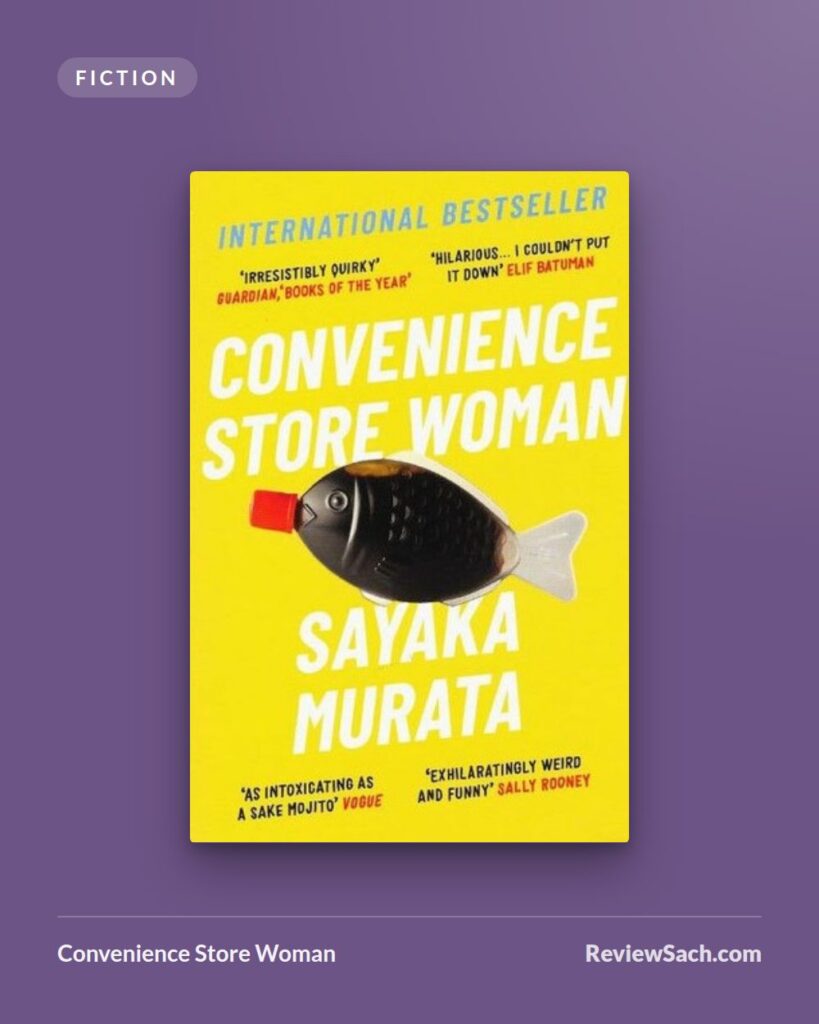
Author: Sayaka Murata · Published: 2016 · Genre: Literary Fiction, Japanese Fiction · Original title: Konbini Ningen
Convenience Store Woman is a short, deadpan novel about a woman who is happiest as a cog in a convenience store, and about the society that won’t leave her alone for it. It’s funny, unsettling and a sharp satire of what “normal” means. At well under 200 pages, it’s an easy recommendation for almost anyone.
What it’s about
Keiko Furukura is 36 and has worked part-time at the same Smile Mart in Tokyo for 18 years, since she was a university student. She has never had a boyfriend and doesn’t particularly want one. As a child she didn’t understand the rules everyone else followed, so she learned to hide her oddness by copying the people around her. As an adult she still borrows her coworkers’ speech patterns and taste in clothes, assembling a personality from theirs. At the store, the manual tells her exactly what to say, how to smile and how to stand, and for the first time she feels like a functioning part of the world.
Her family keeps asking when she’ll get a proper job or get married, and her old school friends, now mostly married with children, treat her life as a problem to be solved. Then a new employee, Shiraha, arrives. He is lazy, bitter and openly misogynist, convinced that modern society is no better than a prehistoric village where useless men get pushed aside. Keiko comes up with an unusual arrangement with him, purely to make people stop asking questions.
What works
- Keiko’s voice. She narrates with cheerful, literal honesty, noticing what everyone else pretends not to see. Her childhood anecdotes, especially one about a dead bird in a park, are funny and a little chilling.
- The store itself. Murata worked part-time in a convenience store herself, and it shows. The sounds, routines, stock deliveries and customer rhythms are written almost lovingly, as if the store were a living creature. Keiko hears its needs the way other people hear their own bodies.
- The satire. The real target isn’t Keiko but everyone around her. Friends, family and coworkers relax once she appears to have a man in her life, even an awful one. The point about conformity lands without a single lecture.
- The ending. Without giving anything away, the final pages are funny, strange and hard to forget, and they’ll leave you arguing with yourself about what counts as a good life.
- Economy. Not a word is wasted. Ginny Tapley Takemori’s English translation keeps the flat, funny tone intact.
What doesn’t
Shiraha is a one-note character, a loud mouthpiece for resentful ideas that the book mocks but doesn’t really explore. His rants go on longer than they need to, and they are the one part of the book that feels padded.
The brevity also leaves some threads underdeveloped. Keiko’s younger sister, who desperately wants her to be “cured”, gets only a few scenes, though her relationship with Keiko is one of the most interesting in the book. Readers expecting a conventional character arc, with growth and a lesson learned, will be disappointed.
Readers also debate whether Keiko should be read as neurodivergent. The novel never labels her, which some find freeing and others find evasive. Either way, the ambiguity is deliberate. The humor also depends on a very dry tone that some readers take as coldness.
Who should read it
Anyone who has felt out of step with what’s expected of them, fans of offbeat comic fiction, and readers new to Japanese literature. It won the Akutagawa Prize, one of Japan’s most prestigious literary awards, in 2016, and it’s a good introduction to Murata. Her later novel Earthlings goes much darker, so approach that one with care.
Rating: 4.5/5
Image credits — Cover image via Open Library. Cover design © the publisher, shown for review purposes.
