

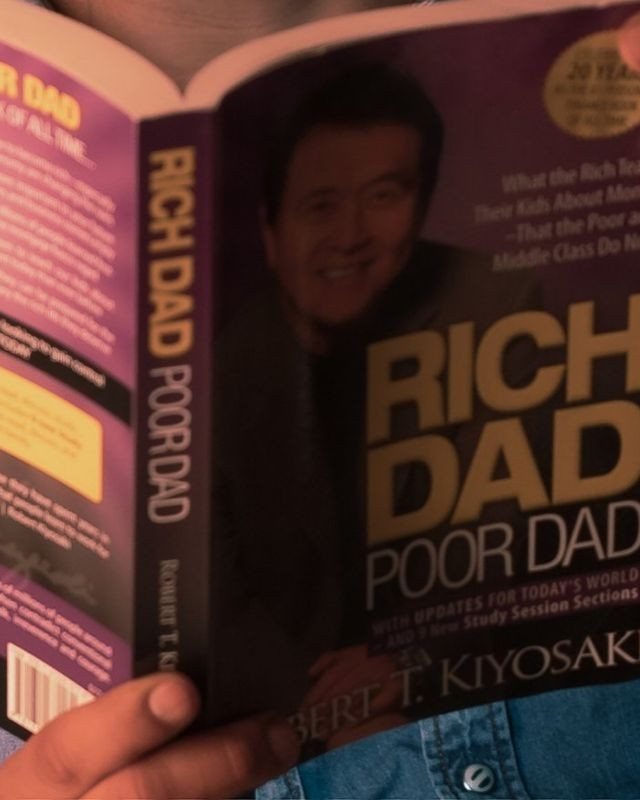
Author: Robert T. Kiyosaki · Published: 1997 · Genre: Personal Finance, Motivation
Rich Dad Poor Dad argues that schools teach people to work for money, while the rich learn to make money work for them. Its central idea, that you should buy things that pay you rather than things that cost you, is worth ten minutes of anyone’s time. The rest is anecdote, salesmanship and advice that ranges from vague to risky. Read it for the spark, not the plan.
The big idea
Kiyosaki contrasts two father figures. His “poor dad”, his own father, was a highly educated government official who valued job security and never got ahead. His “rich dad”, the father of his best friend Mike, was a Hawaii businessman who taught the two boys how money really works, in lessons that began when they were nine.
The core lesson is a redefinition. An asset, Kiyosaki says, is anything that puts money in your pocket; a liability is anything that takes money out. By that definition your home is a liability. The poor and middle class buy liabilities they believe are assets, while the rich buy rental property, businesses and paper assets that produce cash flow. The goal is to escape the rat race of living from pay cheque to pay cheque.
What works
- The cash-flow lens is useful. Many readers have never looked at their own finances as an income statement and a balance sheet. Kiyosaki’s simple diagrams make the point click: if your spending rises every time your salary does, you are running in place.
- It questions the big-house default. Calling a family home a liability is an overstatement, but it forces a fair question about how much house anyone really needs.
- It motivates. Plenty of readers credit it with sparking their first interest in money. Short chapters and a story-driven style reach people who would never open an investing text.
The controversy
The first question is whether rich dad existed as described. For years Kiyosaki avoided naming him, and many readers concluded he was invented. After Hilo hotelier Richard Kimi died in 2009, his son told a Hawaii newspaper that Kiyosaki had based rich dad on his father. Even so, the long lessons delivered almost word for word to a child read like a teaching device, and the financial writer John T. Reed has called many of the book’s accounts extremely unlikely.
The advice is the bigger problem. The book offers almost no concrete steps. It praises real estate, the tax advantages of running a company and “financial intelligence” without explaining risk, leverage or diversification. It sneers at formal education and steady jobs, and treats saving and patient, diversified investing as the timid habits of the middle class. Its stories of snapping up cheap property in a slump and selling at a profit depend on timing and skill most readers don’t have.
Kiyosaki’s own business record adds to the doubts. In 2012 his company Rich Global LLC filed for bankruptcy after a court ordered it to pay more than $23 million to The Learning Annex, a seminar promoter. Seminars sold under the Rich Dad brand have also been criticised as a funnel into expensive courses.
To be fair, the basic distinction between income-producing assets and consumer spending is sound, and better books make it too. Kiyosaki wraps it in a story that can’t be verified and adds little else of value.
Who should read it
Someone who has never thought about money and needs a jolt of motivation, provided they move straight on to something more rigorous. If you want a real plan for investing or getting out of debt, read The Millionaire Next Door or The Simple Path to Wealth instead.
Rating: 2.5/5
Photo credits — Featured image: Photo by Abdullah Alsaibaie on Pexels.
