

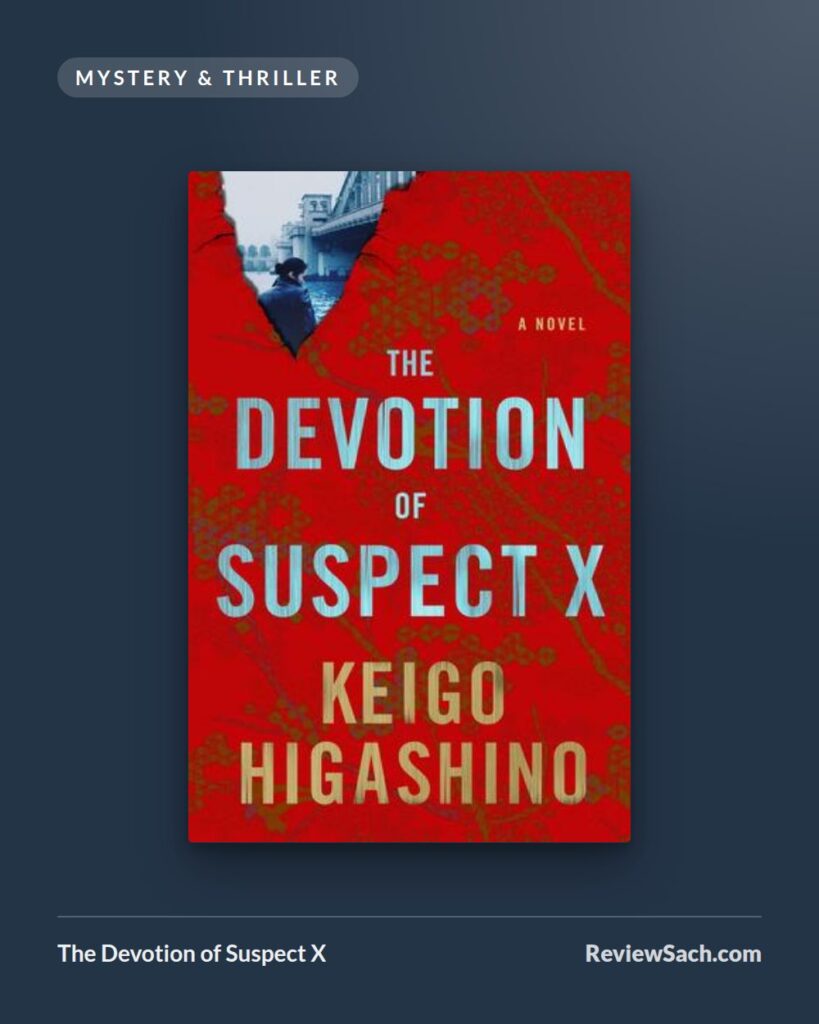
Author: Keigo Higashino · Published: 2005 · Genre: Mystery, Japanese Crime Fiction · Original title: Yōgisha X no Kenshin
The Devotion of Suspect X shows you the killing in its first chapter, then spends the rest of the book making you wonder how on earth it is being covered up. It is one of the smartest puzzle mysteries of the past few decades, and it turns out to be a sad, strange love story as well. Read it if you like classic fair-play detection but want a modern Tokyo setting and a real emotional sting.
What it’s about Yasuko Hanaoka is a divorced single mother who works at a bento shop in Tokyo and is raising her teenage daughter, Misato. Her abusive ex-husband, Shinji Togashi, tracks them down, and a confrontation in their apartment ends with him dead. Her next-door neighbour, Tetsuya Ishigami, is a withdrawn high school maths teacher and a gifted mathematician. He quietly offers to take care of everything, as long as she follows his instructions exactly.
Detective Shunpei Kusanagi soon has Yasuko in his sights, but her story holds. Stuck, he turns to his friend Manabu Yukawa, a physicist who helps the police and is nicknamed Detective Galileo. Yukawa turns out to have studied with Ishigami at university, and he remembers him as a genius. The rest of the book is a duel between two brilliant minds, with Kusanagi and the reader trailing behind.
What works – The structure. You see the crime, but not what Ishigami does next. The tension comes from watching the police test alibis that keep holding up. Every sensible question you ask gets an answer, and each answer only makes the mystery tighter. – The payoff. When the solution arrives, it reframes scenes you took at face value. It is that rare twist that is both shocking and, on reflection, logical. A reread shows how much Higashino left in plain sight. – Ishigami. He could have been a cold schemer. Instead he is lonely, precise and oddly moving, and the devotion in the title is not ironic. It gives the ending real weight. – Yukawa’s conscience. Yukawa is no gleeful puzzle-solver. The closer he gets to the truth, the less he wants to be right, and that reluctance gives the investigation an unusual melancholy.
What doesn’t The prose, at least in Alexander O. Smith’s English translation, is plain and functional. Characters explain things to each other a little too neatly, and Kusanagi exists mainly to be one step behind. Yasuko, whose situation drives the plot, is more passive than she deserves to be, and she gets less inner life than the men circling her. The book’s idea of devotion, which treats total sacrifice as the highest form of love, will strike some readers as troubling rather than touching.
There was also a real argument in Japan about fairness. Soon after publication, the mystery writer Reito Nikaido argued that Higashino deliberately withholds investigative details, so the book does not meet the standard of a true honkaku, or fair-play, puzzle. Other writers and critics defended it, and it went on to win the Honkaku Mystery Award in 2006, alongside the Naoki Prize, one of Japan’s top literary awards. Higashino himself said readers should decide. My view is that the clues are there, but you need to pay close attention to the right things, and most readers won’t.
The English edition was later nominated for the Edgar Award for Best Novel, and the story has been filmed several times, including a 2008 Japanese film and the 2023 Hindi adaptation Jaane Jaan. Read the book first; the adaptations flatten its ideas.
Who should read it Anyone who loves classic puzzle mysteries and wants one that also hurts a little. It is a great entry point to Japanese crime fiction and to Higashino, and it is short enough to finish in a weekend. If you need lush prose or a large cast, look elsewhere.
Rating: 4.5/5
Image credits — Cover image via Open Library. Cover design © the publisher, shown for review purposes.
