

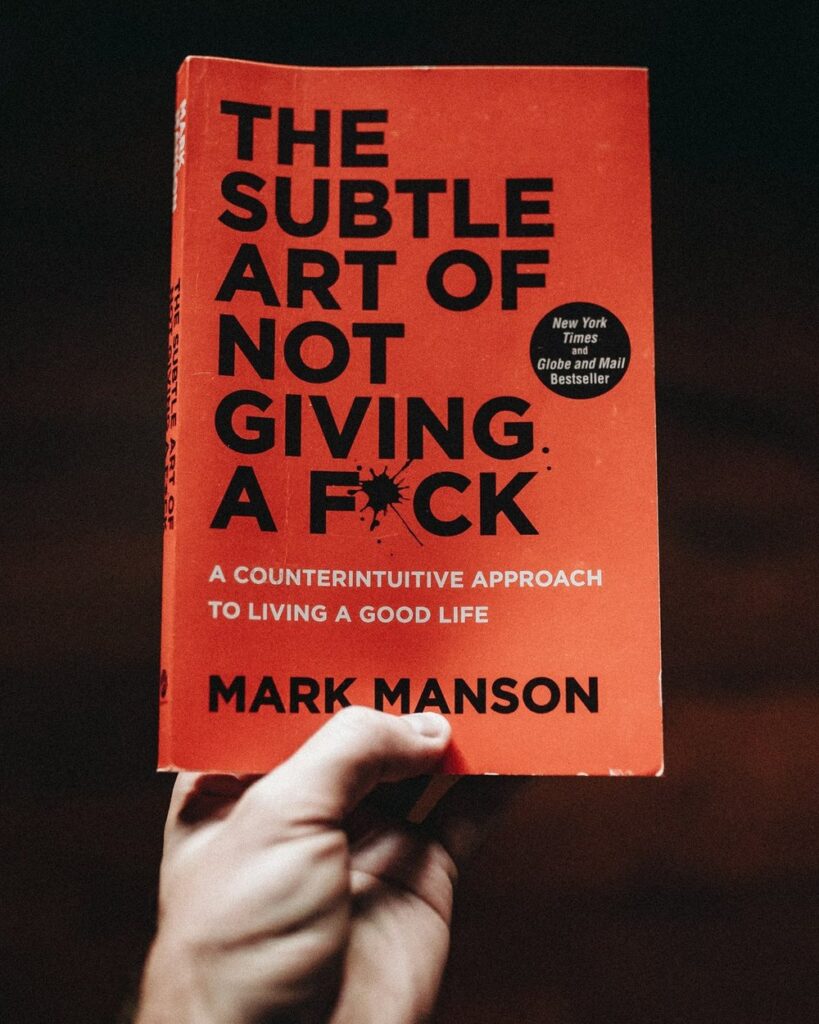
Author: Mark Manson · Published: 2016 · Genre: Self-Help, Philosophy
The Subtle Art of Not Giving a F*ck isn’t about indifference. Mark Manson argues that you only have so much attention to spend, so you should choose carefully what you care about, and that a good life means picking better problems rather than escaping all of them. It’s a useful, funny corrective to positive thinking, best for younger readers tired of relentless optimism. Much of it, though, is old wisdom in new slang.
The big idea
Manson’s target is the self-help industry’s promise of constant happiness. Chasing good feelings, he says, makes you anxious, because it keeps reminding you of what you lack. He borrows Alan Watts’s backwards law: the harder you pursue feeling good, the less satisfied you become, while accepting negative experience is itself a positive one.
His alternatives:
- Choose your values. Pain is unavoidable, so the real question is which struggles you’re willing to take on. Good values are grounded in reality, socially constructive, and within your control. Bad ones, like pleasure or always being right, depend on things outside you.
- Responsibility isn’t fault. You may not be to blame for what happened to you, but you’re responsible for how you respond.
- You’re not special. Most of life is ordinary, and accepting that is freeing.
- Do something. Action creates motivation, not the other way round.
- Be less certain. Manson argues that people avoid anything that threatens their sense of who they are, so they stay stuck. Holding your beliefs about yourself more loosely makes change possible.
He also describes a spiral many readers will recognize: feeling anxious, then feeling anxious about being anxious. Accepting the first bad feeling, he says, stops the second one from piling on.
What works
- Good stories. The best is Dave Mustaine, fired from Metallica before they became famous. He founded Megadeth and sold millions of records, yet still measured himself against Metallica and felt like a failure. Manson sets this beside Pete Best, dropped by the Beatles, who came to feel his life turned out happier. Values, not outcomes, decide how you feel.
- Hiroo Onoda. The Japanese soldier who kept fighting in the Philippine jungle for decades after World War II ended shows how loyalty to a false value can waste a life.
- Voice. It’s direct, self-mocking and easy to read. Manson includes his own failures, and the death of a friend when he was 19, and the book is more reflective than its cover suggests.
- Saying no. His chapter on rejection argues that boundaries and commitment, not endless options, make relationships and life richer. After years of travel, he found that depth beat breadth, and the point lands.
- The ending. The last chapter, drawing on Ernest Becker’s The Denial of Death, turns mortality into a reason to choose what matters.
What doesn’t
The profanity is a marketing device, and it wears thin. The swagger will put some readers off, and the jokey tone can hide how conventional the advice really is.
The ideas are mostly borrowed from Stoicism, Buddhism, existentialism and pop psychology. That isn’t a crime, but readers of Marcus Aurelius or Viktor Frankl won’t find much that’s new. Manson also makes sweeping claims about modern entitlement and social media with little evidence behind them.
The book is also thin on method. It tells you to choose better values but gives little help on turning them into daily choices, so some readers finish it nodding along without knowing what to change on Monday.
Who should read it
Read it if you’re in your twenties or thirties, burned out on upbeat self-help, and want a blunt push toward responsibility. If you already know Stoic philosophy, you can safely skip it.
Rating: 3.5/5
Photo credits — Featured image: Photo by Matthew Hamilton on Unsplash. In-article photo: Photo by NHN on Unsplash.
