

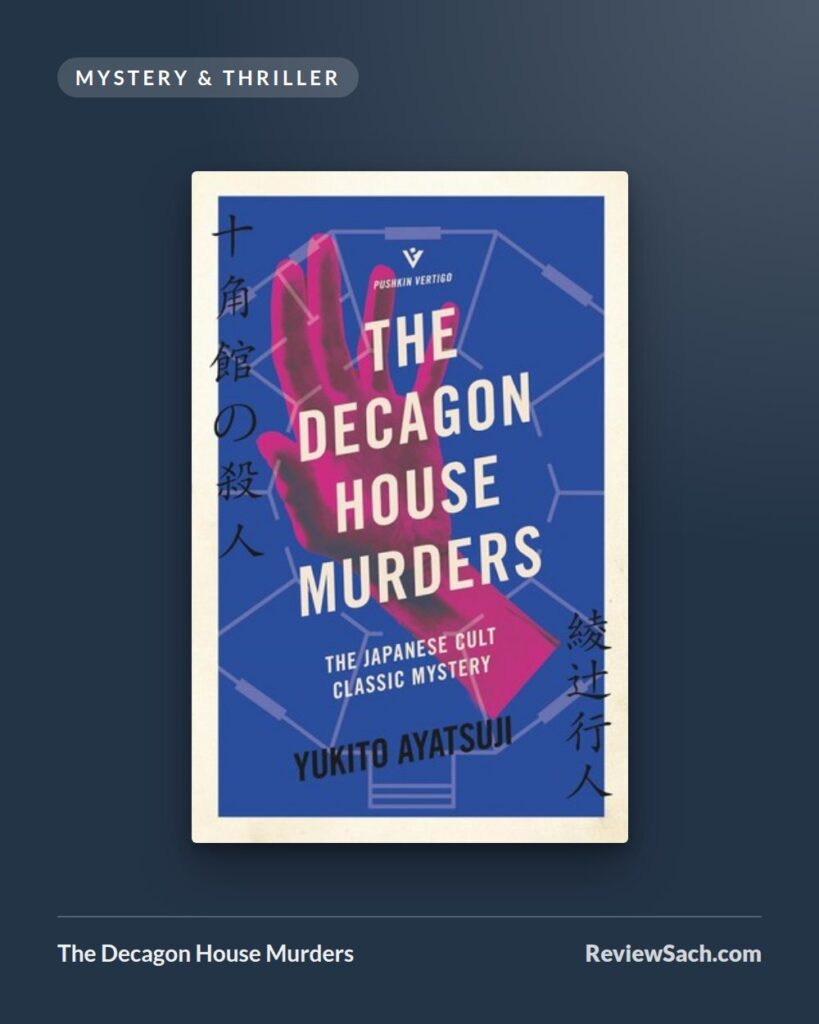
Author: Yukito Ayatsuji · Published: 1987 · Genre: Honkaku Mystery, Closed Circle · Original title: Jukkakukan no Satsujin
The Decagon House Murders is a closed-circle puzzle in the mould of Agatha Christie’s And Then There Were None, and its solution is one of the most admired in the genre. The characters are thin and the dialogue is stiff, but the plotting is superb and scrupulously fair. If you like classic whodunits, read it before anyone spoils it for you.
What it’s about
Seven members of a university mystery club travel to Tsunojima, a small, uninhabited island off the Japanese coast. Six months earlier, the island’s owner, an eccentric architect named Seiji Nakamura, was murdered along with members of his household, and the main house burned to the ground. The case was never solved. What still stands is the Decagon House, the ten-sided guesthouse Nakamura designed.
The students call each other by the names of famous Western mystery writers: Ellery, Agatha, Carr, Poe, Leroux, Van and Orczy. Soon after they arrive, they find a set of plates on the table, each labelled with a role: the first victim, the second victim and so on, plus the detective and the murderer. It seems like a prank. It isn’t.
Meanwhile, on the mainland, Kawaminami, a former club member, receives a letter signed in the dead architect’s name, accusing the club of killing his daughter. He starts digging with fellow member Morisu and a curious outsider named Kiyoshi Shimada. The name is a nod to Soji Shimada and his detective Kiyoshi Mitarai.
What works
- Two tracks. Ayatsuji cuts between the island, where the club is picked off one by one, and the mainland, where amateur detectives dig into the old Nakamura case. The alternation keeps tension high and lets the author hide a lot in plain sight.
- A reveal that delivers. The solution is famously clean. Everything you need is on the page, and the moment it clicks is one of the best in the genre. I’ll say nothing more.
- Genre self-awareness. The students argue about mystery fiction, dismissing the realistic social crime novel in favour of intellectual puzzles. It’s a mission statement: this book became a key text of Japan’s “shin honkaku” revival of the fair-play puzzle.
- Pace. It’s short and brisk. The island is cut off until the boat returns, the numbered plates hang over every meal, and each chapter tightens the screw.
What doesn’t
The characters are paper-thin. The nicknames make the cast easy to track, but they also turn the students into game pieces, and their reactions to murder are oddly muted. The dialogue, especially the banter, is stiff and sometimes juvenile. Some readers will find the whole setup too artificial to take seriously, and the island chapters can feel repetitive as the group bickers over whom to suspect.
A few points of logistics also wobble if you examine them closely. The book asks you to accept its game on its own terms, and readers who want realism will resist. The mainland chapters also move slowly at first, with a lot of talk before they gain momentum. And because the reveal is the main event, the book loses much of its power once you know it. Avoid reviews and discussions that go into detail.
Ho-Ling Wong’s English translation, first published by Locked Room International in 2015 and now available from Pushkin Vertigo, is clear and faithful, if plain. The novel was long called unfilmable, yet a Japanese TV adaptation appeared in 2024.
Who should read it
Readers who love Agatha Christie, closed-circle mysteries and games with the author. It’s also a natural companion to The Tokyo Zodiac Murders. If you need rich characters or realism, you’ll find it hollow, but for pure puzzle pleasure it’s hard to beat.
Rating: 4.5/5
Image credits — Cover image via Open Library. Cover design © the publisher, shown for review purposes.
