

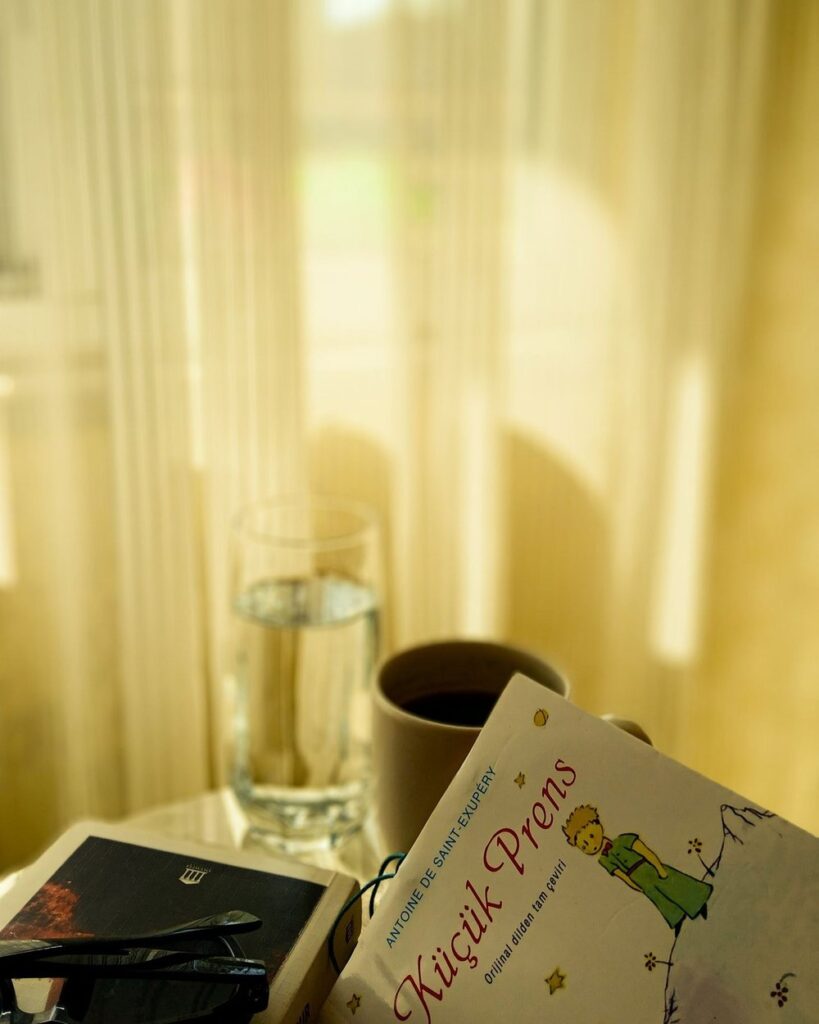
Author: Antoine de Saint-Exupéry · Published: 1943 · Genre: Fable, Children’s literature · Original title: Le Petit Prince
The Little Prince looks like a children’s book, but it’s really a fable for adults about love, loss and what grown-ups forget. It takes about an hour to read and stays with you for years. Some readers find it sentimental and a little smug about adults. Read it anyway, ideally aloud, and again when you’re older.
What it’s about
A pilot crashes his plane in the Sahara, far from any town, with barely a week’s supply of drinking water. On his first morning in the desert, a small boy with golden hair wakes him and asks him to draw a sheep.
The boy is a prince from asteroid B-612, a planet so small that he can watch the sunset again just by moving his chair a few steps. He left home after a falling-out with a vain, beautiful rose he loved but didn’t understand. On his way to Earth he visited six other tiny planets, each home to a single adult: a king with no subjects, a conceited man, a drunkard, a businessman counting the stars he thinks he owns, a lamplighter obeying pointless orders, and a geographer who never explores. On Earth he meets a snake and a fox, and slowly tells the pilot his story.
Saint-Exupéry was a pilot himself and had crashed in the Sahara in 1935. He wrote the book in the United States during the war, and it was first published in New York. He disappeared on a reconnaissance flight the following year. The book has since become one of the most translated works of fiction in the world.
What works
- The fox. The book’s heart is the fox, who asks to be tamed and explains that time and care are what make one rose different from thousands of others. His parting secret, that what is essential is invisible to the eye, is the line everyone remembers, and it earns its fame.
- The satire. Each asteroid adult is a quick sketch of a grown-up obsession: power, admiration, numbers, duty and knowledge without experience. The businessman who wants to own the stars so he can buy more stars is a perfect little joke about wealth. Tellingly, the only one the prince could imagine as a friend is the lamplighter, because he cares about something other than himself.
- The drawings. Saint-Exupéry’s own watercolors are part of the text, starting with the narrator’s childhood drawing of a boa constrictor digesting an elephant, which every adult insists is a hat. The pictures make the book’s argument before the words do.
- The ending. Without spoiling it, the last chapters turn a whimsical book into a sad one, and the shift lands hard.
What doesn’t
The message can feel heavy-handed. The book keeps repeating that adults care about numbers and miss what matters, and by the fifth asteroid you have the point. Some readers find the prince precious and the tone self-satisfied, as if anyone with a job and responsibilities has failed a test.
It also isn’t really a children’s book. Young children may enjoy the planets and the pictures, but the themes of death, loneliness and responsibility are aimed at adults. Parents expecting a light bedtime story should read it themselves first.
Translation matters, too. Katherine Woods’s 1943 English version is the classic but can sound old-fashioned; Richard Howard’s 2000 translation reads more naturally to modern ears. It’s worth choosing an edition with care.
Who should read it
Adults who want a short book with a long shelf life, and parents reading aloud to older children who can handle a sad ending. Readers allergic to sentimentality may want to skip it.
Rating: 4/5
Photo credits — Featured image: Photo by Zeynep Çapraz on Pexels. In-article photo: Photo by Fatma Medine on Pexels.
