

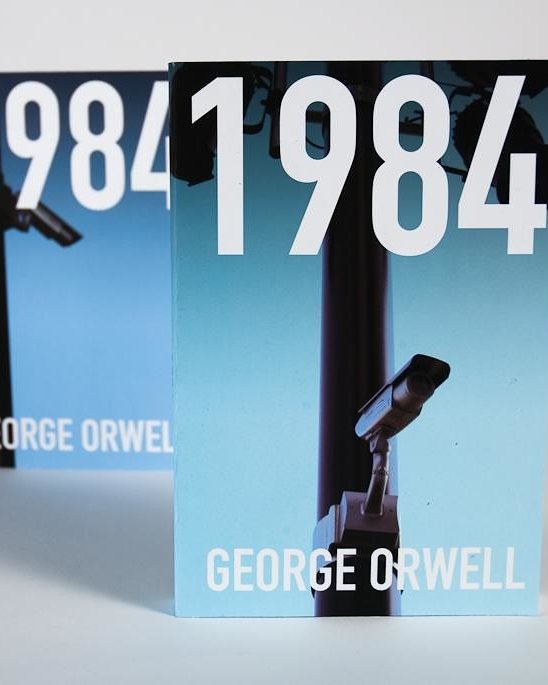
Author: George Orwell · Published: 1949 · Genre: Dystopian fiction, Political fiction
1984 is about a state that doesn’t just watch its citizens but decides what is true, and then makes them believe it. It is bleak and occasionally preachy, and it is still the clearest novel ever written about how power behaves when nothing limits it. Read it if you care about politics, language or freedom. Skip it only if you need hope in your fiction.
What it’s about
Winston Smith lives in London, now the main city of Airstrip One, a province of the superstate Oceania. He works at the Ministry of Truth, where his job is to rewrite old newspaper articles so the past always matches whatever the Party says today. Telescreens in every room watch and listen. Posters of Big Brother, the Party’s never-seen leader, hang everywhere.
Winston starts a secret diary, which is already a crime. Then he begins an affair with Julia, a young woman who works in the Fiction Department, and rents a room above an antique shop so they can meet in private. He also becomes convinced that O’Brien, a senior member of the Inner Party, secretly shares his doubts. And he keeps returning to the idea that if there is any hope, it lies with the proles, the poor majority the Party barely bothers to watch. The novel follows what happens when one man tries to keep a small corner of his mind free.
Orwell wrote much of the book on the Scottish island of Jura while seriously ill with tuberculosis. He died in January 1950, only months after it came out.
What works
- The ideas stick. Orwell gave us a vocabulary we still use: Big Brother, thoughtcrime, doublethink, Newspeak, the memory hole. Doublethink, the habit of holding two contradictory beliefs and accepting both, explains a lot of political behavior better than most textbooks.
- Language as a weapon. Newspeak is designed to shrink the dictionary until disloyal thoughts can’t be expressed at all. The appendix explaining its rules reads like a technical manual for mind control, and it is chilling precisely because it is so dry.
- The texture of misery. Orwell makes this world physical: the smell of boiled cabbage in the stairwell, oily Victory Gin, shortages of razor blades, compulsory morning exercises in front of the telescreen. The oppression feels lived-in, not abstract.
- The Two Minutes Hate. The daily ritual of screaming at Emmanuel Goldstein, the Party’s official enemy, shows how easily collective rage can be steered from one target to another.
What doesn’t
The middle of the book stalls. When Winston reads from Goldstein’s forbidden book, The Theory and Practice of Oligarchical Collectivism, Orwell drops long chapters of political essay into the story. The analysis is sharp, but for those pages the novel stops being a novel.
Julia is thin. She is lively, practical and funny about the Party’s hypocrisy, but she exists mostly as Winston’s partner in rebellion, and Orwell gives her little inner life. Winston himself is not especially likeable either. That is partly the point, but it makes the opening chapters feel slow.
The book has had its own run-ins with censors. It was banned in the Soviet Union, and it has been challenged in American schools, sometimes for its politics and sometimes for its sexual content. Readers on the left and the right have both claimed it, and they still argue over whether its target was Stalinism alone or any government that grows too powerful. Orwell, a democratic socialist, said the book was not an attack on socialism but a warning about where centralized power can lead.
Who should read it
Anyone who follows the news should read 1984 at least once, and ideally again ten years later. Teenagers can handle it, and adults will notice more. If you want a dystopia with more action and less despair, this isn’t it.
Rating: 4.5/5
Photo credits — Featured image: Photo by colindunn via Flickr, CC BY 2.0, cropped. In-article photo: Photo by Me-Hot-Ah via Wikimedia Commons, CC BY-SA 4.0, cropped.
