

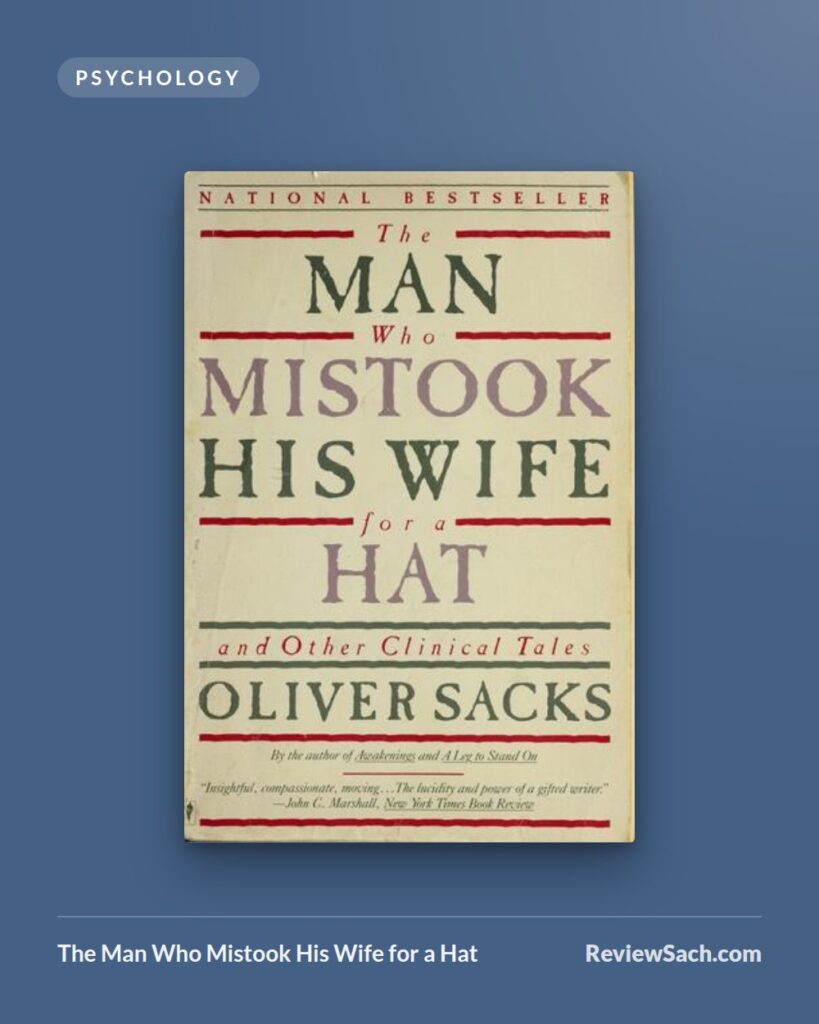
Author: Oliver Sacks · Published: 1985 · Genre: Psychology, Neurology, Essays
The Man Who Mistook His Wife for a Hat collects two dozen case histories of patients with unusual brain disorders, written by a neurologist with a novelist’s eye. For forty years it was the gateway book to neuroscience for general readers. It is still moving and memorable, but since 2025 we know Sacks embellished some of these stories, so treat it as literary nonfiction rather than a clinical record.
What it’s about
Sacks groups the cases into four parts. Losses covers deficits, such as the loss of memory or perception. Excesses covers conditions that produce too much, such as tics and compulsions. Transports covers vivid reminiscences, hallucinations and altered states. The World of the Simple profiles people with intellectual disabilities who show striking gifts.
The title case is Dr. P., a cultured music teacher who could no longer recognize faces or objects by sight, though he could describe their parts, and who at one point reached for his wife’s head as if it were his hat. Jimmie G. has severe memory loss from Korsakoff’s syndrome and believes it is still the 1940s. Christina loses her sense of where her own body is. Ray, a jazz drummer with Tourette’s syndrome, finds that medication calms his tics but dulls his playing, so he takes it on weekdays and goes without it on weekends. In one short essay, patients with aphasia who can’t follow words burst out laughing at a televised presidential speech, because they pick up the false notes in the speaker’s tone and face.
What works
- Humanity. Sacks’s real subject is how people hold on to a sense of self when the brain fails. He asks not only what is broken but what remains, and how patients adapt around the damage.
- The writing. Few doctors write this well. The essays blend clinical detail, the history of neurology and philosophy without ever reading like a textbook. He openly builds on the Russian neuropsychologist A. R. Luria, who pioneered this kind of richly narrated case study.
- Range. In a few hundred pages you meet visual agnosia, amnesia, lost body sense, Tourette’s and savant abilities, and each essay is short enough to read in one sitting.
The controversy
Even before 2025, the book had critics. Some disability advocates argued that Sacks turned patients into literary curiosities and built a career on their stories. Skeptics also doubted his account of the twins John and Michael, who supposedly swapped six-digit prime numbers for fun and could instantly count a box of spilled matches.
Then in December 2025, The New Yorker published a long report by Rachel Aviv based on Sacks’s private journals. In them he admitted giving patients powers they did not have, including powers of speech, and conceded that some details were invented outright. That doesn’t make every chapter false, but it means none of them can be read as a straight clinical record, and the most astonishing details deserve the most doubt.
Defenders point out that the conditions Sacks described are real and well documented, and that his essays taught a generation of readers to see patients as whole people rather than diagnoses. That legacy is genuine.
But the revelations matter. A case history carries authority because we assume it is true, and readers who took these stories as evidence about how the brain works were misled in places. Since we now can’t tell which details are accurate and which are not, every striking scene in the book comes with a question mark.
Who should read it
Curious general readers, and students thinking about medicine or psychology, will still find it absorbing. Read it as a humane, partly fictionalized portrait of neurological difference, and check a modern source before relying on any specific detail.
Rating: 3.5/5
Image credits — Cover image via Open Library. Cover design © the publisher, shown for review purposes.
