

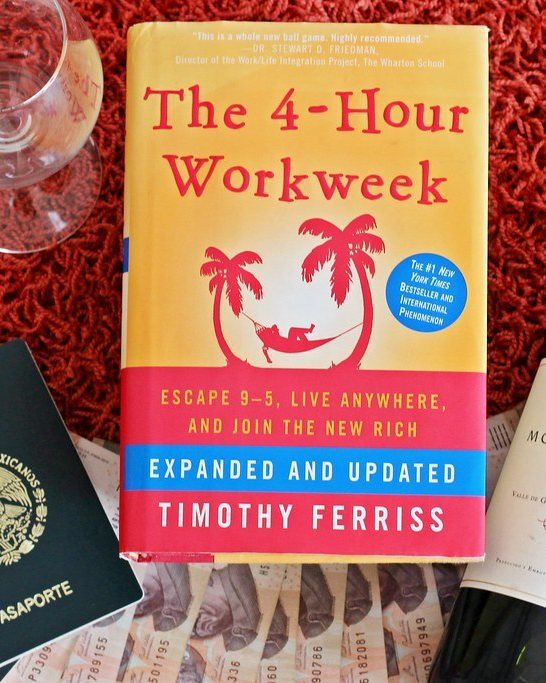
Author: Timothy Ferriss · Published: 2007 · Genre: Self-Help, Business
The 4-Hour Workweek argues that you don’t need to wait until retirement to live the life you want; you can redesign your work now to buy back time and freedom. Its big questions still land, and it helped popularize remote work and “lifestyle design” long before either was normal. But many of its tactics have aged badly, and the title promises something few readers will get. Read it for the mindset, not the playbook.
The big idea
Ferriss organizes the book around a four-step plan he calls DEAL: Definition, Elimination, Automation and Liberation.
Definition asks you to stop treating retirement as the goal. He introduces the “New Rich,” people who value time and mobility over a bigger salary, and suggests taking “mini-retirements” throughout life instead of one long one at the end.
Elimination applies the Pareto principle, that most results come from a small share of effort, and Parkinson’s law, that work expands to fill the time available. Cut low-value work, set tighter deadlines, and adopt a “low-information diet” by ignoring most news and email.
Automation means outsourcing tasks to virtual assistants and building a “muse,” a small product business that runs without you. Liberation covers negotiating remote work with your boss, then using that freedom to travel, often to cheaper countries where your income stretches further, a tactic he calls geoarbitrage.
What works
- The questions are sharp. Ferriss asks what you would do if money weren’t the constraint, then asks you to put a price on that dream. It often costs less than people assume. That exercise alone reframes a lot of vague ambition.
- The attack on busywork holds up. Checking email at set times, declining pointless meetings and focusing on the few tasks that matter is now standard productivity advice. This book did a lot to spread it.
- Fear-setting. Ferriss asks you to write down the worst realistic outcome of a big change, how you would recover from it, and what staying put is costing you. It’s a practical antidote to vague dread, and it has aged better than almost anything else in the book.
- It anticipated remote work. The chapter on persuading an employer to let you work from elsewhere reads almost like a pandemic-era memo, written more than a decade early. Like the rest of the book, it comes with scripts and case studies, so it’s rarely dull.
What doesn’t
The title is the biggest problem. Ferriss clearly works far more than four hours a week, and his own success came from relentless effort, not automation. Critics have long pointed out that the promise is marketing, not a realistic outcome for most readers.
The muse model has aged poorly. The main example is Ferriss’s own supplement company, and the advice on drop-shipping, cheap online ads and quick product tests reflects the internet of the mid-2000s. Many readers who tried to copy it found crowded markets and thin margins.
Some of the advice also shades into gaming the system. Ferriss proudly describes winning a Chinese kickboxing championship by exploiting the weigh-in rules and a rule that let him win by pushing opponents off the platform. He presents this as clever; plenty of readers see it as cutting corners. The book also leans on outsourcing to low-paid assistants abroad without much thought for the people doing the work.
Finally, the book assumes a particular starting point: a portable job, some savings and few caring duties. For many readers, the escape plan simply doesn’t apply.
Who should read it
Read it if you feel trapped in a job and need a jolt to question the default path, or if you want to understand where modern ideas about remote work and lifestyle design came from. Skip it if you want a reliable business manual; newer books cover online business far better.
Rating: 3.5/5
Photo credits — Featured image: Photo by Aaron Benitez via Flickr, CC BY-SA 2.0, cropped.
