

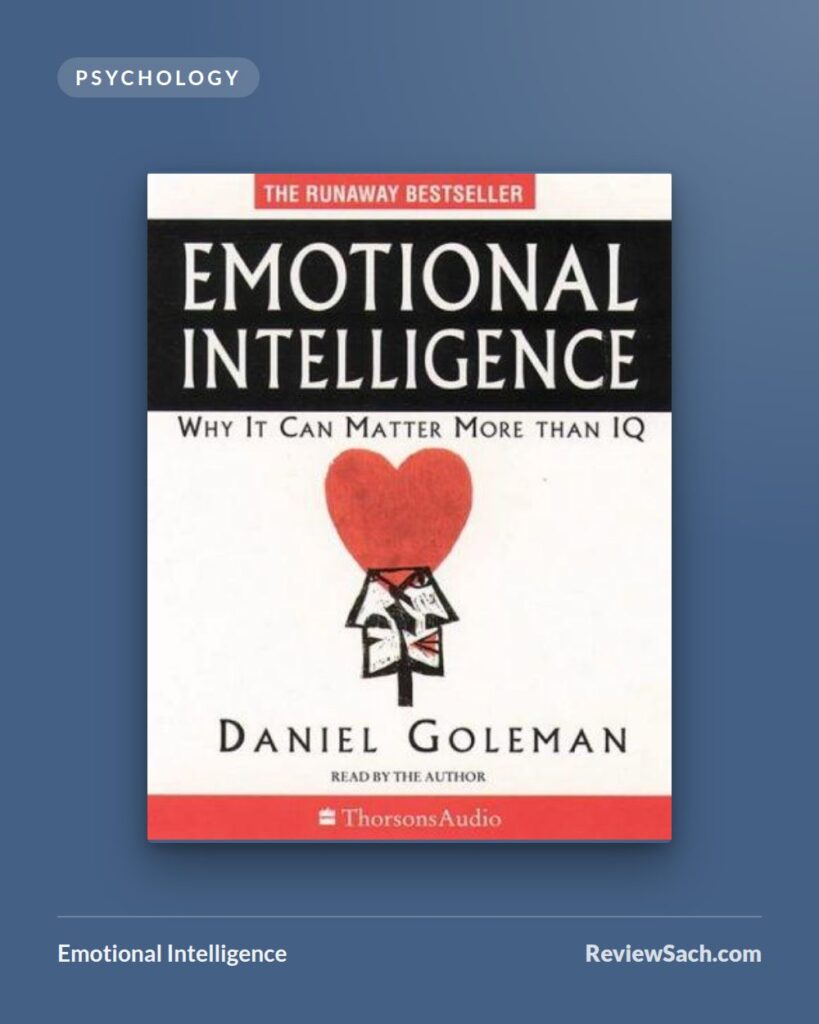
Author: Daniel Goleman · Published: 1995 · Genre: Psychology, Self-Help
Emotional Intelligence argues that the ability to understand and manage emotions, your own and other people’s, matters as much as raw intellect for how life turns out. The book changed how schools and companies talk about feelings, and its core message is sensible. But it oversells the science, and its subtitle’s promise that emotional intelligence can matter more than IQ has not held up. Read it for the ideas, not the evidence.
The big idea
Goleman, a psychologist by training who was then a science writer at The New York Times, built on work by psychologists Peter Salovey and John Mayer, who had introduced the academic concept of emotional intelligence in 1990. He organizes it into five areas: knowing your emotions, managing them, motivating yourself, recognizing emotions in others and handling relationships.
The opening part draws on brain research, notably Joseph LeDoux’s work on the amygdala. Goleman describes how a fast emotional circuit can react before the thinking brain catches up, which he calls an emotional hijacking. Later sections apply the ideas to marriage, work, health and childhood, and the book closes with a case for teaching emotional literacy in schools.
What works
- It gave people a vocabulary. Before this book, emotional skills were often dismissed as soft. Goleman made a clear case that self-awareness, impulse control and empathy are skills that can be learned, and that they shape relationships and careers.
- Strong stories. The marshmallow test, in which preschoolers chose between one treat now or two later, is a vivid illustration of impulse control. So is his account of how marriages are worn down by criticism and contempt, drawn from psychologist John Gottman’s research on couples. His section on empathy usefully explains that we read other people’s feelings mostly from tone, gesture and facial expression rather than their words.
- Practical relevance. The chapters on handling anger and worry, and on how criticism lands at work, offer sensible advice most readers can use right away. The case for teaching children to name and manage feelings was ahead of its time and helped spread social and emotional learning programs in schools.
What doesn’t
The headline claim outruns the evidence. Goleman suggests IQ explains only a modest share of success in life and implies emotional skills explain much of the rest, but the book offers no study showing that emotional intelligence, as he defines it, predicts outcomes better than IQ. Research since has generally found that emotional intelligence measures add only modestly to prediction once intelligence and personality are taken into account. Mayer and Salovey themselves criticized popular versions of the idea for stretching it too far.
The definition is also very loose. Goleman bundles motivation, optimism, empathy, social skill and self-control into one term, so almost any positive trait can count. That makes the idea easy to embrace and hard to test.
Some of the evidence has aged. A 2018 study with a larger and more diverse sample found that the link between the marshmallow test and later achievement was much weaker than early research suggested, and it shrank further once family background was taken into account.
The brain science is also dated and simplified. The amygdala is not a single emotion switch, and neuroscience has moved away from neat divisions between an emotional brain and a rational one.
Finally, the book is long and baggy. Its many anecdotes and the steady stream of research summaries make it slower going than its simple message requires.
Who should read it
Managers, teachers and parents who want a readable introduction to emotional skills. Skip the grand claims and focus on the practical chapters. Readers who want the rigorous version should look for the academic work of Mayer and Salovey.
Rating: 3/5
Image credits — Cover image via Open Library. Cover design © the publisher, shown for review purposes.
