

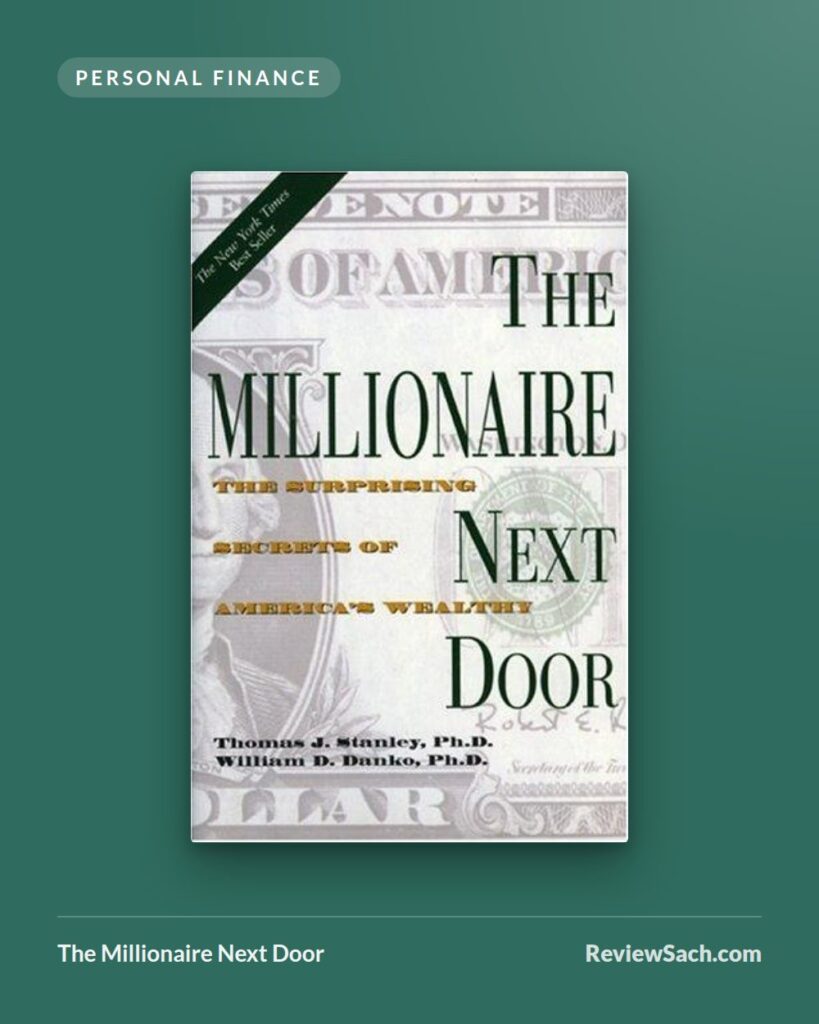
Author: Thomas J. Stanley and William D. Danko · Published: 1996 · Genre: Personal Finance, Wealth Building
The Millionaire Next Door argues that most wealthy Americans don’t look rich: they earn solid incomes, spend far less than they could, and let savings pile up quietly. It is one of the best books ever written about the gap between income and wealth. Read it if you still think being rich means driving a luxury car, and read it with an eye on its age.
The big idea
Stanley and Danko, two business-school academics, spent years surveying and interviewing people with a net worth of $1 million or more. What they found cut against the image sold by advertisers. The typical millionaire in their research ran an unglamorous business, lived in an ordinary house, drove an older car and bought inexpensive suits. Most had built the money themselves rather than inheriting it.
The authors split people into two groups. Prodigious accumulators of wealth (PAWs) hold far more net worth than their income would predict. Under accumulators (UAWs) earn well but own little, because their money goes on status. The book offers a rough yardstick: multiply your age by your pre-tax household income, divide by ten, and compare the result with your net worth. The Texan phrase “big hat, no cattle” sums up the UAW.
What works
- It reframes wealth. Income is what you earn; wealth is what you keep. Once you see that a high-earning doctor with a big house can be poorer than a contractor with a modest one, you stop measuring yourself against the neighbours’ cars.
- The detail is memorable. The chapters on what millionaires pay for watches, suits and vehicles make frugality concrete rather than preachy. The recurring finding is that heavy spending is a choice, often driven by the expectations of colleagues and neighbours.
- Economic outpatient care. The sharpest chapter looks at parents who keep subsidising their adult children. The authors argue that regular cash gifts tend to make the recipients spend more and accumulate less, not become independent. Whether or not you agree, few money books ask the question at all.
- It respects ordinary work. The heroes are owners of dull, steady businesses, not stock pickers or celebrities. That makes the message feel achievable for readers with ordinary jobs and no special talent for markets.
What doesn’t
The data is old. The research predates the internet economy and today’s housing costs, and much of it was gathered during a long run of strong US markets. A 2018 follow-up, The Next Millionaire Next Door, completed by Stanley’s daughter Sarah Stanley Fallaw after his death, argues that the core patterns still hold, but readers should treat specific figures as history.
Critics also point to survivorship bias. The book studies people who succeeded; it cannot see the frugal business owners whose firms failed. Self-employment looks like a reliable path to wealth partly because only the winners ended up in the sample.
The writing is repetitive. The same point about cars and suits returns chapter after chapter, and the book reads more like a research report than a guide. There is almost nothing on how to invest, only on how to stop overspending. It is also thoroughly American in its tax, housing and business examples.
Finally, the tone can tip into moralising. The implied message, that anyone who isn’t wealthy simply spent badly, is unfair to people on low incomes, for whom the arithmetic is far harder.
Who should read it
Anyone earning a good salary who still feels broke, and anyone tempted to judge financial success by appearances. Pair it with a practical investing book, because this one explains why to save but not where to put the money.
Rating: 4/5
Image credits — Cover image via Open Library. Cover design © the publisher, shown for review purposes.
