

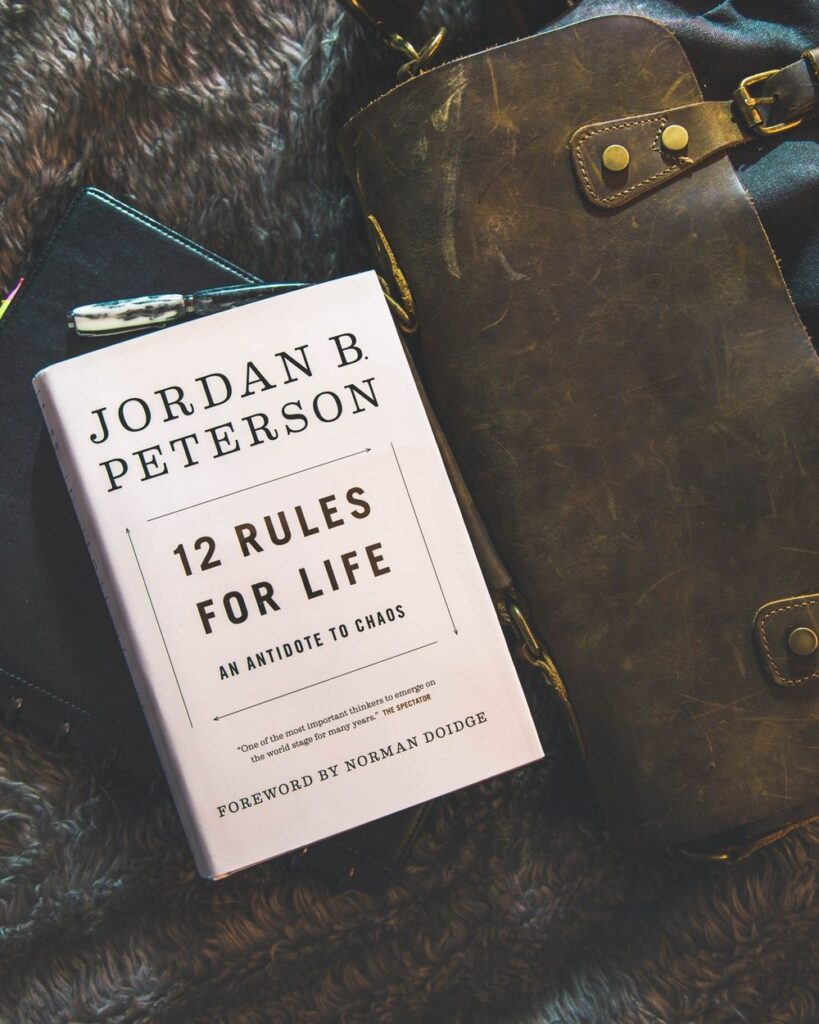
Author: Jordan B. Peterson · Published: 2018 · Genre: Self-Help, Psychology
12 Rules for Life: An Antidote to Chaos argues that life involves suffering, and that the way to bear it is to take responsibility, tell the truth and pursue meaning. The best advice is solid and has clearly helped many readers, especially young men. But the book is long, digressive and sometimes overreaching, and Peterson’s public reputation makes it hard to read neutrally. It’s worth it if you want a sterner kind of self-help and can sift the useful from the sprawling.
The big idea
Peterson, a Canadian clinical psychologist who taught at Harvard and the University of Toronto, frames life as a balance between order and chaos. Too much order turns into tyranny; too much chaos turns into terror. Meaning, he says, lives on the border between the two, and a good life means standing on that line.
Each chapter takes one rule and uses it as a doorway into psychology, evolution, religion and his own clinical and family life. Some rules are plain: tell the truth, or at least don’t lie. Some are quirky: do not bother children when they are skateboarding, and pet a cat when you encounter one on the street. The most famous, Rule 6, says to set your house in perfect order before you criticize the world. His fans shortened it to “clean your room”.
What works
- Responsibility as meaning. Rule 2, treat yourself like someone you are responsible for helping, is a strong hook. Peterson points out that people are often more careful about giving a sick pet its medication than about taking their own.
- Comparison. Rule 4, compare yourself to who you were yesterday, not to who someone else is today, is practical advice against envy and a good antidote to social media.
- Parenting. Rule 5, do not let your children do anything that makes you dislike them, argues that parents who avoid setting limits end up resenting their kids, and that clear, early discipline is kinder in the long run.
- Listening. Rule 9, assume the person you’re listening to might know something you don’t, draws on his work as a therapist and is some of the book’s best writing.
- Personal sections. His account of his daughter Mikhaila’s severe childhood arthritis, in the final chapter, is moving and grounds all the talk of suffering in something real.
- Seriousness. Unlike upbeat self-help, it treats young readers as capable of carrying real burdens. That’s a big part of why so many say it helped them.
The controversy
The science is shaky in places. Rule 1, stand up straight with your shoulders back, opens with lobsters, arguing that dominance hierarchies and serotonin connect us to them across hundreds of millions of years. Biologists pointed out that lobster and human nervous systems are very different, and that the analogy says little about how human societies work.
Long stretches also read Genesis and other ancient stories as psychological truths. It’s an interesting lens, but Peterson often presents interpretation with the confidence of fact, and the prose can be dense and repetitive.
The larger debate is about Peterson himself. He became famous in 2016 by opposing a Canadian bill that added gender identity and expression to human rights law, and for his attacks on what he calls postmodern neo-Marxism. Critics say the book, especially the skateboarding chapter’s long discussion of masculinity and feminism, carries those politics and a narrow view of men and women. Supporters say he gives overdue attention to young men who feel lost. Both sides have a point: most of the self-help advice stands on its own, but the book isn’t politically neutral.
Who should read it
Read it if you feel adrift and want demanding advice about responsibility and meaning. If you’re after concise, evidence-based self-help, or can’t stand long mythological detours, look elsewhere.
Rating: 3/5
Photo credits — Featured image: Photo by Travis Rupert on Pexels. In-article photo: Photo by Matt Lillywhite on Unsplash.
