

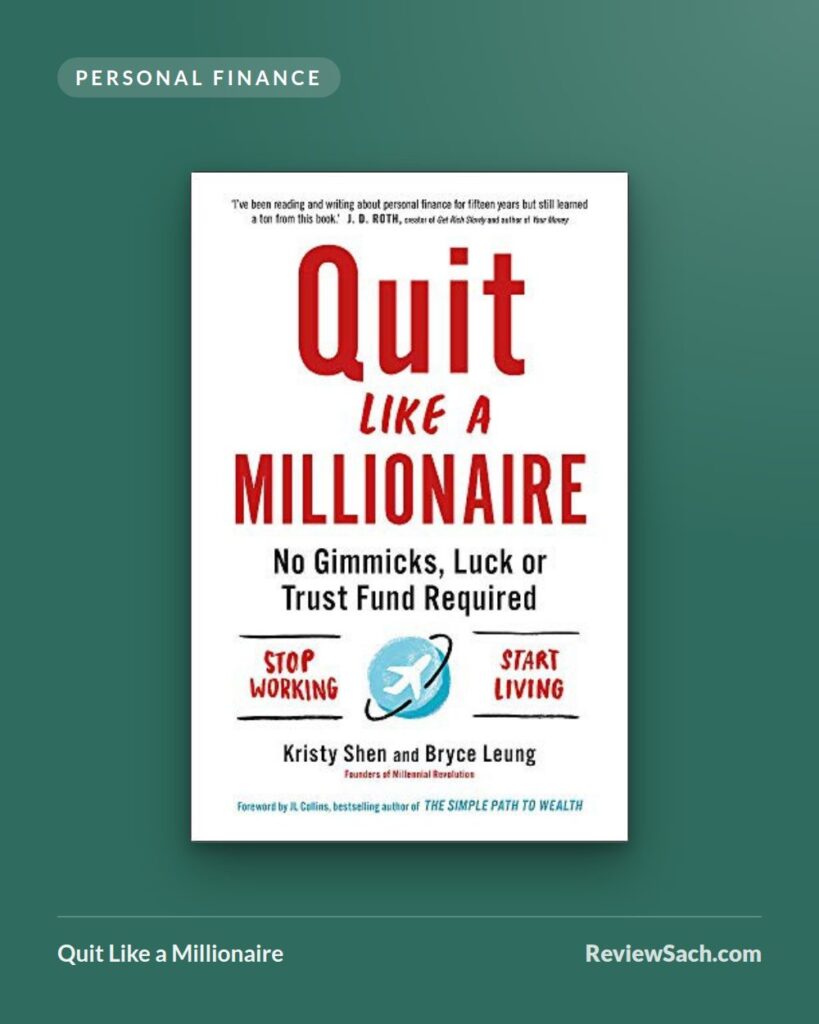
Author: Kristy Shen and Bryce Leung · Published: 2019 · Genre: Personal Finance, Early Retirement
Quit Like a Millionaire is one of the most practical early-retirement books, anchored by a memorable immigrant story. Kristy Shen and Bryce Leung explain how they built a portfolio of about $1 million and retired in their early thirties, and they offer real tools for making that money last. It is worth reading for anyone curious about financial independence, but their path relied on high engineering salaries that many readers won’t have.
What it’s about
Shen grew up in poverty in China before her family moved to Canada when she was a child. That background drives the book’s tone: money means security, and every choice is judged by the numbers. She and Leung, both computer engineers, saved aggressively, invested in index funds rather than property, and quit their jobs to travel the world. The couple first found an audience through their blog, Millennial Revolution, and the book keeps its brisk, jokey voice. JL Collins, author of The Simple Path to Wealth, wrote the foreword.
The first part covers earning. Shen chose engineering over her dream of becoming a writer after running the numbers, and the authors offer a “POT score” (pay over tuition) to compare degrees by their expected return. The middle section covers saving and investing, including their argument that a house is not an investment, especially in expensive cities such as Toronto. The final part tackles retirement itself, from the 4% rule to accessing tax-advantaged accounts early.
What works
- Portfolio defences. Their “Yield Shield” (tilting part of the portfolio towards higher-yielding assets to cover spending) and “Cash Cushion” (holding cash so you don’t have to sell in a crash) are concrete responses to sequence-of-returns risk, the danger of a market fall early in a long retirement.
- Geographic arbitrage. They show that travelling in cheaper countries cost them about the same as living in Toronto, which reframes what retirement spending has to look like.
- Maths, not myths. Each big decision, from renting versus buying to how much to withdraw, comes with the calculation behind it, so readers can plug in their own numbers instead of borrowing the authors’ conclusions.
- Candour. Shen writes with humour about her childhood and about defying the cultural expectation to buy a home, which makes the spreadsheets feel human.
- Cross-border detail. Canadian and American readers both get specifics on retirement accounts and taxes, which most FIRE books ignore.
What doesn’t
The central story has survivorship bias. Two engineers with good salaries and no children is close to a best-case starting point, and the advice to pick a lucrative degree over a passion is easier for some people than others. Reviewers have also questioned how well the plan copes with the cost of raising children, which the book handles only lightly.
The Yield Shield has trade-offs the enthusiasm can hide. Chasing higher income through assets such as REITs, dividend stocks and riskier bonds can add risk and tax drag, and income is not the same as total return. Their stance against home-owning is well argued for pricey markets but weaker in cheaper ones, where owning can make sense.
The wider debate over early retirement applies too. A retirement lasting fifty years leaves more room for things to go wrong, from health costs to a weak decade for markets. The authors’ defences help, but they don’t remove that risk, and readers should weigh it honestly.
Who should read it
Young professionals with good incomes who want a clear, numbers-first route to financial independence. People with families or modest incomes will still find useful tools, but should expect a longer road. Canadians in particular will appreciate a FIRE book that takes their tax system seriously.
Rating: 3.5/5
Image credits — Cover image via Open Library. Cover design © the publisher, shown for review purposes.
