

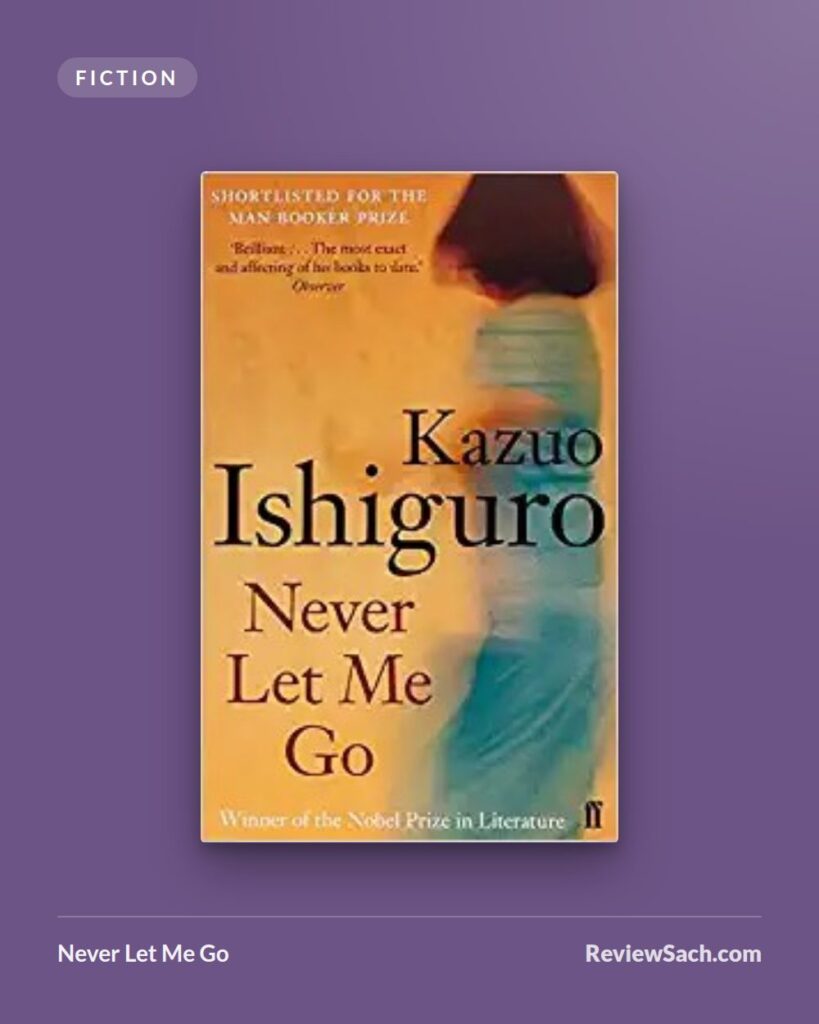
Author: Kazuo Ishiguro · Published: 2005 · Genre: Literary Fiction, Dystopian Fiction
Never Let Me Go is a novel about friendship, memory and mortality disguised as a boarding-school story, and it is one of the best English novels of this century. It moves slowly and hides its horror in plain sight, which some readers find frustrating. If you like fiction that works through restraint rather than plot, read it.
What it’s about
Kathy H. is 31 and has worked as a “carer” for eleven years. She looks after “donors”, and she tells us so on the first pages without explaining what either word means. Then she drifts back to her childhood at Hailsham, a secluded school in the English countryside, and to her two closest friends: bossy, insecure Ruth and Tommy, the boy with the temper tantrums who is mocked for being bad at art.
The guardians at Hailsham push the students to make art and warn them, again and again, about the dangers of smoking. A woman the children call Madame collects their best pieces and seems oddly afraid of them. Later the three friends move to the Cottages, a run-down farm where older students wait for the next stage of their lives, and chase a rumor about how couples who are truly in love might win more time together. The book’s opening note sets it in England in the late 1990s, but it’s an England that never quite existed, familiar in every surface detail and wrong underneath.
What works
- The voice. Kathy narrates like someone tidying a drawer: patient, precise, occasionally petty. She circles back to small grievances, a lost cassette tape, a remark overheard in a corridor. That ordinariness is exactly what makes the book frightening.
- The slow reveal. Ishiguro never stages a big twist. The truth arrives in fragments, the way children actually learn difficult things, half-told and half-understood. When a guardian, Miss Lucy, finally says the quiet part out loud, it lands harder because the students react so mildly.
- The friendship triangle. Ruth is one of fiction’s most believable frenemies. Her lies, small cruelties and desperate need to belong are drawn with real sympathy, and the tension between her, Kathy and Tommy carries the middle of the book.
- Small, perfect scenes. A trip to Norfolk, which the Hailsham children believe is England’s “lost corner” where lost things end up, turns a schoolyard joke into one of the most tender episodes in modern fiction.
What doesn’t
The students’ passivity is the most common complaint. Nobody runs, nobody fights, and some readers find that implausible or maddening. It is intentional, since the book is about how people accept the lives they’re handed, but it does drain the plot of urgency.
The speculative frame is also thin. Ishiguro shows little interest in how this alternative England works, and readers who want world-building will find the explanations offered near the end sketchy. The prose is so plain that, on a quick read, it can seem flat rather than controlled.
Spoiler warning
The students are clones, raised so that their organs can be harvested in early adulthood; “completing” is the book’s euphemism for dying after the donations. Knowing this won’t ruin the novel. Ishiguro makes it clear about a third of the way in, and he cares far more about how the characters live with it than about the secret itself.
Who should read it
Read it if you liked The Remains of the Day or any novel where what’s left unsaid matters most. It was shortlisted for the Booker Prize in 2005 and is the best entry point to the writer who won the Nobel Prize in 2017. Skip it if you need characters who act on their anger. The 2010 film, with Carey Mulligan, Andrew Garfield and Keira Knightley, is faithful and well acted, but it can’t reproduce Kathy’s voice.
Rating: 4.5/5
Image credits — Cover image via Open Library. Cover design © the publisher, shown for review purposes.
