

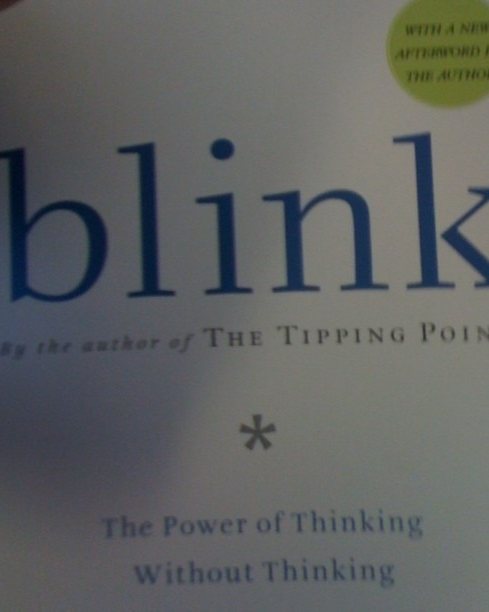
Author: Malcolm Gladwell · Published: 2005 · Genre: Psychology, Popular Science
Blink is about the decisions we make in the first two seconds, and it argues that these rapid judgments can be as good as careful deliberation, or disastrously wrong. It’s a fast, entertaining read with unforgettable stories. But it never delivers a clear answer to its own question, and parts of the research behind it have weakened. Read it for the anecdotes, not as a guide to decision-making.
What it’s about
Gladwell calls rapid, unconscious judgment thin-slicing: finding patterns from narrow slices of experience. He opens with an ancient Greek statue, a kouros, that the J. Paul Getty Museum bought after months of scientific testing. Several art experts felt instantly that something was wrong with it, and doubts about its authenticity have followed it ever since.
Other chapters show thin-slicing working well. Psychologist John Gottman predicts which couples will divorce from short samples of their conversation. A Chicago hospital improves its diagnosis of chest pain by focusing on a handful of key factors instead of gathering ever more data.
Then the book turns. Unconscious bias helped a tall, handsome and underqualified Warren Harding become president. Orchestras began hiring far more women only once auditions took place behind a screen. And four New York police officers shot and killed Amadou Diallo, an unarmed man, after a chain of split-second misjudgments.
What works
- The storytelling. Gladwell is a master at linking unlikely cases, from a war game in which retired Marine general Paul Van Riper beat a much better-equipped force with fast, improvised decisions, to a tennis coach who can sense a double fault before the racket hits the ball.
- The case for less information. The hospital chest-pain story makes a strong point: more data can make experts worse, and simple decision rules often beat judgment. That lesson is well supported and still underused in medicine and hiring.
- Reading faces. The chapter on psychologists Paul Ekman and Wallace Friesen, who catalogued the facial muscle movements behind emotions, shows how much a face gives away in an instant, and how trained observers can learn to read it.
- The blind auditions. The orchestra example is a vivid, practical demonstration that removing information can make decisions fairer, and it has a clear lesson for anyone who interviews people.
What doesn’t
The book contradicts itself. Snap judgments are brilliant in some chapters and dangerous in others, and Gladwell never gives a usable rule for telling the difference. He suggests that expertise and the right conditions matter, but the point stays vague. Kahneman later handled the same question far more clearly: intuition deserves trust in regular environments where experts get quick, reliable feedback.
Several studies Gladwell relies on have not held up. He describes research in which students primed with words about old age walked more slowly afterward, and another in which people who first thought about professors did better at trivia. Later replication attempts failed to reproduce both. He also presents the Implicit Association Test as a window into hidden bias, but later research found it predicts actual behavior only weakly and often gives the same person different results on different days.
Gottman’s divorce predictions are also less impressive than they sound. Critics note that the headline accuracy figures came from fitting models to couples whose outcomes were already known, rather than from predicting the futures of new couples.
Finally, the stories do most of the persuading. The book reads like a series of excellent magazine pieces loosely strung around a theme, and it ends without pulling them together.
Who should read it
Readers who want an entertaining introduction to intuition and unconscious bias, and fans of Gladwell’s style. For a sturdier account of when to trust your gut, read Kahneman’s Thinking, Fast and Slow afterward.
Rating: 3/5
Photo credits — Featured image: Photo by Juvs via Flickr, CC BY-SA 2.0, cropped.
