

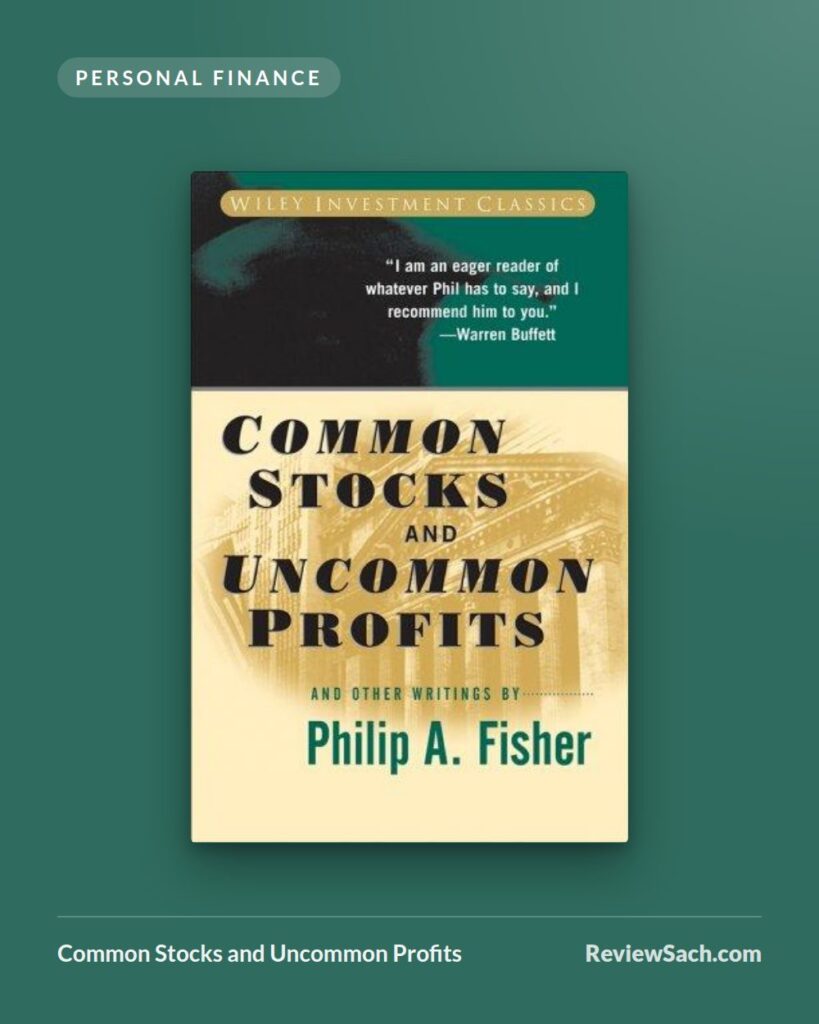
Author: Philip A. Fisher · Published: 1958 · Genre: Investing, Business
Common Stocks and Uncommon Profits is the founding text of growth investing: find a handful of outstanding companies, learn everything about them, and hold them for a very long time. It is dated in style and examples but remarkably modern in its thinking. Serious stock pickers should read it; casual investors can skip it.
The big idea
Philip Fisher, a California money manager, argued that the biggest profits come not from buying statistically cheap stocks but from owning exceptional businesses that can grow sales and profits for many years. To find them, he offers fifteen points to look for in a company. They include whether its products have enough market potential for years of growth, whether management keeps developing new products, how effective its research and sales teams are, whether profit margins are healthy and protected, how it treats its workers, and whether managers are honest and speak openly when things go wrong.
His research method is “scuttlebutt”: talk to customers, suppliers, competitors, former employees and industry researchers to build a picture no annual report can give. Only after that legwork, he says, should an investor approach management.
Fisher practised what he preached, and he is famous for holding Motorola for decades. Modern editions add two of his later works and an introduction by his son, the money manager Ken Fisher.
What works
- Quality over cheapness. Fisher saw that a great company bought at a fair price usually beats a mediocre one bought at a bargain. Warren Buffett has described himself as a blend of Benjamin Graham and Fisher, and Fisher’s fingerprints are all over Berkshire Hathaway’s later preference for durable, high-quality businesses.
- Management matters. His focus on integrity, and on whether executives hide bad news or share it, anticipates much of today’s debate about corporate governance.
- Rules for selling. Fisher gives only three good reasons to sell: you made a mistake, the company no longer meets the fifteen points, or, rarely, a much better opportunity appears. His conclusion, that the right time to sell a well-chosen stock is almost never, is a useful cure for over-trading.
- Scuttlebutt as a habit of mind. Even if you can’t interview suppliers, the idea of checking a company’s story against what customers, rivals and employees say is timeless. Today’s investor can do a rough version with industry reports, product reviews and job-site comments.
- The “don’ts”. Short lists of mistakes, such as buying a stock because you like the tone of its annual report or quibbling over tiny differences in price, are still relevant.
What doesn’t
The examples come from 1950s industry, and the prose is formal and often repetitive. A modern reader has to work to translate chemicals and electronics firms of that era into today’s companies.
Scuttlebutt is also harder than it sounds. An individual can’t easily interview a company’s suppliers and rivals, and later US rules against selective disclosure limit what executives can share privately with investors. Professional analysts have time and access that most readers don’t.
The approach is concentrated and demanding. Fisher is relaxed about holding relatively few stocks, which magnifies the damage when judgement is wrong. Growth stocks bought on a great story can disappoint for years, and the book says far more about quality than about valuation, so it is easy to overpay for a wonderful company. That trade-off matters for anyone copying the method today.
Who should read it
Investors who want to analyse businesses, and anyone curious about where Buffett’s shift towards quality came from. If you invest through index funds, it will teach you how good companies work, but you don’t need it to invest well. Read it slowly, a few of the fifteen points at a time.
Rating: 4/5
Image credits — Cover image via Open Library. Cover design © the publisher, shown for review purposes.
