

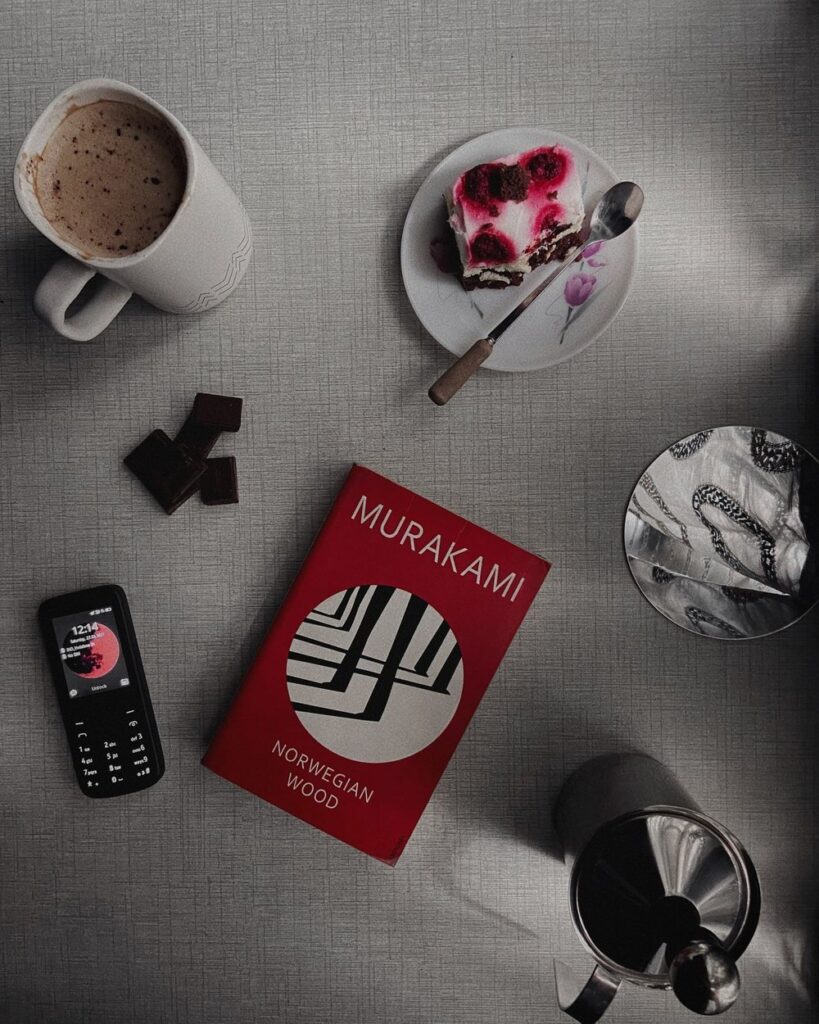
Author: Haruki Murakami · Published: 1987 · Genre: Literary fiction, Coming-of-age · Original title: Noruwei no Mori
Norwegian Wood is Murakami without the talking cats or parallel worlds: a straightforward, sad love story about a university student caught between two women in late-1960s Tokyo. It’s the most accessible book he has written and a good way in. But it’s heavy on death and sex, light on plot, and its women sometimes seem to exist mainly to shape the narrator.

What it’s about
At thirty-seven, Toru Watanabe hears an orchestral version of the Beatles song “Norwegian Wood” as his plane lands in Hamburg, and it pulls him back almost twenty years. The story he remembers takes place in Tokyo around 1968 and 1969, when he is a student living in a dormitory while protests shake the university campuses.
When Toru was seventeen, his best friend Kizuki killed himself. In Tokyo, Toru runs into Naoko, Kizuki’s girlfriend, and the two drift into a fragile relationship built on shared loss. Naoko then withdraws from the world and enters a remote sanatorium in the mountains near Kyoto, where she lives with an older patient named Reiko, a former music teacher. Meanwhile, back in Tokyo, Toru meets Midori, a talkative, blunt classmate who is everything Naoko is not. The novel is about Toru being pulled between the past and the present.
The book was a huge bestseller in Japan and made Murakami a household name there. Tran Anh Hung directed a film version in 2010, but the novel’s inner voice doesn’t translate easily to the screen.
What works
- The mood. Murakami is excellent at loneliness: late-night dormitory conversations, long walks through Tokyo, rain, records, cheap meals. Jay Rubin’s English translation keeps the prose plain and clear.
- Midori. She is the book’s life force: funny, rude, impatient, and caring for her sick father in the hospital with a tough, unsentimental humor that Toru has never seen before. Every scene with her comes as a relief.
- The honesty about grief. Toru doesn’t recover in neat stages. The novel understands that some losses are carried rather than resolved, and that grief can make people behave badly.
- The period detail. The student strikes stay in the background, but Murakami is sharp about them. Toru notices how quickly the loudest campus radicals slip back into class and answer the roll call once the strike ends, and his contempt says a lot about him.
- The side characters. Toru’s fussy, stammering roommate, known as Storm Trooper, provides comic relief. Nagasawa, a charming, cynical older student, shows Toru a colder way to live that he half admires and half fears.
What doesn’t
The book contains a lot of suicide and a lot of sex, and they sometimes sit uncomfortably close together. Some scenes read as frank and humane; others feel gratuitous. One of Reiko’s stories, involving a thirteen-year-old piano pupil, is especially hard going.
The women are the bigger problem. Naoko, Midori, Reiko and Hatsumi, Nagasawa’s patient girlfriend, are vivid, but the story is always about what they mean to Toru. Critics have long made this point about Murakami’s fiction in general, and it applies here with particular force.
Plot is minimal. If you want events rather than atmosphere, the long middle stretch at the sanatorium can drag. Toru himself is passive, and some readers will wish he made more decisions instead of simply reacting to the people around him.
Who should read it
Readers new to Murakami who prefer realism to surrealism, and anyone drawn to quiet, sad novels about first love and loss. Readers sensitive to depictions of suicide should go in prepared, because it is central to the story.
Rating: 3.5/5
Photo credits — Featured image: Photo by Onlyifiknow on Pexels. In-article photo: Photo by Sundve via Flickr, CC BY-SA 2.0, cropped.
